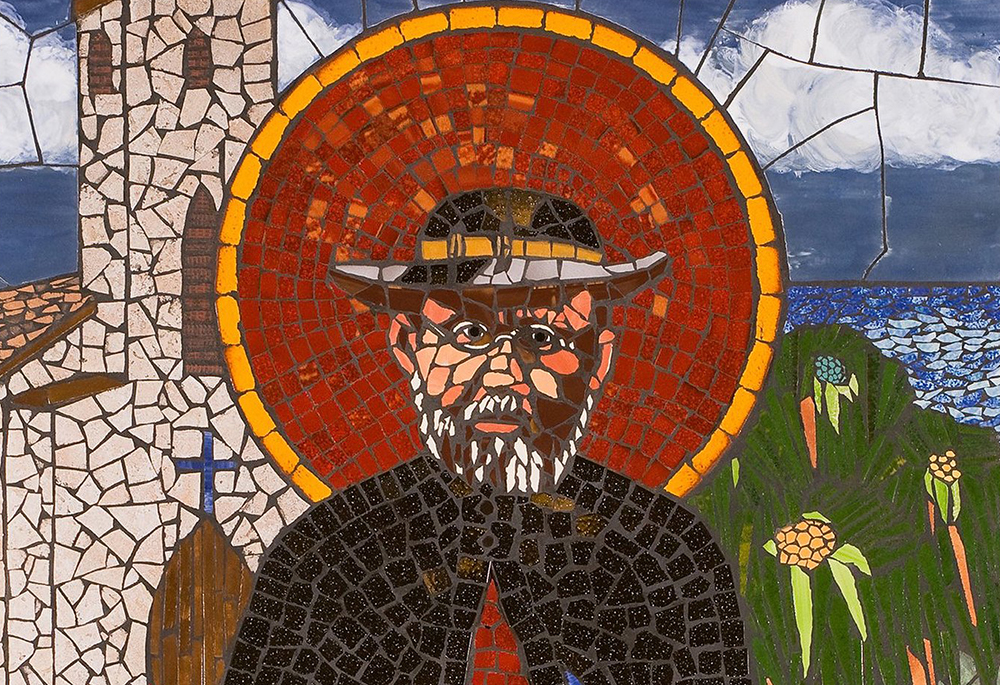
Damien de Veuster, a Belgian missionary priest famed for his work with leprosy patients in Hawaii, is depicted in a mosaic by Karen Lucas at Immaculate Conception Church in Lihue, Hawaii. (CNS/Courtesy of the Diocese of Honolulu)

by Sr. Sujata Jena
Recently, I had the rare privilege of making a pilgrimage to the birthplace of the Congregation of the Sacred Hearts of Jesus and Mary, the congregation to which I belong. Twenty-eight brothers and sisters from 14 countries journeyed together July 7-28 through France and Belgium, accompanied by members of our congregation who offered input and reflections along the way.
We visited places deeply connected with our founders, the birthplace of our first saint, St. Damien de Veuster, and the first martyrs of the congregation at Picpus.
The Congregation of the Sacred Hearts of Jesus and Mary was born amid the turmoil of the French Revolution through the encounter of two people from very different backgrounds: Henriette Aymer de Chevalerie, born in 1767 into a noble family, and Pierre Coudrin, born in 1768 into a farming family.
At a time when the church was being persecuted, Pierre refused to take the revolutionary oath and was secretly ordained a priest in an Irish library in Paris in 1792. The following Sunday, he returned to his home parish, celebrated his first Mass, and publicly declared that he and his family would remain loyal to the pope in Rome, not to the state. He then escaped the authorities pursuing him.
One day, he had a vision of a group of men and women spreading the Gospel everywhere — a call he understood as God's invitation to establish a religious community.
Henriette had been imprisoned with her mother for sheltering clandestine priests. Her time in prison became a profound moment of conversion and deeper surrender to God. When Pierre and Henriette met in 1794, their experiences revealed a remarkable convergence: both felt called to gather men and women who would give themselves to God and proclaim the love of the Sacred Hearts of Jesus and Mary.
On Christmas Eve in 1800, amid Mass, Pierre and Henriette consecrated themselves to the Sacred Hearts through religious vows. Their first companions followed soon after. The congregation received papal approval by a decree of Pope Pius VII on Nov. 17, 1817.
The congregation started by serving the church's needs in post-revolutionary France by opening schools for the poor and hostels for those unable to pay. They supported missionary evangelization, cared for seminaries nurturing vocations for the congregation, and supported persecuted Ireland. Each new foundation was also a center of the Eucharist and reparative adoration.
The congregation spread its mission across continents and islands. This missionary response to the Spirit's call has marked our history and given the church many holy men and women. Among them, St. Damien de Veuster, apostle of Molokai, holds a special place in the heart of the church and the world.
Encounter with the first saint of the congregation
"Well then, Mother, see you in heaven!" These were the farewell words of young Damien as he left Belgium for the Hawaiian mission. Perhaps neither mother nor son knew that he would never return to his homeland.
His words became almost prophetic. When we arrived at Damien's family home, we were deeply touched by this simple yet profound farewell. It was no longer merely a historical phrase; it became a greeting that accompanied us throughout our journey. Until the final days of the pilgrimage, we often greeted one another with "See you in heaven," carrying Damien's faith, hope and missionary spirit in our hearts.
Born Joseph de Veuster on Jan. 3, 1840, in Tremelo, Belgium, he was the seventh of eight children in a humble, hardworking family. Strong, warm, determined and deeply faithful, he entered the Congregation of the Sacred Hearts in 1859, taking the name Damien, and professed his vows in Paris in 1860.
Damien longed to become a missionary. When his older brother, a member of the same religious order, fell ill and could no longer go to Hawaii, Damien volunteered in his place. He arrived in Honolulu in 1864 and was ordained a priest.
Advertisement
His mission eventually led him to Molokai, where people with leprosy were forcibly isolated, separated from their families and abandoned by society. In 1873, Damien chose not merely to serve them but to live among them. He became their priest, companion and brother — building homes and a church, caring for the sick, burying the dead and, above all, restoring dignity to those treated as outcasts.
Damien's own life also challenged the prejudices of his time. Leprosy was widely associated with heredity and with people considered poor, "filthy," or racially inferior. Yet Damien was a young, healthy, white European from Belgium — and he too contracted the disease. His life exposed the injustice of such prejudice: leprosy did not belong to a race, class or social group; it could affect anyone. What moves me most about Damien is not simply that he went to Molokai, but that he volunteered to remain where others were afraid to go, among people whom society had abandoned.
He died at Kalawao on April 15, 1889, aged 49, after about 25 years as a missionary and 16 years among the people of Molokai. Within a short time, the world came to know of his heroic and radical following of Christ. Toward the end of his life, he said, "I am the happiest missionary in the world." He was canonized by Pope Benedict XVI on Oct. 11, 2009.
About 225 years later, standing in the places where the congregation began was, for me, an experience of profound grace. Walking where our founders walked, praying where they prayed, and listening to the stories of their lives and those of the first members made people I had known largely through books and formation suddenly more real. Their struggles, courage, silence, adoration and trust in God became more meaningful to me. I felt closer to them, and my appreciation for the charism they handed on to us deepened.
As I reflected on the lives of our founders, I saw many parallels with the context in which I live and minister. In India, many vulnerable people, especially social and religious minorities, continue to face violence, persecution, discrimination and marginalization.
Finally, the pilgrimage was enriched by journeying with brothers and sisters from 14 countries and meeting many others from around the world. Sharing our experiences, cultures, faith and mission deepened my sense of belonging to one international congregation. I am deeply grateful to the congregation for giving me this opportunity to know and rediscover our history.
I return home with a grateful heart, enriched by the people I have met and inspired by the faith of our founders and St. Damien. Returning to the roots has helped me rediscover the call — to follow Christ with the same zeal and passion, faith and courage that shaped their lives, and to give myself generously wherever God calls me.