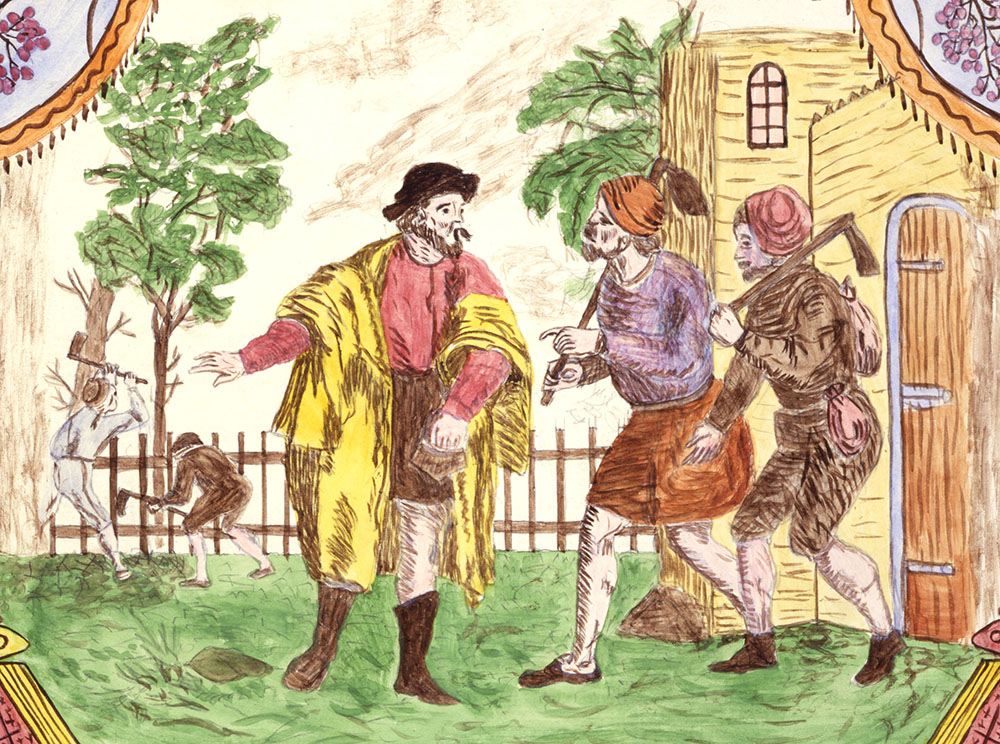
"Parable of the Laborers in the Vineyard," watercolor and pencil on paper, circa 1880, by Lawrence W. Ladd (Smithsonian American Art Museum)

by Sr. Juliet Mousseau
Contributor
Editor's note: Welcome to Theologians' Corner, where each week a different woman theologian from around the world offers a fresh reflection on the Sunday readings.

Twenty-Fifth Sunday in Ordinary Time
September 20, 2026
Jesus teaches us in parables, and sometimes those parables hide their truths very effectively. Today's Gospel reading of the workers in the vineyard (Matthew 20:1-16) is puzzling for both professional interpreters and laity alike.
The landowner hires workers at dawn and promises them a regular daily wage. Then, throughout the rest of the day, the owner finds more workers who haven't been put to work. Sending them off to the vineyards, the owner assures them, "I will give you what is just."
Jesus continues: At the end of the day, all the workers line up for their pay, and those who started the latest in the day are paid a full day's wage. So are those who worked from dawn until the end of the day. Anyone who has dealt with human resources issues cringes here. When workers compare themselves to others, they will always find that someone among them works less for more pay, at least in their eyes.
This whole setup gets the people grumbling. It's not fair, they say, for us to work harder and get paid the same amount as those who barely did anything.
A bit of context might help us. In the previous parable (Matthew 19), Jesus tells us about the rich young man who asks how to gain eternal life. When Jesus answers that he must follow the commandments, the man says, "All of these I have observed. What do I still lack?"
Jesus' answer seems too much for him to accept. "Go, sell what you have and give to the poor, and you will have treasure in heaven." The man goes away sad, to which Jesus says, "It will be hard for one who is rich to enter the kingdom of heaven." Harder, in fact, than his camel passing through the eye of a needle.
Parables turn the world upside down. They are relatable because everyone in Jesus' audience can understand the realities they explore. But there's always an unexpected twist. No one listening to Jesus would have expected the landowner in today's parable to offer the same wage for those who worked a few hours as for those who toiled the whole day. That's just not how our world works.
Advertisement
As Sulpician Fr. Raymond Brown states in An Introduction to the New Testament about the parable of the rich young man, "The reward at the end has the same upside-down character as the kingdom: It is not given to the first and most powerful of this world, but to the last who have left behind precious things for the sake of Jesus' name."
So too for the parable of the workers in the vineyard.
Today's parable detaches physical labor from the money the worker receives. Jesus wants us to know that the kingdom of God doesn't judge us by our abilities or inabilities, our production or our lack thereof. God judges us worthy of everything simply for existing. We have the dignity of creatures made in God's image and likeness, worthy of so much more than we expect. We receive of God's abundance not because of our own actions, but rather because God wants to shower generosity over us.
In the topsy-turvy world that Jesus introduces through parables, we see the human tendency toward comparison and grumbling. We also see the incredible and incomprehensible abundance of God's love for each and every one of us.
The work and giftedness of one lifetime cannot overcome the immensity of God's love and generosity — what could be more precious than us, human beings, the work of God's hands? And that is precisely what we are, no matter what we accomplish or how much we disappoint ourselves or other people. God rewards us generously. Not because we earned it, but because God wants to.
What feels backward to us fits neatly into the deeper reality of our world. The reality is that nothing we "possess" is actually ours at all.
We didn't earn the earth or the sky, the food we eat, the water we drink, or the many beautiful things that make our lives pleasant or interesting. They are all God's, offered to us in abundance for our use while we are here. If we hold onto them too tightly, we become blind to the work we are called to do to bring about the kingdom of God here on earth. So we learn from today's parable to allow God's generosity to shower everyone abundantly, simply for the reason that God desires to love us.