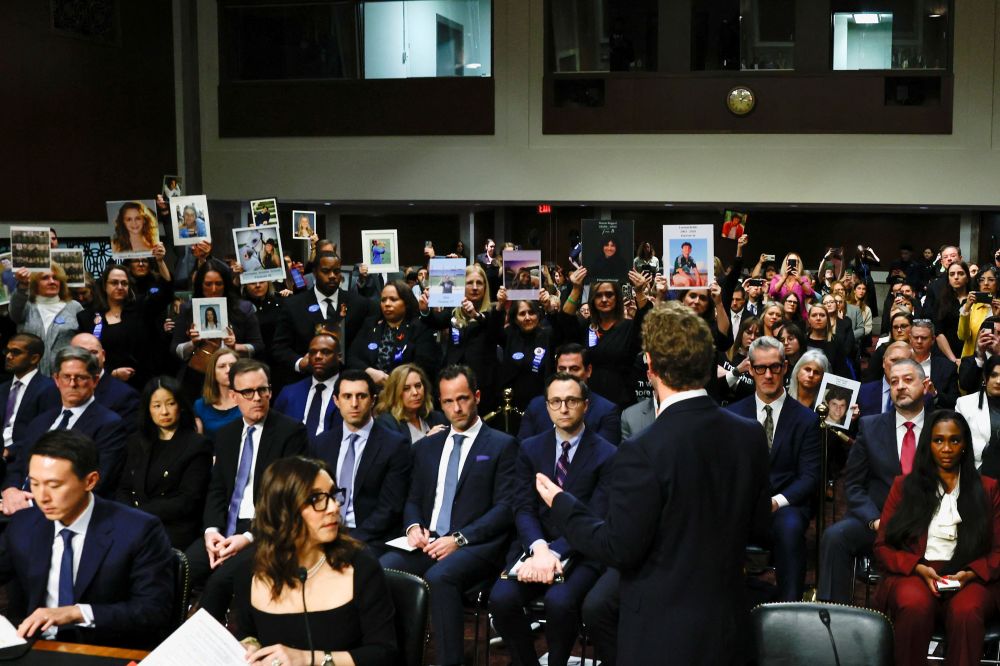
Meta's CEO Mark Zuckerberg stands and faces the audience holding up photos of their children as he testifies during the Senate Judiciary Committee hearing on online child sexual exploitation at the U.S. Capitol in Washington Jan. 31, 2024. (OSV News/Reuters/Evelyn Hockstein)

by Sr. Nancy Brown
The winds are changing and the waves are gently lapping up on the shore. I felt a breath of fresh air when I heard about the two recent court cases, one in California and the other in New Mexico concerning youth and social media. Are internet corporations finally being held accountable for their neglect of the effect of their behavior on children? Is the safety of children becoming a priority in our courtrooms today?
In New Mexico, Meta was found liable for the manner in which its platforms endangered children and exposed them not only to sexually explicit material but also put them in contact with sexual predators. I can only imagine how disturbing, frightening and damaging that would be for a young child, not to mention the disbelief and anger of parents.
In the same week another case ended in victory for a 20-year-old woman in California. She started watching porn on YouTube at age 6 and Instagram at 9 on her cellphone. By age 10, she was starting to have feelings of anxiety and depression, and had begun self-harming. The court ordered Meta and YouTube to pay her $6 million for the damages caused by their platforms. Her cellphone was reportedly full of sexual harassment from older men, bullying from peers, hateful comments from strangers, and content promoting self-harm or restrictive eating. No money can ever heal the severe damages already done.
These platforms were found negligent for failing to provide warnings about the addictive nature and dangers of their designs. Their main goal was to make huge profits, ignoring the harm done to children. There are many other lawsuits underway, including cases involving 350 families and 250 school districts in the California area.
This same theme, profits over safety, is being played out worldwide by enabling children to have free access to pornographic material through internet platforms owned by big companies. Globally, many countries are now considering, have passed or are implementing restrictions prohibiting underage youth from accessing social media. Australia is leading the way with its Social Media Minimum Age obligation, which requires providers to take reasonable steps to prevent children under 16 from having accounts.
In the United States, about 25 states have opted to put age-verification measures in place. Currently, in Canada, Bill S-209, An Act to Protect Young Persons from Exposure to Pornographic Material, has been introduced into the House of Commons after being passed by the Canadian Senate. This law would force platforms to comply with age verification restrictions or face hefty fines.
In 2024, Childlight, a research company tracking child exploitation, estimated that 300 million children had been affected by online child sexual abuse and exploitation, representing a colossal violation of the fundamental human rights of children and the adults they become.
Advertisement
Multiple studies have shown that exposure to pornography has significant negative effects on a child's mental health, relationships and sexual attitudes. Because the adolescent brain is just developing, the effects of porn are exacerbated during this time of development. Children and teens exposed to pornography learn distorted perspectives on gender roles and the meaning of consent, and have a decreased capacity for empathy. It sexualizes women and girls and shapes the behavior of young men in a negative manner. Over half of mainstream porn includes both physical and verbal violence against women.
Reem Alsalem, the U.N. special rapporteur on violence against women and girls, describes pornography as filmed prostitution. She states in her report that violence against women and children is prolific in pornography, citing an analysis of popular pornography videos completed in 2010. It found that 88.2% of scenes contained acts of physical assault (e.g., gagging, choking or strangulation) and 48.7% contained acts of degrading verbal name-calling. Women involved in pornography often recounted being exposed to rectal and throat gonorrhoea; tearing of the throat, vagina, and anus; and chlamydia of the eye. It is deplorable that young children are exposed to these actions.
Pornography, prostitution and human trafficking are all interconnected. Both prostitution and pornography fuel trafficking, violating human dignity and gender equality. Pornography leads to an increase in the sexual exploitation and prostitution/trafficking, particularly of children. Girls are lured and trapped into sexual exploitation younger and younger, including some as young as 8. Statistics Canada reports that in 2021-22, there was a 45% increase in online sexual exploitation in one year.
This current reality calls for a Gospel response from all of us. Perhaps there is a movement in your area working to make our world safer for our young people. Can you find a way to act locally or nationally to further this cause?
Surely, we can ask ourselves, "How would Jesus respond to this reality today?" In anger as he did in the temple? Or insisting that the little children come to him? I suspect his great love of children would force him to speak the truth to power and challenge leaders to act with justice and compassion. "Let the little children come to me and do not stop them; for it is to such as these that the Kingdom of heaven belongs" (Matthew 19:13-14).