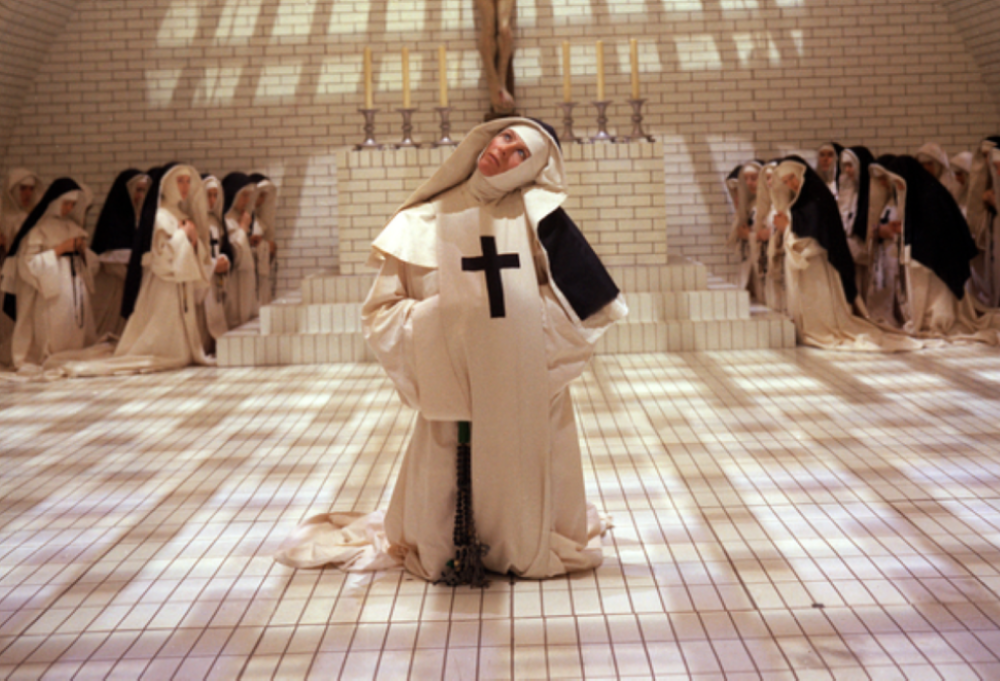
Vanessa Redgrave played Sr. Jeanne des Anges in Ken Russell's 1971 film "The Devils," now restored and rereleased. (Warner Bros.)

by Zachary Lee
When director Ken Russell's "The Devils" was released in 1971, its violent and sexual religious content created a maelstrom of controversy that resulted in it being banned in several countries and heavily censored in others. Now the unedited film has been released into the world, having debuted at Cannes and currently playing in select theaters.
"The Devils" chronicles the alleged Loudun possessions of the 1630s, partially adapted from Aldous Huxley's 1952 nonfiction book The Devils of Loudun and John Whiting's play "The Devils." Oliver Reed stars as Fr. Urbain Grandier, a beloved priest in the town of Loudun, France, who is accused of witchcraft by the local Mother Superior, Sr. Jeanne des Anges (Vanessa Redgrave). The conniving Cardinal Richelieu (Christopher Logue), who views Grandier's influence as a political threat to King Louis XIII (Graham Armitage), sees Anges' accusation as an opportunity to eliminate the risk.
Mark Kermode, a film critic and longtime friend of the late director, discovered the cut footage in the Warner Brothers archives in 2002 and helped oversee the film's restoration. The National Catholic Reporter spoke with Kermode about the controversial work, its message about church and state, and how Russell's Catholicism galvanized his critique.
This interview has been edited for length and clarity.
NCR: "The Devils" was released in 1971. So at that point, far more violent and controversial films, like "A Clockwork Orange" and "Sunday Bloody Sunday" and even "Witchhammer," which deals with similar themes, came out a year earlier. Why did "The Devils" receive such extreme pushback?
Kermode: It's a good question. … When he was making it, [Russell] was not thinking, "This film is going to be a problem." When he was shooting the film's most controversial sequences, he knew he was not being histrionic; he was simply depicting things as they happened.
The film is about two conflicting things: politics and religion. The film, from the beginning, deals with life and death … people are aware the film is exploring these subjects in a way that doesn't make you think that's what you're watching.
I think when executives read the script, they thought, "OK, this film is about religion and politics set in 17th-century France, and it's a historical text. How bad can it be?" I think the harsh pushback it got was because people were responding on a visceral level. … That's the power of "The Devils" in that people aren't and weren't prepared for how well it works as a film.
We live now in a time where we almost expect licentious, violent content in our media, yet Ken's ideas remain just as salient and dangerous to those in power. I wonder how people may push back against its themes today if they don't have those superficial "content" concerns to fall back on.
I [made] the documentary "Hell on Earth: The Desecration and Resurrection of The Devils," and Fr. Gene Phillips, S.J., was a big part of that. The way he talks about ["The Devils"] is that it is always about Grandier's spiritual enrichment. It is about Grandier's discovery of his own faith being counterposed with this pantomime of debauched blasphemy.
Advertisement
Yes, the film is about the unholy marriage between church and state and about the very kind of human corruption of the rituals, but in this internal journey for Grandier, he was actually discovering his own purpose in life. [But] when the film came out, people did not write about any of that. They just spoke about all the flashy, controversial stuff.
Ken took religion very seriously. I asked Ken about his Catholicism once, his conversion to it, and he said that the night before taking Communion and becoming a part of the Catholic Church, the priest asked him, "Do you have any questions?" To this, he said, "Only one … I don't know [that] I believe any of this stuff." To that, the priest said, "Join the club."
Ken had always said that his creative powers were absolutely liberated by that leap of faith. So what he's doing with "The Devils" is he's looking at a system of rituals and dogmas that he's not sure if he believes in, but he agrees to use those as a way of unlocking something in him.
Can you speak more to the idea that the strength of Ken's critique could be attributed to a late conversion?
I think that Ken was genuinely fascinated by ritual because he found that within ritual you could access spirituality, creativity and the human spirit. False religion doesn't mean religion isn't right. It means that there is a difference between religion and false religion.
With "The Devils," the whole point is that he is appalled and offended when a spiritual home becomes a pantomimed production. … Although Ken was not by any means orthodox, he was somebody who, on a very day-to-day level, lived his life as if he believed profoundly in the soul.
I think Ken was very happy that the film was taught in theology courses. Weirdly enough, "The Devils" was taken more seriously in some religious quarters than it was in the [forum] of popular opinion. I'm curious to see how today's Catholics might respond. The film is about Grandier's — and Ken's — leap of faith; it is about realizing that you actually have a purpose, not just because you heard from the heavens, but because you discovered that it was always there.