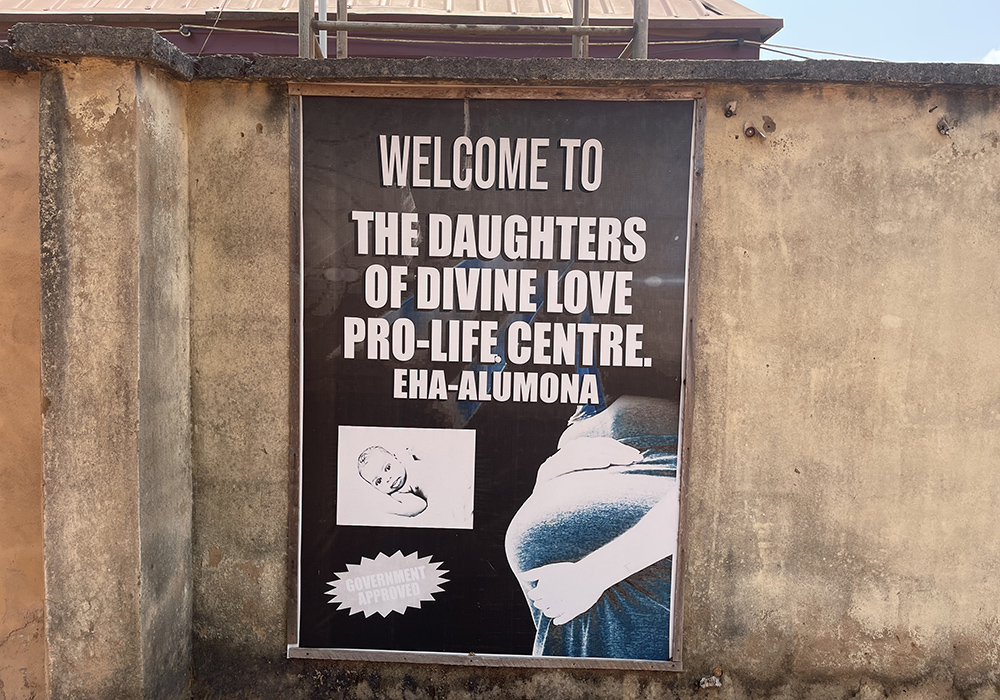
A sign outside for the Daughters of Divine Love Pro-Life Centre is mounted on the facility’s perimeter wall in Eha-Alumona, Nigeria. (John Chukwu)

by John Chukwu
In Eha-Alumona, a quiet rural community in southeastern Nigeria, a group of Catholic sisters is working to rewrite the stories of vulnerable girls whose lives have been upended by unplanned pregnancies, rejection and stigma.
At the Daughters of Divine Love Pro-Life Centre in the community, teenage girls and young women arrive burdened by fear, shame and uncertainty. Some have been cast out by their families. Others come from homes already strained by poverty. A few arrive alone, with nowhere else to turn.
"We welcome them, counsel them and stay with them until they deliver," said Sr. Mary Imelda Okonkwo, who oversees the center. "The aim is to save the lives of both the mother and the unborn child."
Their work unfolds against a troubling national backdrop. According to a 2024 UNICEF Nigeria situation analysis report, the country records a high adolescent birth rate of 75 births per 1,000 girls aged 15-19, often linked to poverty and limited access to education.
The center was established in response to a pattern the sisters could no longer ignore: rising cases of unsafe abortions, abandoned babies and young girls in distress.
"When girls started coming for abortions and babies were being dumped at the DDL hospital near the center, the congregation decided to act," said Chukwu Samuel, an engineer who assists the sisters at the facility. "The place became a safe alternative."
Unsafe abortion remains a major public health concern in Nigeria, where access to reproductive health services remains uneven. The World Health Organization cites unsafe abortions as "an important preventable cause of maternal deaths."
For many girls who find their way here, the center is often a lifeline — a place where their future, and even their lives, can be saved.
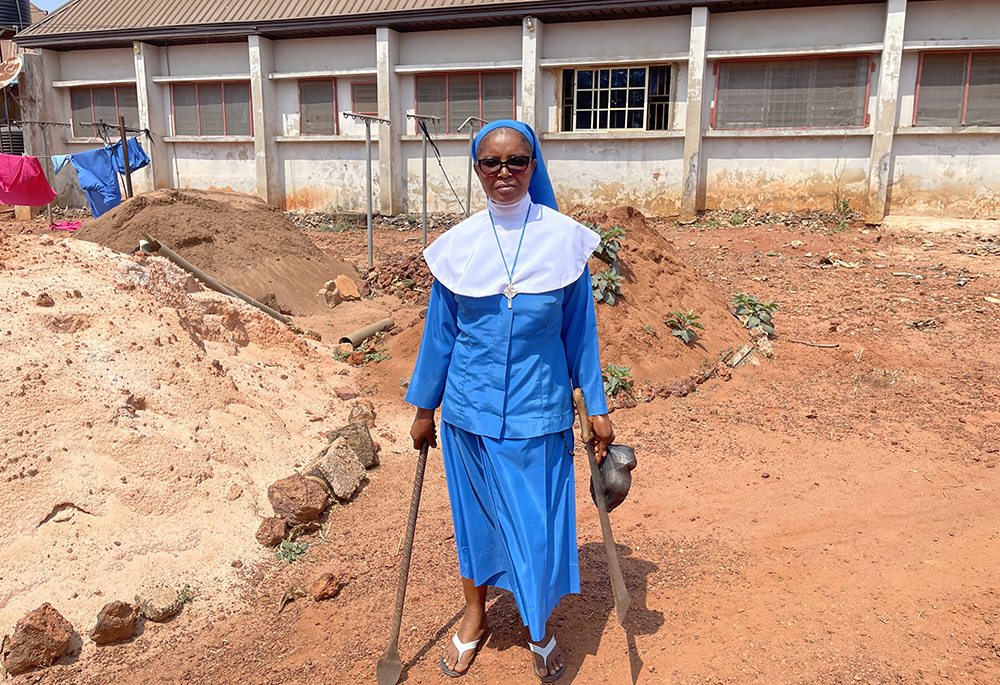
Sr. Mary Imelda Okonkwo poses with farming tools after inspecting the farmland used to support pregnant teenagers at the Daughters of Divine Love Pro-Life Centre in Eha-Alumona, Nigeria. (John Chukwu)
A refuge for the rejected
The circumstances that bring the girls here vary, but the underlying causes are often the same: poverty, pressure and abandonment.
Some are sent quietly by parents hoping to conceal the pregnancy and avoid public shame. Others are rejected outright. Many say the men responsible disappeared once they disclosed they were pregnant.
"When a pregnant girl arrives here, we first listen to her story of how she got pregnant and the person who was responsible," Okonkwo said. "Then we take her to the hospital for medical tests to determine whether she is free from HIV, hepatitis or any other communicable diseases."
Okonkwo explained that when a girl's test results show that she is disease-free, she is immediately admitted to stay with other pregnant girls. However, those who test positive for any illness are not turned away; instead, they are housed separately and given appropriate treatment.
The support the girls receive when they arrive is immediate and comprehensive: food, shelter, medical care and emotional support. But just as critical is restoring their sense of worth.
For Chioma, a 17-year-old who arrived after completing her secondary school exams, the center provided something she did not expect: comfort.
"It was homely," she said. "They welcomed me very well. They encouraged us and made us feel we still have a bright future."
That reassurance is important. Across Nigeria, thousands of girls drop out of school each year due to pregnancy. According to the 2018 Nigeria Demographic and Health Survey, teenage pregnancy is associated with school dropout. Many pregnant girls are unable to complete their education.
Advertisement
Life at the center is structured to restore dignity and confidence. The girls participate in daily prayers, group counseling and mentoring sessions. They are also introduced to practical skills, as part of a deliberate effort to prepare them for life beyond the center. The girls shared only their first names with GSR in order to protect their privacy.
"We teach them baking, soap-making, farming, even small business skills," Okonkwo explained. "If they learn something here, they can use it to start life again."
Ngozi, who is in her 20s, said her parents brought her to the Pro-Life Centre when she became pregnant. She noted that the training gave her renewed hope after months of uncertainty. "The sisters teach us to live morally and avoid following men who could lead us into this kind of mess again," she added.
Promise, 24, who had been learning hairdressing before her pregnancy, said the emotional support she received was just as important. "I was afraid when I came," she said. "But the sisters' encouragement helped me overcome my fear. I decided that once I leave here, I will focus on my work and complete my hairdressing learning."
Beyond vocational training, the sisters work to reshape how the girls see themselves. "The girls should not see their condition as something very shameful," said Sr. Adeline Igweonu, a lecturer at the Daughters of Divine Love School of Medical Laboratory Technicians, Eha-Alumona, Nsukka, who supports the centre. "We make them understand that even if people see it as an abomination, they should see it as the work of God in procreating life."
For the girls who have given birth — "social mothers," as the sisters call them — leaving the center marks the beginning of a new chapter. Some return to school; others start small businesses with modest support from the sisters; and a few reconcile with their families.
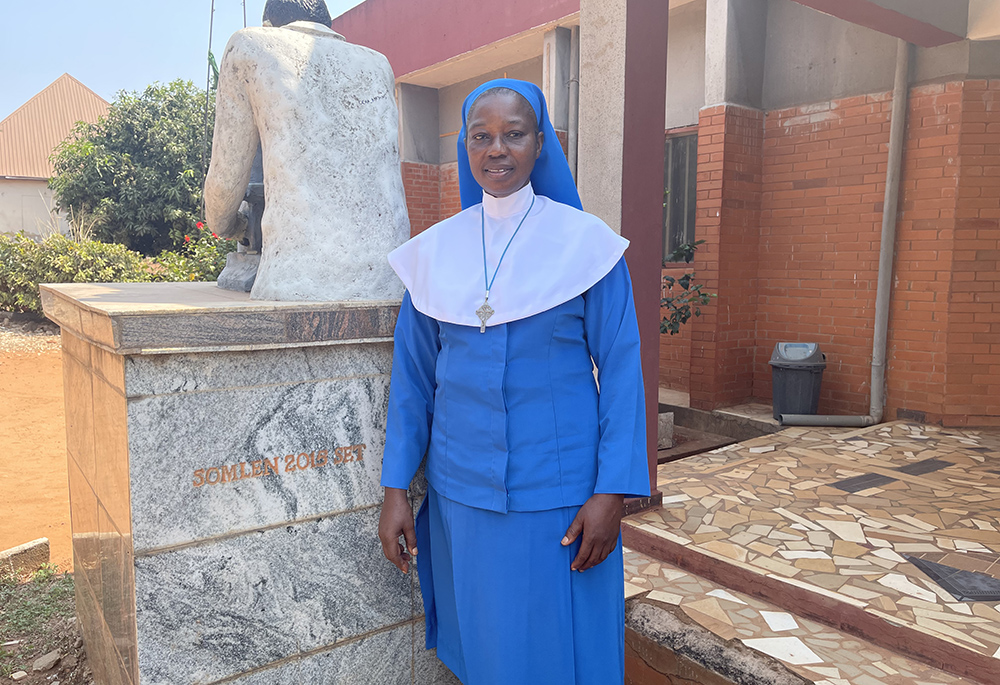
Sr. Adeline Igweonu poses in front of the Daughters of Divine Love School of Medical Laboratory Technicians building in Eha-Alumona, Nigeria. (John Chukwu)
"There was one girl whose parents took her back after she delivered and enrolled her in our medical laboratory school here," Okonkwo recalled. "She is now in her first year. We are proud of her."
Others return simply to express gratitude. "One girl came back after starting her business," Samuel said. "She was very grateful for the support she received."
These small victories reflect a broader reality: with the right support, many vulnerable girls can rebuild their lives.
Struggles behind the mission
Despite the impact of their work, the sisters operate under significant constraints. "We lack sufficient resources to care for the girls," Okonkwo said. "Most times, we go begging people to assist us."
The center relies heavily on donations and small-scale farming to survive. Basic infrastructure — such as water systems, electricity and funding for staff — remains a constant challenge.
"We need support to expand our farm, provide water and care for these girls properly," she added.
Igweonu echoed the strain. "We pay for their hospital bills and feed them daily. You know how much it takes to feed a family of four. Then, you'll now talk about feeding up to eight girls," she said. "It is not easy for us."
Yet, despite these limitations, the sisters continue, driven by conviction rather than resources.
Okonkwo revealed that her motivation is deeply rooted in her upbringing.
"My parents, including my siblings, have always helped people in need. My mother cooks and gives to others. She shares the little she has," she said. "It was from there that I developed a love for helping others."
At its core, the work of the sisters challenges deeply ingrained attitudes about pregnancy, shame and acceptance. It promotes a different perception, one that may be unpopular but is powerful enough to sustain the hope of the girls amid the societal condemnation and stigma that accompany their condition.
"Being pregnant is not a crime," Samuel said. "Parents should not condemn their children who become pregnant out of wedlock. Rather, they should befriend them and guide them appropriately to avoid making mistakes."
He also stressed the importance of communication within families. "Being too harsh with a child can scare them away," he noted. "Parents should learn to accommodate their children and develop strong communication channels with them."
For the young women at the center, the message is one of resilience and second chances. "When I saw myself in this condition, I felt it was the end. Before meeting the sisters, my mother encouraged me not to lose hope," Chioma said.
Ngozi recalled that she was very anxious when she found out she was pregnant. "After the discovery, I started looking for who will help me," she said. "Coming to this Pro-Life Centre gave me a new life."
Despite the sisters' compassion, patience and support for the girls, Okonkwo noted that they do not allow any girl to return to the center if she becomes pregnant again.
"Some of them get pregnant again after their first experience," she said. "We don't allow them to return if it happens a second time."