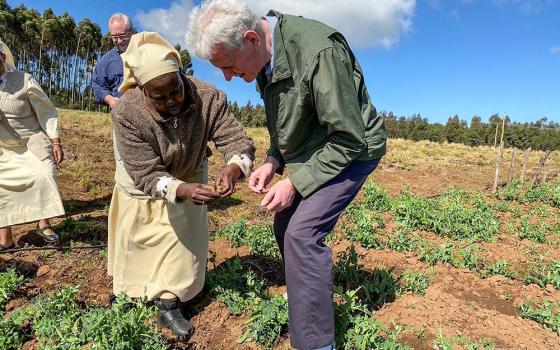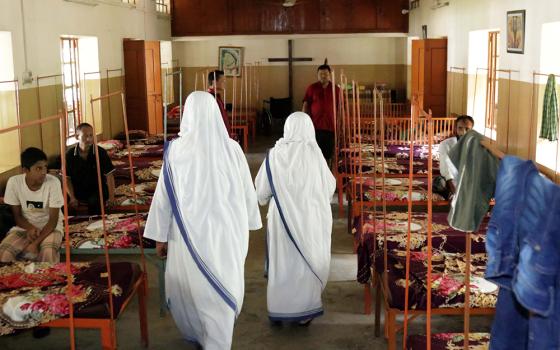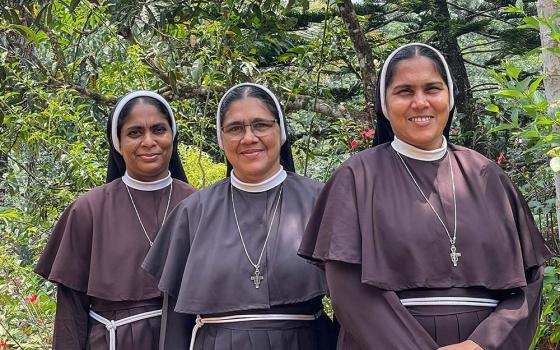
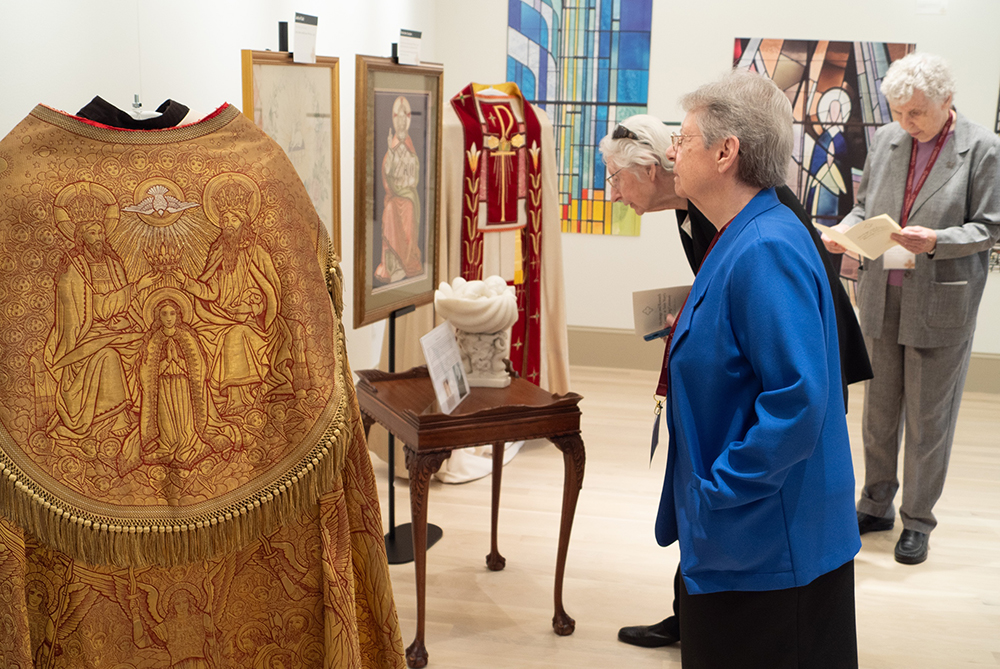
Visitors browse exhibits at the opening of the Heritage and Research Center at St. Mary's May 26, a collaborative heritage center and archive for 10 congregations of Catholic sisters in the Midwest located in Indiana. (Courtesy of the Heritage and Research Center at St. Mary's)

What began as an ambitious idea among a handful of sisters in 2018 has become a landmark effort to safeguard the history of Catholic sisters, with a collaborative archive that will preserve the records of 10 congregations for future generations.
The Heritage and Research Center at St. Mary's (HARC) has opened in Notre Dame, Indiana, offering a new home for stories that might otherwise have been lost.
HARC is part of a consortium of four sites working to collect and preserve religious archives; it joins the Women Religious Archives Collaborative in Cleveland, which is expected to open next year, and archives at Boston College and Santa Clara University.
The 10 congregations in HARC are from Indiana, Illinois, Iowa, Wisconsin, and Missouri.
"This is the most collaborative experience I have had," Holy Cross Sr. Suzanne Brennan, one of the founders and a board member for the center, told Global Sisters Report. "Everyone was very committed, very dedicated to moving this along."
The center is on the campus of St. Mary's College, a sponsored ministry of the Sisters of the Holy Cross, and was blessed by the local bishop in a celebration May 26. Each participating congregation curates its own collection of materials; the center will also show how the congregations continue their ministries today, serve as a gathering space and provide programming, interactive exhibits, classes and internships.
Advertisement
"For generations, sisters have influenced education, healthcare, social services and spiritual life in communities across the region and far beyond, yet many of these stories and records have remained inaccessible and untold," said Barbara Gordon, HARC's executive director, in a statement announcing the opening.
"Archives are not simply records of the past — they are living legacies that continue to shape the present and future. HARC will serve as a place of scholarship, discovery and connection, inspiring conversations and action around faith, leadership, service and social impact while making the witness of Catholic women religious accessible for generations to come."
While HARC is not open to the public, it does take appointments, and the archivist team is available by phone or email for research inquiries. The collections are expected to be open by fall 2027.
An urgent need
The need for long-term plans for congregations' archives is getting more urgent every day. According to statistics Leadership Conference of Women Religious officials shared at their 2022 assembly, one-third of all congregations in the United States have fewer than 50 members, and the number of communities with enough members to hold a chapter and elect leaders was expected to drop dramatically after 2025.
The legacies of those holy lives and ministries are in danger of being lost. According to a study released in 2023 by the Center for Applied Research in the Apostolate, nearly half of congregations in the study do not have a long-term plan for their archival collections, and nearly 40% need to relocate their archives in the next decade.
In addition to the national consortium, plans for an archive for 11 Franciscan communities were recently announced, and the Felician Sisters of North America in November opened their Heritage Center & Archives to house the collections of their eight former provinces and the new combined province.
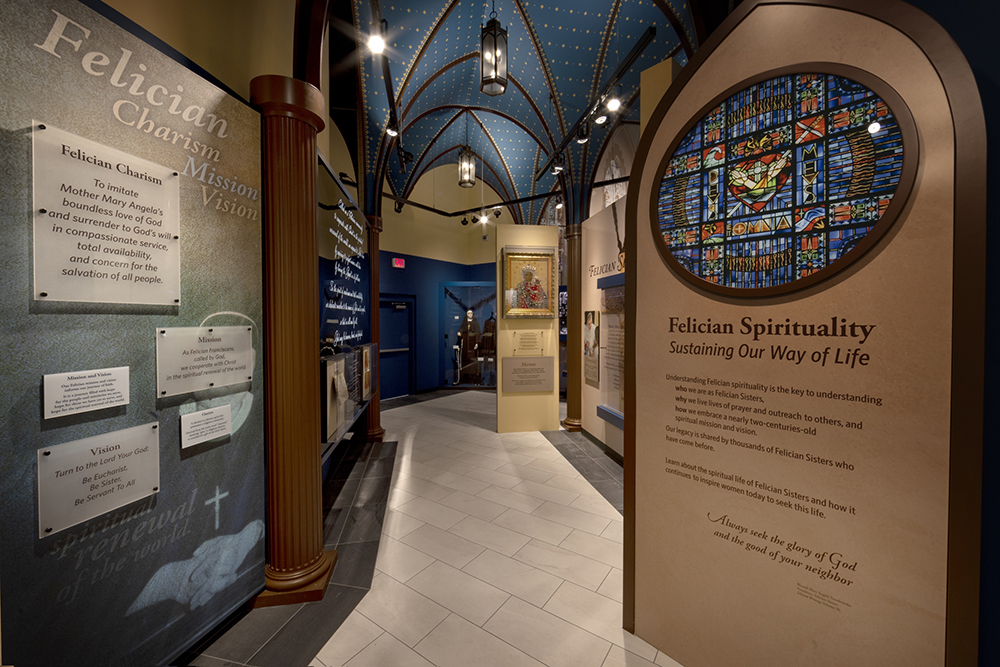
The many exhibits at the Felician Sisters of North America's Heritage Center & Archives tell the story of the sisters' 150 years of ministry in North America. (Courtesy of the Felician Sisters of North America)
The Felician center's opening was part of the conclusion of the congregation's 150th anniversary celebration. It is housed on the campus of the order's Madonna University in Livonia, Michigan, part of a larger campus home to its hospice, Montessori school, senior clergy village, nursing home, a hospital and its Livonia convent.
Julie Kresge, the Felicians' chief mission advancement officer, said the heritage part of these centers can be just as important as the archives they protect and preserve.
"We've heard from guests going through, they say things like 'I had no idea you were everywhere,' " Kresge said. "Because if you live in Chicago, you only know the sisters in Chicago — you don't know they're all across North America."
Visitors to the center will first encounter a 20-minute movie that tells the story of the sisters, beginning with the five sent to Polonia, Wisconsin in 1874 and the 150 years of ministry that followed. One section even includes a section of the stone wall that surrounded the Polonian convent.
One area features the sisters' current work, which is focused on social service and justice and peace initiatives. Another is the Laudato Sí room, which looks like a forest.
Kresge said the archives used to be split between locations in Enfield, Connecticut, and Buffalo, New York. Now they are in one location and there is room to grow, as needed.
"People can research church history, find family members," she said. "Most of what we have is Felician history, but there is also the history of places our sisters served" that might not be available anywhere else.
None of the collaborative archive efforts are easy, or inexpensive, but Brennan said the time, money and effort are worth it.
HARC "took a little longer than we thought, but it was well worth the wait," Brennan said. "We wanted to know how our stories were going to be told."