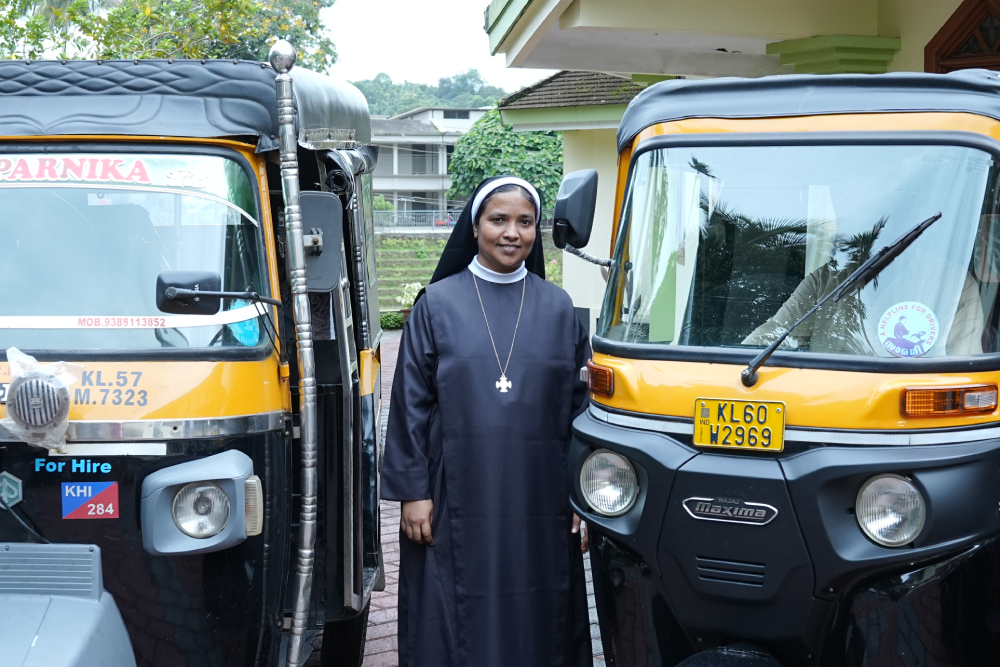
Sr. Rose Maria, coordinator of the Sarathi Helpline for Drivers, with autorickshaw drivers in Koodaranji, a small town in Kozhikode district, Kerala, southwestern India. (Johnson Suvarana Studio)

by George Kommattam
Eight years ago, Sudheesh V. Sreeram fell ill while driving his auto-rickshaw, a three-wheeler taxi, in Kozhikode, a town in the southwestern Indian state of Kerala. The doctors advised him to undergo a pacemaker implantation immediately.
"I had no savings, even though I had worked as a driver for 25 years," Sreeram said.
Then three Catholic nuns and a few driver friends came to his house.
The group was led by Sr. Rose Maria, who had launched Sarathi Helpline for Drivers, an organization for taxi drivers coordinated by her Congregation of the Mother of Carmel.
Sreeram said the visitors supported him with interest-free loans for the implant.
"Today, I am the treasurer of one of the Sarathi units," the Hindu driver, who is now 52, told Global Sisters Report in June.
Sreeram is among more than 100 members of Sarathi in eight units in Kerala's northern districts of Kozhikode and Malappuram.
Maria, who coordinates these units, says taxi drivers, who work long hours, have uncertain income and limited social security. "Their families become vulnerable when illness or emergencies strike, as in Sreeram's case," she told GSR.
Sarathi, also sponsored by the Kerala Catholic Bishops' Council, unites drivers from Christian, Hindu and Muslim religions through self-help groups that promote savings, mutual support and responsible living.
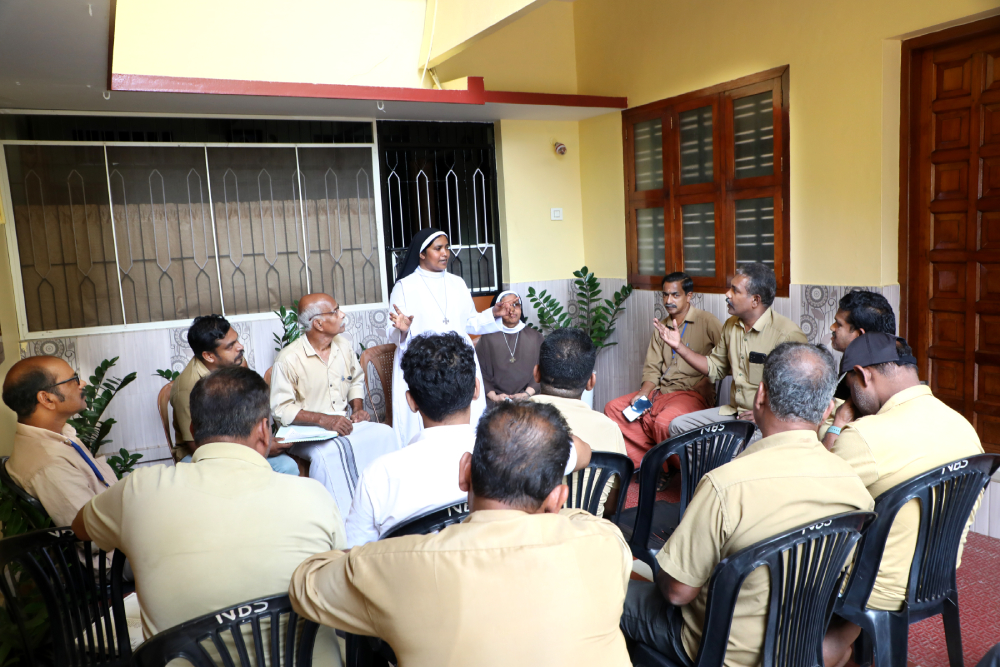
Sr. Rose Maria, coordinator of the Sarathi Helpline for Drivers, and Sr. Gracelyn Mathew, director of the Marikunnu unit, interact with drivers during their weekly meeting on June 22 at the sisters' convent in Marikunnu, a neighborhood in Kozhikode district, Kerala, southwestern India. (Venu Sai Studio)
Fr. Sebastian Thekkanath, Sarathi's national director, estimates that Kerala has some 1.5 million auto-rickshaw drivers. "We have 80,000 members in 1,000 units," the priest told GSR.
Kozhikode alone reportedly had 6,000 auto-rickshaw drivers in 2023.
Thekkanath said the organization has opened units in Delhi, Odisha in eastern India and Tamil Nada, Kerala's eastern neighbor, all managed by different congregations.
"Nearly 25 women religious congregations are involved in Sarathi activities," the priest of the Archdiocese of Ernakulam-Angamaly told GSR in July.
The organization has also launched an app for the taxi drivers.
Maria said she started the organization in 2016 in Thiruvambady, a town in Kozhikode district, after attending a school function honoring local taxi drivers.
"The gesture touched me because drivers are among the least recognized and most forgotten workers in our society," said the nun, who has a master's degree in social work.
She organized drivers under the Thejus Charitable Trust, her congregation's social service wing. She said their aim is to help drivers become self-reliant and responsible citizens.
The 41-year-old nun said autorickshaw drivers, who work alone and often serve passengers by driving during emergencies, are left without support when facing difficulties of their own. Many drivers have low and irregular incomes and there are few government welfare schemes to help during illness, accidents or financial hardship.
Most drivers, she said, are not interested in becoming members as the organization demands "a certain level of discipline" such as giving up alcohol and smoking.
"Moreover, we have our limitations to reach out to all. Not all sisters are ready to go out to recruit members. Funds is another problem as each congregation has to generate funds for its units," Maria said.
Members gather every week over tea, discuss concerns and contribute small amounts to a common fund. Each unit maintains its bank account and manages its activities independently.
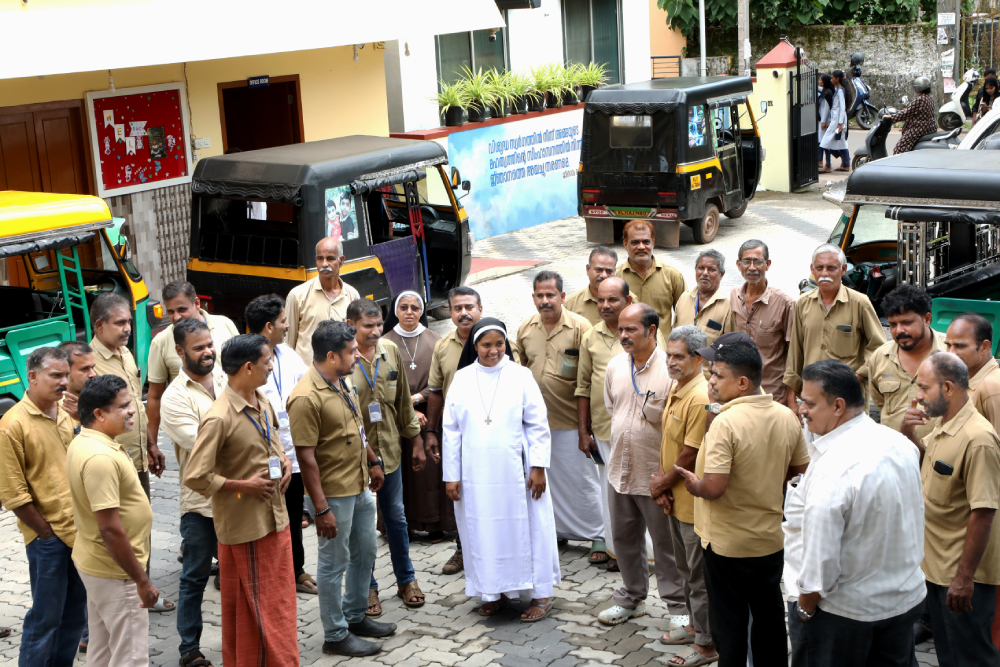
Sr. Rose Maria, coordinator of the Sarathi Helpline for Drivers, and Sr. Gracelyn Mathew, director of the Marikunnu unit, interact with drivers in Marikunnu, a neighborhood in Kozhikode district, Kerala, South India. (Venu Sai Studio)
Jolly Ponnamvarikayil, secretary of the 10-member unit in Koodaranji, a village in Kozhikode district, said the habit of saving taught by Sarathi has transformed many families.
"Each member in our group has some 50,000 rupees as savings, and it's growing," the 54-year-old Catholic told GSR.
Jijo Thomas Valiaplackal, another member of the unit, said, "The money belongs to us. We decide how to use it. This gives us confidence and security."
Maria said her congregation continues to support the units in Kozhikode and Malappuram providing loans and emergency assistance.
Sr. Suman George, the leader of the Koodaranji unit, said many drivers come to Sarathi for money.
"But when we spend time with them, we often discover family tensions, loneliness or emotional struggles behind those problems," George told GSR.
The 61-year-old nun said they focus on moral values, counseling support, awareness classes, family gatherings and responsible living. The Sarathi members also organize pilgrimages, family gatherings, annual celebrations, and outreach activities.
"When families become stronger, drivers overcome their struggles easily," she said.
T.K. Riyas, a physically challenged driver, said Sarathi helps its members focus on the drivers' well-being.
"More than economic security, emotional support matters to me the most. I feel that I have someone to call when in crisis. Earlier, I faced problems alone," Riyas told GSR.
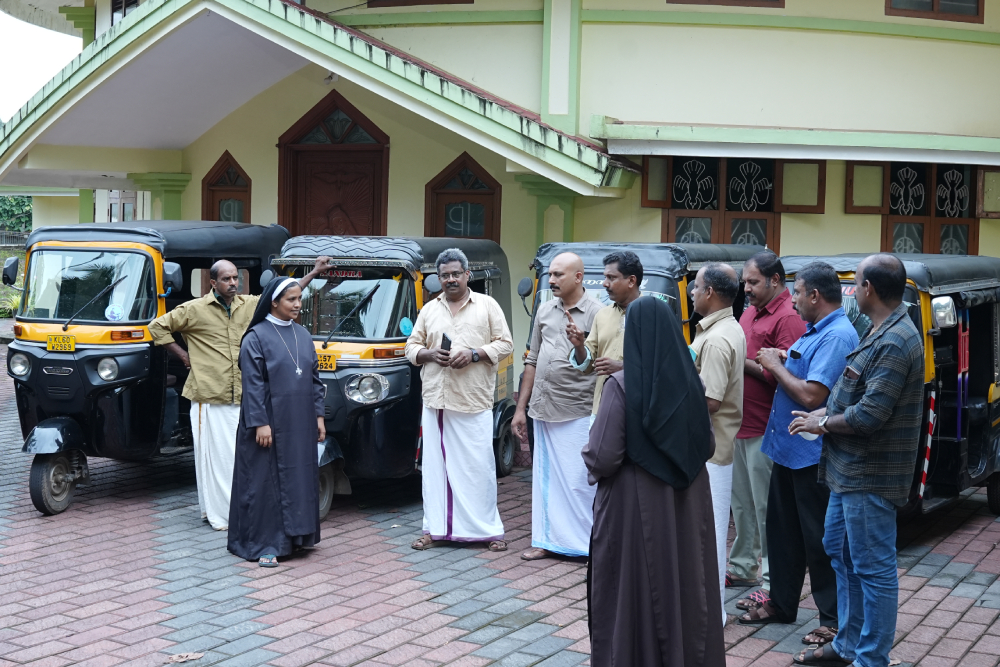
Sr. Rose Maria, coordinator of the Sarathi Helpline for Drivers, interacts with autorickshaw drivers in Koodaranji, a small town in Kozhikode district, Kerala, southwestern India. (Johnson Suvarana Studio)
Sr. Gracelyn Mathew, coordinator of the 19-member unit in Marikunnu, a suburb in Kozhikode city, said Sarathi functions through shared responsibility.
"Each member has responsibilities. When somebody faces a crisis, the group responds immediately. Our role is to accompany and guide them while the members take ownership of the movement," Mathew told GSR.
Maria said people trust Sarathi members more than others. She recalled an incident where a Sarathi member was in an accident and was taken to a police station.
"The police contacted our convent and informed us that a Sarathi member was there. They knew someone from Sarathi would come and take responsibility," Maria said.
She said such solidarity became evident when Joshy Cheenkallel, president of the Koodaranji unit, died three months ago.
The Sarathi members stepped in to help the family members with hospital visits, treatment arrangements and emotional support. "They were there for us in every way," Cheenkallel's wife told GSR.
The organization also breaks down religious barriers.
"We do not ask about religion or politics. We work only for the welfare of drivers and their families," Maria said.
V. K. Salim, a member of the Marikunnu unit, said such openness is Sarathi's greatest asset.
"We allow nothing that divides us, no posts or messages in our WhatsApp groups that would create divisions among members," the 50-year-old Muslim told GSR.
Advertisement
He said their only policy is to help one another. "The sisters' inspiration and leadership are our power. They lead us from the front," he said.
The members also participate in activities such as cleaning public spaces, visiting palliative care centers and planting trees on World Environment Day.
Suresh Eranjayil, a founder member of the Marikunnu unit, said the organization has changed the way drivers view their role in society. "Discipline and unity have become our trademark," he told GSR.
He said the nuns encourage the members to think beyond their needs.
"Earlier, I believed driving was only to earn money. The sisters have taught us that helping others is also part of our duty," he said.
The changes have not gone unnoticed.
Fr. Thomas Nagaparambil, the parish priest of Thiruvambady, described Sarathi as a unique ministry among an often-overlooked group.
"Sarathi is the most fruitful charitable activity of the Carmelite sisters," he told GSR.
Sreeram said more than financial aid, the greatest gift he received from Sarathi was a new understanding of community.
"As long as my heart permits, I will do good to others. The Sarathi people stood by me when I had nowhere else to go," he said.