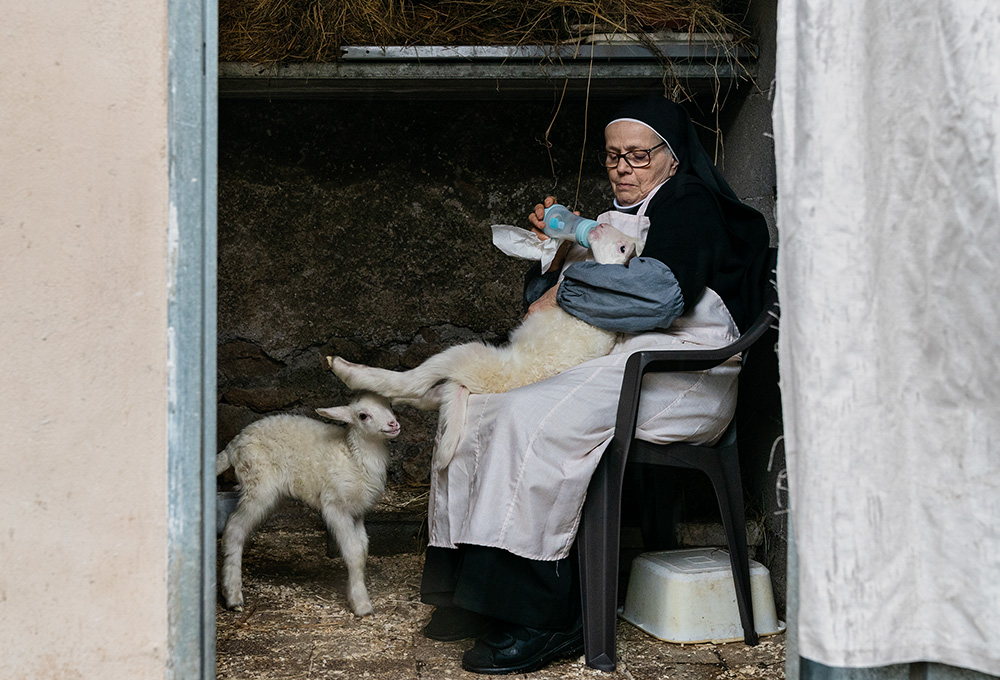
The new Italian documentary film "Agnus Dei" follows the Benedictine sisters in Rome who care for two lambs whose wool becomes part of a papal vestment — a centuries-old tradition. The lambs' principal caretaker is Sr. Vincenza Portaluri, shown here with the animals. (Riccardo Ghilardi)

For months, two newborn lambs become part of the daily rhythm of life inside a Benedictine monastery in Rome. The sisters of St. Cecilia feed the lambs, care for them and gently shepherd them through an ancient ritual whose final destination reaches all the way to the pope.
In a tradition dating back hundreds of years, the lambs' shorn wool is used for a vestment known as a pallium, a woolen band worn over the shoulders. It is bestowed on the pope at his inauguration Mass, and on metropolitan archbishops during a sacred annual ritual: the June 29 solemnity of Sts. Peter and Paul.
The tender relationship between the sisters and lambs — at once practical, affectionate and deeply symbolic — lies at the heart of a new Italian documentary, "Agnus Dei" ("Lamb of God"), which offers a rare glimpse into a cloistered world where this centuries-old tradition endures.
What follows throughout the film's 73 minutes is a quietly commanding, hypnotically mesmerizing and visually arresting film that follows the animals from birth to their formal blessing and then subsequent time with the Benedictine nuns of the monastery of St. Cecilia in Trastevere, Rome.
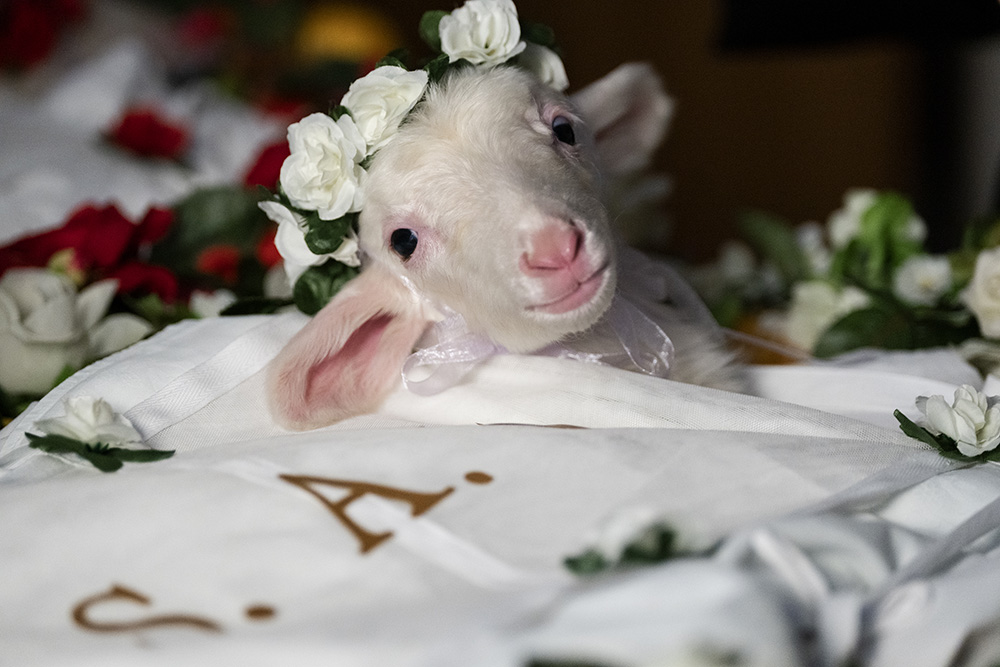
One of the two lambs featured in the new Italian documentary film "Agnus Dei" who become part of an ancient ritual whose final destination reaches all the way to the pope (Riccardo Ghilardi)
The film's narrative arc may seem simple. But equally important is the symbolic power of the Christ story, with the lambs representing purity and innocence, sacrifice and redemption.
Along the way, Italian director Massimiliano Camaiti distills the quiet, sacred, almost timeless world within the sisters' monastery with uncommon care, love and respect.
Without any narration — an intentional decision — Camaiti told GSR, the viewer is "entering a parallel world," one that focuses on storytelling solely through images.
And what images they are: Birth. Blessings. Ritual. Solemnity. The love found in the Benedictine community, the tenderness shown by the sisters to the vulnerable lambs. The climax of seeing the vestments worn by Pope Leo XIV and a group of metropolitan archbishops.
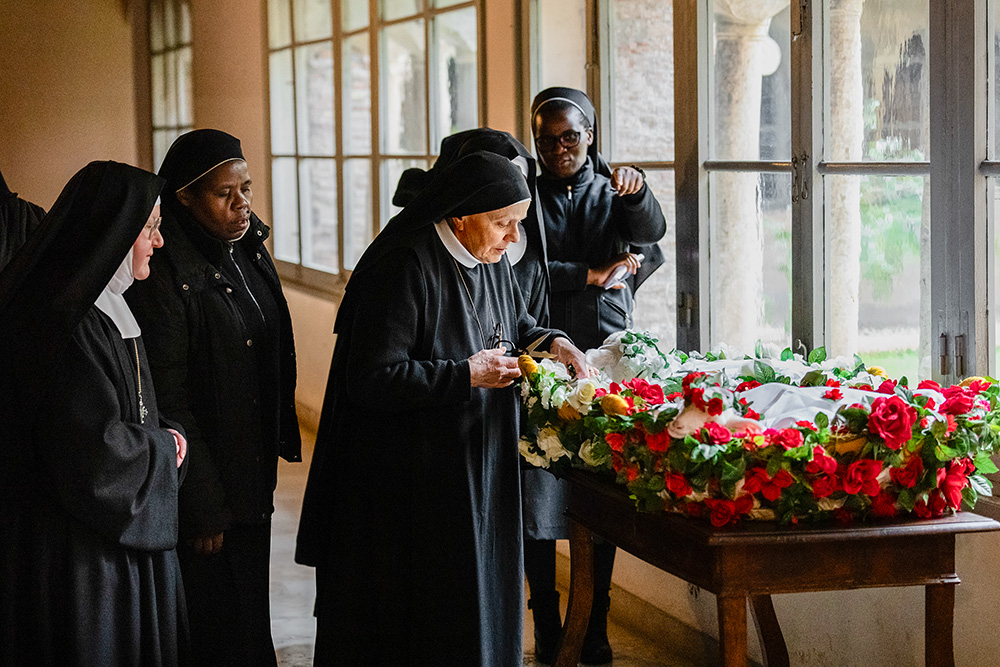
The new Italian documentary film "Agnus Dei" follows the lives of the Benedictine nuns of the monastery of St. Cecilia in Trastevere, Rome, seen here in preparation for the blessing of two lambs whose wool will be used in the creation of vestments known as pallia. (Riccardo Ghilardi)
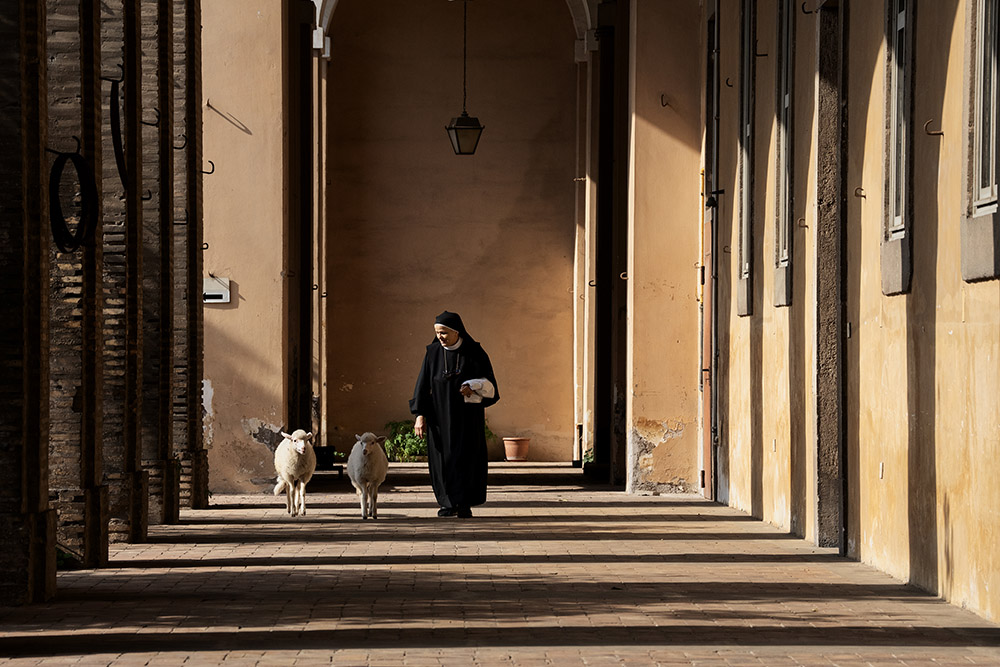
The life of two lambs in the Benedictine monastery of St. Cecilia in Trastevere, Rome, is the focus of a new Italian documentary, "Agnus Dei." (Riccardo Ghilardi)
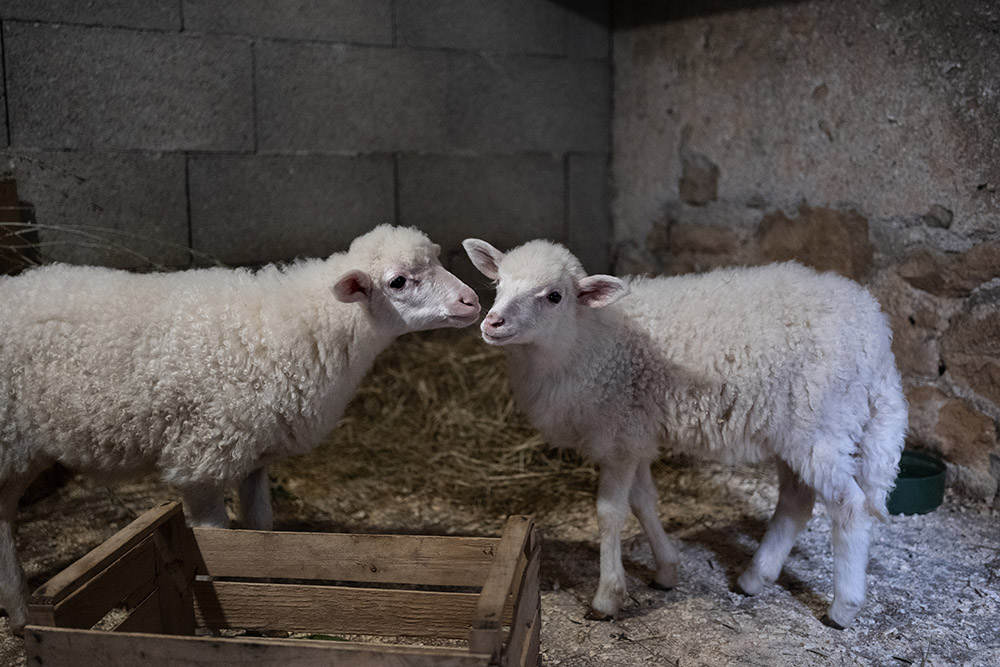
The two lambs featured in the new documentary "Agnus Dei" whose shorn wool will be used by Benedictine sisters at the monastery of St. Cecilia in Trastevere, Rome, to create vestments known as pallia (Riccardo Ghilardi)
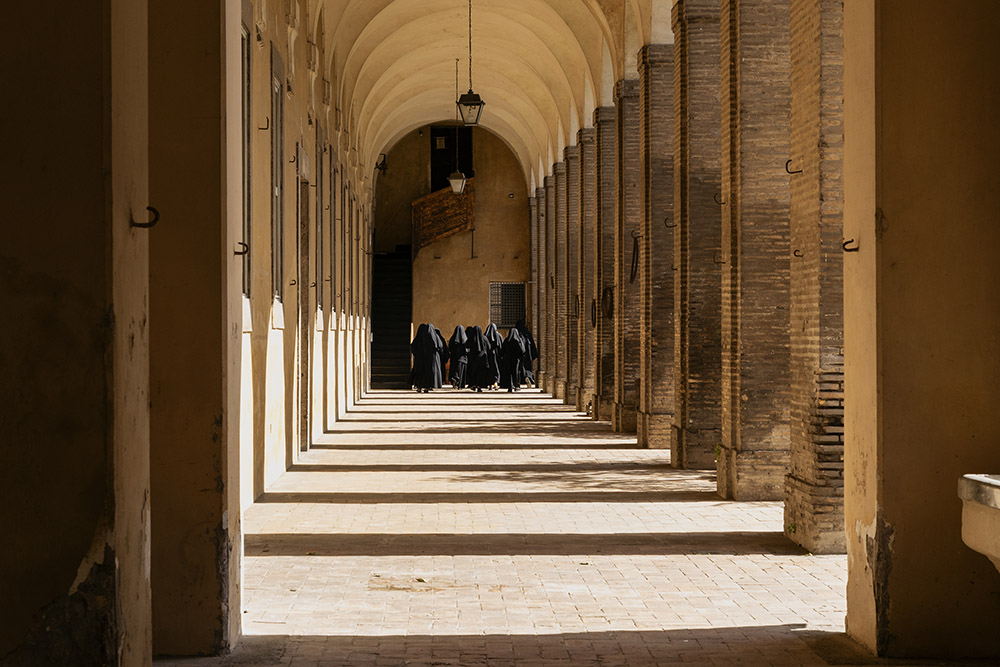
The new Italian documentary film "Agnus Dei" follows the lives of the Benedictine nuns of the monastery of St. Cecilia in Trastevere, Rome. (Riccardo Ghilardi)
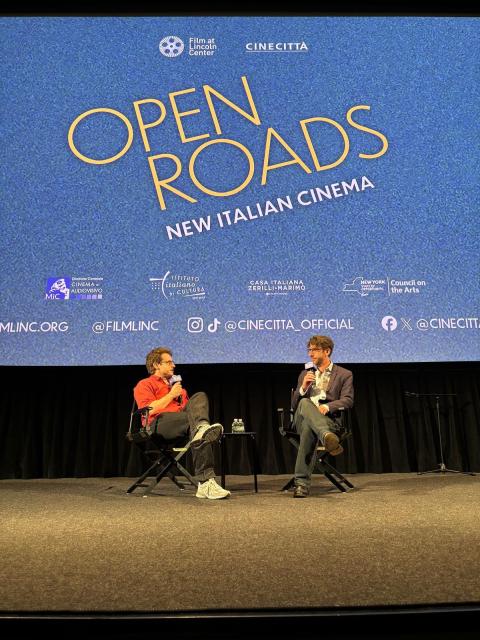
For the filmmakers, the experience was like "being a fly on the wall, but that helps the audience live the experience," said producer Giovanna Nicolai, who joined Camaiti in a May 29 interview at the Walter Reade Theater in New York.
There, "Agnus Dei" was shown this past week at its North American premiere, featured as part of Film at Lincoln Center's "Open Roads: New Italian Cinema" festival.
The documentary was originally premiered at the Venice Biennale, has had a successful release in Italy and has been picked up by several international film festivals, including Open Roads. The film was also selected for production by Biennale College Cinema, which the director and producer call a prestigious workshop, based in Venice, Italy, for first- and second-time filmmakers.
Four projects from hundreds of applications were awarded with 200,000-euro grants for film production. "The trick," Nicolai said, "is that no other funds could be added," meaning the four films had to be completed within the set budget.
'A kind of revelation'
In a director's statement provided by the Lincoln Center festival, Camaiti said his discovery of the ancient tradition actually "happened by chance," when he walked past the basilica in Trastevere, a Rome neighborhood located just south of Vatican City, on the celebration day of St. Agnes in January 2021.
"Seeing two lambs covered in flowers, joyfully celebrated by the nuns before being blessed by a priest, was a kind of revelation," he writes. "That's when the idea was born to follow the journey of the two animals: from birth to the completion of the ritual that transforms their wool into a vestment destined to be worn by the pope."
The lambs, he said, "opened the doors to a secret world, marked by a different rhythm, a different breath, one that not even the sudden intrusion of history could disturb."
History takes different forms. Several times, the camera looks upward, catching the image of a plane amid the clouds, suggesting a frenetic globalized world beyond the monastery's still and quiet walls.
Advertisement
But more concretely, viewers find themselves watching as the sisters hear radio reports of Pope Francis' declining health and then, finally, the pope's death on April 21, 2025, the day after Easter.
Though sadness is apparent, and "as the nuns' activities were paused for only a few hours," Camaiti recalled, he captures the indelible reality that life in the monastery quietly "resumed, unchanged and unchanging, as it has always been through the centuries."
"They are used to moving on," Nicolai said of the sisters. "They do what they do no matter who is the pope," noting they must deliver the pallia on time.
The film ends memorably: The sisters watch the Sts. Peter and Paul service on television — with a new pontiff, Pope Leo XIV, presiding, and the sisters' careful craftsmanship on full display. They react both with pride and with characteristic modesty.
"The fruit of our labor," one of the sisters remarks.
"They are happy to be in the background," Camaiti said.
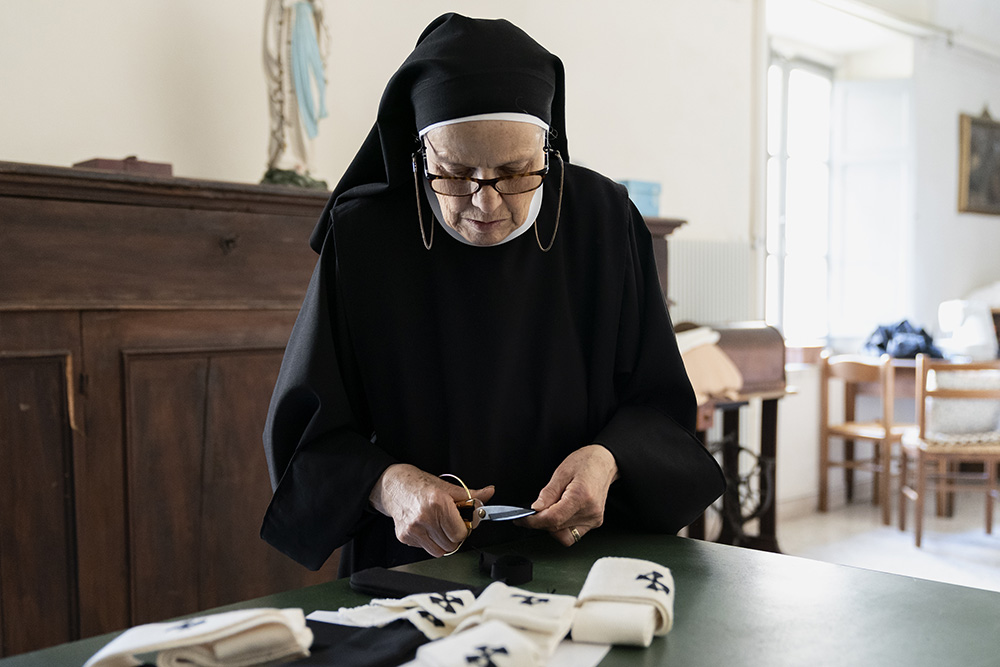
Benedictine Sr. Vincenza Portaluri prepares the pallia that will be bestowed on metropolitan archbishops in the June 29 solemnity of Sts. Peter and Paul. The vestments are made by the sisters from wool of two lambs who stay with the sisters in their Rome monastery. (Riccardo Ghilardi)
Relationship with the sisters 'built over time'
Another scene is of a family reunion. Much of the film focuses on Sr. Vincenza Portaluri, who is the lambs' primary caretaker but who, as the viewers learn, entered religious life after being married and then widowed. At one point the camera shows her smiling while lovingly holding faded photographs of her and her late husband in earlier times.
But also captured is Portaluri meeting her family, including her son and grandchildren, for a family dinner at the monastery — a meal marked by memories, jokes and friendly banter. It is a moving reminder that while sisters are members of chosen communities, they are also tied to family, lineage and kin.
Camaiti said it took some doing to convince the sisters to agree to participate in the film, with his proposal greeted with an initial polite no.
But when Camaiti outlined his artistic vision and assured the sisters of a respectful portrayal of their lives, and after he showed them 20 minutes of initial footage, they agreed and cooperated fully.
The film was shot over 25 days spanning six months in 2025, from January to June.
The sisters "trusted us, but it was a relationship we had to build slowly, over time," Nicolai said, adding that now "we're like family."
"They just got used to our presence, and it became very natural."
Camaiti attended Catholic schools, but like many Italians, fell away from the church. Still, he said the experience of making the film has brought him closer to the church and a recognition of the importance of spirituality in the contemporary world.
That shows in the film — which Camaiti proudly notes the sisters have seen and praised.
As for the blessed lambs, "they are back home now," he said, returned to the farm where they were born and are now fully grown.
"I like to think that there is a flock of blessed sheep somewhere in the countryside just outside of Rome."