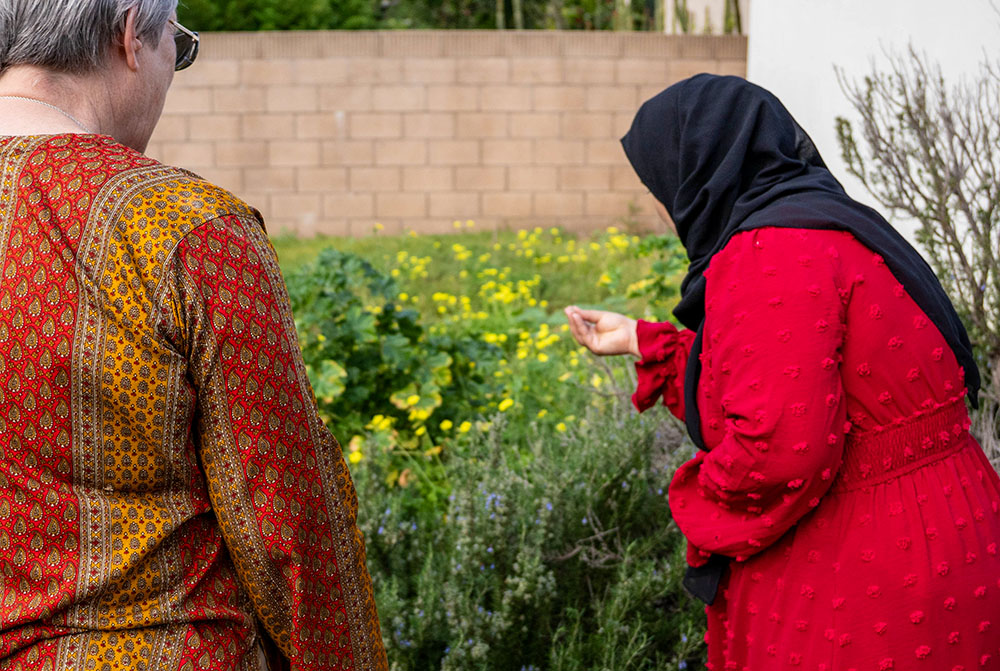
A woman staying in the CSJ Shelter for Refugee Families, a ministry that sponsors and houses families in the immigration process, shows St. Joseph Sr. Sue Dunning, left, the plants in the shelter's garden. (Courtesy of the Sisters of St. Joseph of Orange)

It is difficult enough to meet the needs of asylum-seekers or refugees who have arrived in the United States with nothing but the clothes they are wearing. But after the relief of finally being safe after months or years of constant danger, the trauma they buried while trying to survive often comes roaring back.
"It's a lot of emotional stress," said Sr. Sue Dunning, a Sister of St. Joseph of Orange, and director of the California congregation's CSJ Shelter for Refugee Families. "Most people have gone through horrendous experiences just to get to the border."
Trauma, she said, is just one of myriad issues that come up for these families, and each one must be dealt with, whether it is finding health care or getting work permits.
The shelter only houses families in the U.S. legally, either through the asylum process or the government's Refugee Resettlement Program. But because immigration officials are targeting even those allowed to be here, including arresting them at their required court hearings, Global Sisters Report is not naming those staying in the shelters, or giving the exact location of most of the shelters themselves.
Currently, Dunning said, there is a family from Afghanistan and another from Mexico being sheltered. One was granted asylum by a judge in November, but is still awaiting a work permit and a green card; the other is here through Refugee Resettlement and has work permits.
Government statistics show that nearly three-fourths of those in Immigration and Customs Enforcement detention as of November have never been convicted of any criminal offense, and that of the 5,373 people detained during the government shutdown last fall, 97% had no criminal history, even traffic violations.
Advertisement
"Every single human deserves to be treated with dignity and respect," Dunning said. "These folks coming to our borders, I don't see them treated with dignity and respect, I don't see their basic human rights coming from the government, so it's up to us."
A January analysis by The New York Times found that the Trump administration had deported 540,000 people since taking office; the administration announced Feb. 19 plans to open eight mega-detention centers across the country, each able to hold between 7,000 and 10,000 people, a $38 billion plan that the U.S. Conference of Catholic Bishops said "should challenge the conscience of every American."
Defending immigrants and refugees is a cause many congregations of Catholic sisters have taken up, particularly congregations of Sisters of St. Joseph: In New York state, the Sisters of St. Joseph of Rochester have been sheltering immigrants since 2023, and the Sisters of St. Joseph of Brentwood have been in the ministry since 2022 — at one point sheltering 60 people on their campus and currently housing about 35.
Dunning said her congregation got involved after its 2016 Chapter decided they needed to do something to minister to immigrants, though they weren't sure what. In 2018, they found the answer when the Leadership Conference of Women Religious put out a call for sisters to minister at the U.S.-Mexico border, where thousands of asylum seekers were overwhelming the services available for them.
The Sisters of St. Joseph of Orange contacted Catholic Charities in San Diego, Dunning said, and found there was a need for sponsors for those in the asylum process. That year they took in two families, and then a third.
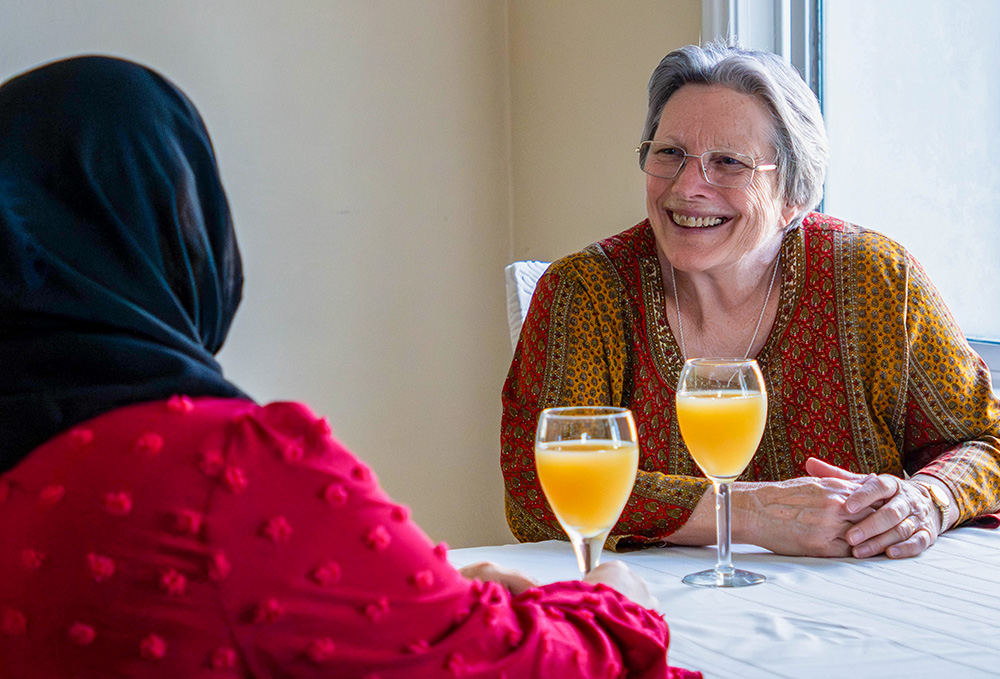
St. Joseph Sr. Sue Dunning, right, talks with a woman staying in the CSJ Shelter for Refugee Families, a ministry that sponsors and houses families in the immigration process. (Courtesy of the Sisters of St. Joseph of Orange)
"We would find a pro-bono lawyer, provide room and board, health care, whatever they needed," she said. "But we were starting from scratch — none of us had any idea how to do this."
Fortunately, they found a local nonprofit that trains the support teams serving families in the asylum process, and are now working with another that provides counseling for torture and trauma victims.
"You just have to keep at it until you can get the help people need," Dunning said. "We're doing what we can to alleviate the conditions" people are in.
Sr. Donna Del Santo said the Rochester ministry was much less intentional: She ran into a friend who worked with refugees who said she had a family of six that needed a place to stay for the weekend.
"Orange was much more organized — they really intended to do this kind of work," Del Santo said. "Our response was to say yes and we'll figure it out."
She said the immigration crackdown currently taking place has added yet another layer of stress. While she's not worried about herself or the congregation, even though there have been government attempts to shut down similar ministries such as Annunciation House and Catholic Charities of the Rio Grande Valley, both in Texas. But she is worried about the families they are sheltering, even though they have the legal right to be here.
'It's about relationship, about being available to your neighbor. Your world just gets so much bigger because of them, because of these relationships.'
—St. Joseph Sr. Donna Del Santo
"The sisters have all been arrested for civil disobedience, so I don't feel unsafe for myself, but I don't feel I have the ability to keep this community safe," Del Santo said. "I had to sit down with the family, particularly with the youngest child, and explain that you do not open the door to anyone you do not recognize. We've had to heighten awareness in a way I never thought I would have to do."
Brentwood's Sr. Annelle Fitzpatrick said her congregation began housing Afghan families after that country's government fell to the Taliban, and then Ukrainian families after their country was invaded by Russia. Both of those sources, however, have dried up because the Refugee Resettlement Program has essentially been shut down.
Even worse, she said, the work authorizations of the refugees they're housing are not getting renewed.
"If you don't get a paycheck, you're going to be deported," Fitzpatrick said "They've submitted [their paperwork], but nobody gets back to them."
And employers don't dare keep them on the payroll, she said, because they can be fined $10,000. She identifies with the mythical man forced to eternally roll an immense boulder up a hill.
"I feel like Sisyphus — you go up the hill, get a phone call and the rock rolls back down," Fitzpatrick said. "But we're managing to keep them afloat."
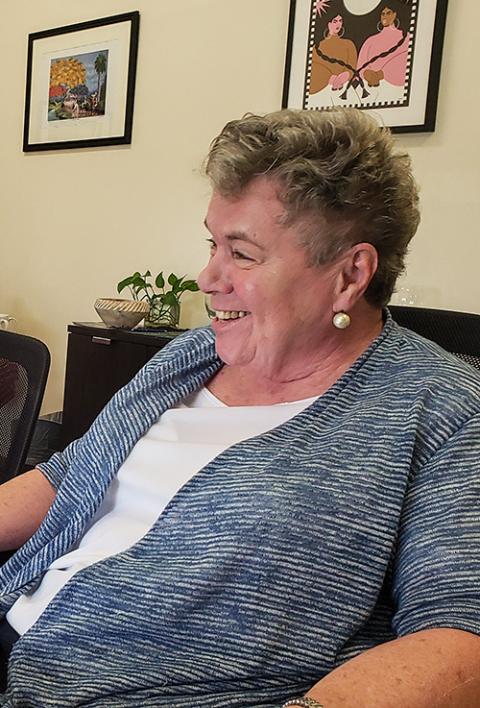
Sr. Annelle Fitzpatrick of the Sisters of St. Joseph of Brentwood (GSR photo/Chris Herlinger)
Brentwood's ministry focuses heavily on job training, helping refugees get commercial driver's licenses or to learn skilled trades such as electrician or plumber.
Fitzpatrick said her congregation houses its families on their campus in a building that long ago was their boarding school, which is why they can house up to 100 people if needed.
"They're right here on the grounds — we're proud of that," she said. "Jesus said, 'I was homeless and you gave me a place to live.' "
All three sisters talked about the unique mixture of sadness and joy that comes from this ministry.
"We've had good times, bad times. One couple got married," Fitzpatrick said. "Our real emphasis is on building community and a sense that you have a family. I want to know if someone's eating alone or someone's depressed."
Del Santo said the lived reality of what these families have been through is heartbreaking. But it comes with something far greater.
"All the sudden I'm becoming 'granny' or 'abuela' — that's not something I've ever been before. But it's about relationship, about being available to your neighbor," she said. "Your world just gets so much bigger because of them, because of these relationships."
Dunning said you can't help but feel the stress the families are under.
"They came with a lot of hope, but they lose hope at some point," she said. "Boy, has it been tough."
But one of the first families the congregation sheltered has relocated to New York, where both parents are working and the family is doing well.
"They're not just surviving, they're thriving," Dunning said. "It's just thrilling to see that happen. That is pure joy."