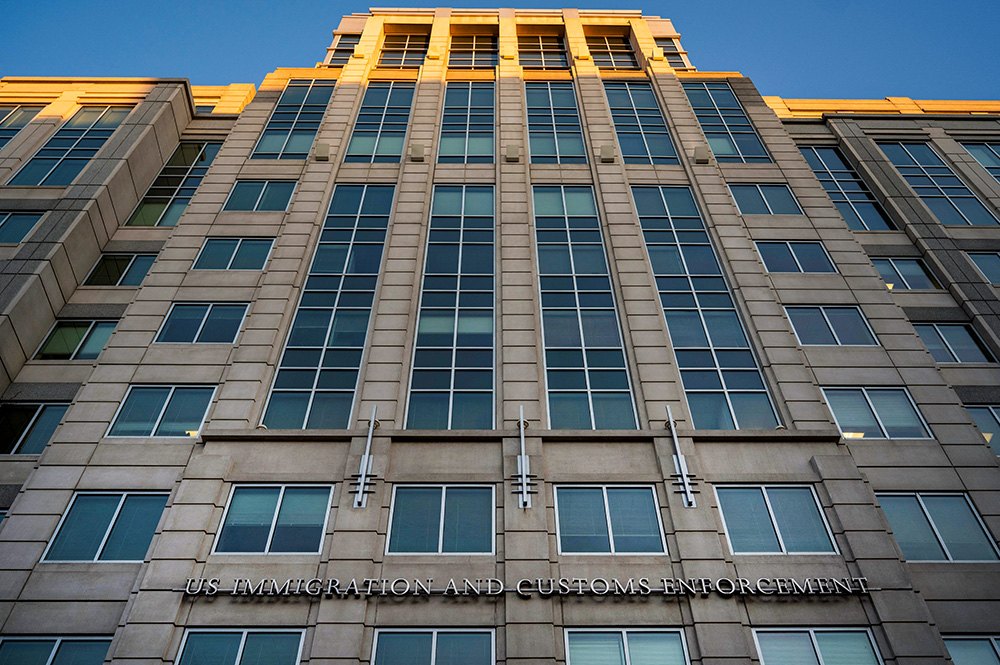
Sunlight hits the U.S. Immigration and Customs Enforcement building in Washington Jan. 18, 2025. (OSV News/Reuters/Vincent Alban)

Though the Trump administration has made nearly every aspect of immigration more difficult, there is at least a small bit of good news for international religious workers using R-1 visas to minister in the United States.
Those who have used up all the time allowed by an R-1 visa no longer have to remain outside the United States for one year before applying for another one.
"It's going to significantly reduce the time religious organizations have to wait for that worker; that's a big difference," Mercy Sr. Mary Ann Clarahan said of this policy change that the Catholic Legal Immigration Network announced in January. Clarahan is the Sisters of Mercy of the Americas' liaison to the network, known as CLINIC.
While only a handful of Mercy sisters are in the U.S. on R-1 visas, CLINIC works with more than 150 dioceses, religious congregations and other groups and several hundred religious workers.
"Foreign-born religious workers are a backbone of the Catholic Church in the United States and for many other faith traditions. Nearly 90% of U.S. dioceses are reliant on the ministry of foreign-born priests and religious," Anna Gallagher, CLINIC's executive director, said in the announcement. "This policy change will allow some relief for these ministers, priests, and other religious, and ensure better continuity of care for the communities they serve."
But the process is still difficult — and just one wrinkle in a campaign that, as of October, had brought nearly 500 policy changes on immigration.
"While this announcement offers welcome relief, religious workers are still required to depart the United States after five years, even though they may now return for a new R-1 period without waiting a full year abroad, Miguel Naranjo, CLINIC's director of Religious Immigration Services, said in the announcement. "This change, while helpful, does not fully resolve the challenges facing clergy, particularly as travel bans continue to prevent many from obtaining visas at all."
Advertisement
In an interview with Global Sisters Report, Naranjo pointed out that even though religious workers can apply for a new visa sooner, getting one is far from guaranteed.
Clarahan said 75 countries aren't getting other visas at all, and another 16 are severely limited, up from last fall when there were 12 on the no-visa list and seven were extremely limited. Those restrictions don't apply to religious worker visas — yet.
For tourists in those countries wanting to visit the United States, "you're getting nowhere, so don't even bother applying," she said. And while R-1 visas aren't currently part of those restrictions, "that could change."
In fact, Naranjo told attendees at the Resource Center for Religious Institute's annual conference in October that while no change was announced, R-1 visas issued to religious workers from some countries in Africa are only valid for 90 days; applicants in other African countries are not getting visas at all. Aside from some exceptions, such as for Mexico, most R-1 visas are valid for 2 1/2 years and can be renewed once before you have to leave the country and apply for a new one.
Naranjo also told the conference that religious worker visas used to allow multiple entries, meaning a religious worker could minister in the United States, then go home to visit family or their religious congregation, and use that visa to reenter the U.S.
Now, Naranjo said, they are seeing R-1 visas with only one entry allowed, meaning if a visa holder leaves the country, they will not be allowed back in without a new visa.
Clarahan said that will force some tough decisions.
"You will really have to decide, 'If my mother is dying ... will I be able to get back?' " she said.
Naranjo told GSR that all the new restrictions have forced religious congregations to move novitiates and other formation activities overseas.
"They're changing the way they operate, changing the formation process," he said.
Meanwhile, Naranjo said, the U.S. State Department has been slow to change, and staff at embassies and consulates in charge of issuing R-1 visas may not know that the 12-month waiting period before applying for a new visa no longer exists.
"Their policy manuals still say one year," he said.