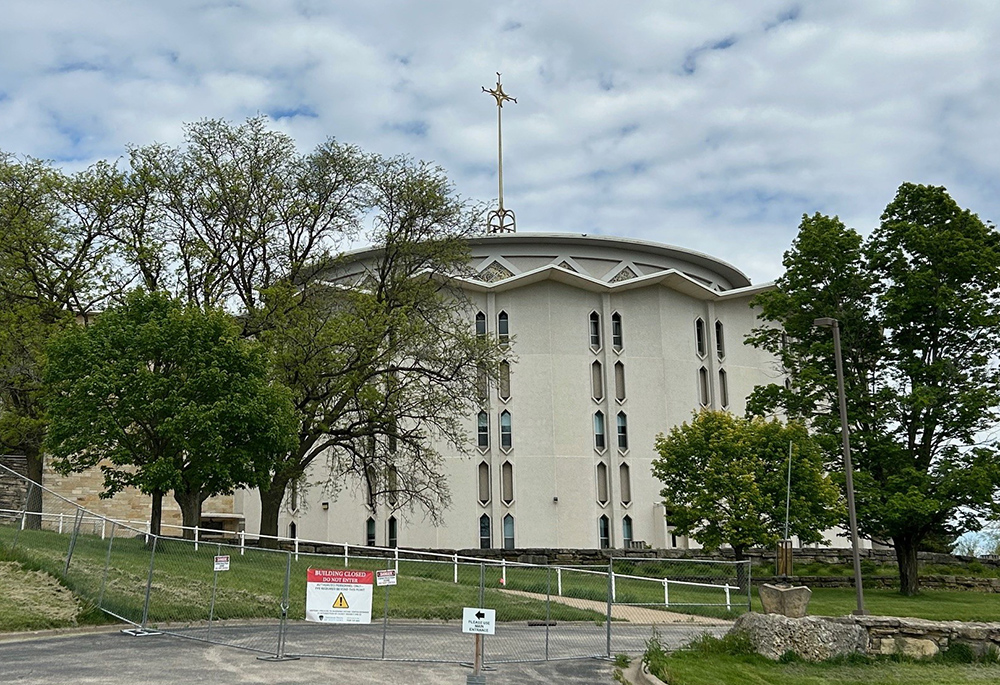
Queen of the Rosary Chapel at Sinsinawa Mound in Wisconsin, a circular chapel designed in 1966, features 37 diamond-shaped, stained-glass windows by Sr. Teresita Kelly. The chapel is slated for deconstruction in 2026 as part of the Sinsinawa Dominican Sisters' facility downsizing. (Courtesy of Quincy Howard)

by Sr. Quincy Howard
Contributor
The readings from the Acts of the Apostles and John's Gospel leading into Pentecost are unsettling because they speak so directly to the human experience of endings. They speak not of a dramatic collapse, but of a quieter realization that what once held everything together will no longer work in the same way.
Again and again, the disciples ask the same questions we recognize whenever familiar structures begin to fail:
- What do we do now?
- What remains?
- What can still be trusted?
John's Gospel describes a particularly destabilizing moment for the disciples when they can feel the world they have known — built upon Jesus' physical presence among them — coming to an end. It is a small moment in the life of the church, but it echoes a much larger pattern — one that feels strikingly familiar today. Jesus speaks constantly of departure, absence and change. Thomas wants certainty. Philip wants clarity. They want a map for what comes next. So do we.
Because endings increasingly define this moment in our history. Economic systems built on endless growth leave people exhausted, disconnected, and in poverty. Religious institutions wrestle with credibility and relevance. Technological conveniences control our daily lives, often leaving us fragmented and overstimulated. Even our relationship with the earth reveals the fragility of systems we once assumed were permanent. In these uncertain times, I feel a number of endings looming just over the horizon.
Yet in John's Gospel, Jesus does not offer the disciples a strategy for preserving stability. Instead, he redirects them away from structures and toward relationship: "I am the way, the truth, and the life."
Not a blueprint. Not a preservation plan. A relationship. He knows that what ultimately sustains us is not the permanence of institutions, but our ability to remain connected — to God, to one another and to love itself — even as the forms around us change.
The Acts of the Apostles offers a remarkable companion lesson. In Acts, the early church discovers that existing structures are no longer serving the people well. The system that once functioned faithfully began creating exclusion and strain. Widows are being overlooked. And the disciples are faced with a familiar choice: cling to the old system because it is familiar or allow the community itself to be reshaped.
What is remarkable is that the disciples do not interpret change as betrayal. They listen. They reorganize. They create new forms of leadership so the mission itself can survive and deepen.
The early church survives not because it preserves its old structures, but because it learns how to remain rooted in purpose while becoming flexible in form. Resurrection, in Acts, is not the restoration of the old shape, but the emergence of new life through transformation.
That insight feels deeply important right now. Because when systems begin unraveling, our instinct is often panic or nostalgia. We either frantically try to preserve everything exactly as it was, or we assume nothing meaningful can survive. But Acts suggests another possibility: faithful rebuilding. Rebuilding that makes room for grief, humility, attentiveness and shared responsibility.
I occupy one of those places where endings are not abstract ideas but lived realities in my community of Dominican Sisters. Our beloved Queen of the Rosary Chapel — a sacred place filled with memory, identity and prayer — is facing deconstruction. A building made of cement, something that has held identity and belonging, is coming down. My ministry is to accompany the process until it is gone, and it requires a different posture from me.
It is difficult to overstate the significance of this project. Buildings like this are not just physical structures. They anchor stories. They give form to faith. They hold generations of prayer within their walls. Their permanence feels like a promise.
I find myself returning to the language of hospice care. Hospice is the discipline of accompaniment when continuation in the old form is no longer possible. It asks:
- How do we honor what has been?
- How do we remain present to one another?
- How do we resist rushing past grief?
- How do we allow dignity and love to remain visible until the very end?
Those questions apply not only to people nearing death, but to communities, institutions, and systems moving through profound transition. With a median age of 84 years old, they are questions for my own congregation.
Advertisement
They are also questions for a world in transition. As global systems strain and familiar structures unravel, the temptation is to rush — to fix, to rebuild, to restore what was. But hospice teaches us another way: to slow down, to pay attention, to resist the illusion that everything can or should be preserved unchanged.
Perhaps humanity itself is in a kind of hospice moment. Because hospice care is not only about passing away but is also about clarity — the kind of clarity that emerges with endings. It strips away illusions of permanence. It reveals what is truly essential.
It forces us to ask whether we place our faith in the heart of the matter — or only in the structures that surround it.
When Jesus tells the disciples not to let their hearts be troubled, he is not dismissing grief. He is reminding them that endings are not the final truth. The ground beneath us may shift. Institutions, economies and even sacred buildings may not endure as we expect. But the relationship with God endures.
The way is not a map, it is a relationship.
The final truth is not a structure, but a way of being.
And perhaps that is the hope we are being asked to carry now: that God is still building. Not always visibly. Not always quickly. Not always in forms we immediately recognize. But faithfully, patiently, and lovingly — even amidst the rubble — God is still building.