
(GSR graphic/Olivia Bardo)

"Evolving Religious Life," a continuing series from Global Sisters Report, explores how Catholic sisters are adapting to the realities of congregations in transition and new forms of religious life. While we write often about these trends, this particular series will focus more closely on sisters' hopes for the future.

The Sisters of St. Francis of Philadelphia were in a situation familiar to congregations of Catholic sisters across the United States: Their motherhouse was far too large for the number of sisters living and working there.
But the historic building, dating to the late 1800s, was home to about 35 sisters and they still needed access to offices, meeting spaces, and, of course, the chapel.
Fortunately, the convent had neighbors willing to help.
Neumann University, whose campus abuts the motherhouse grounds, in 2021 purchased the motherhouse, several other buildings and 63 acres, including the sisters' cemetery, almost doubling the university's physical size. The sisters, whose congregation founded and sponsors the university, rent the space they need and retain ownership of the retirement home, a farm and other buildings.
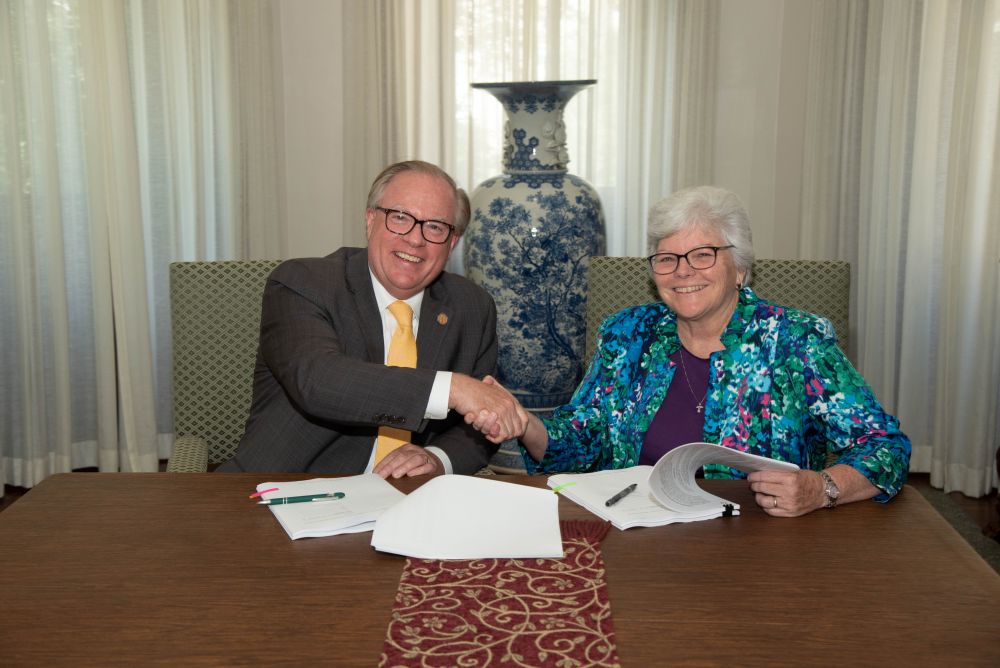
Neumann University President Chris Domes and Sr. Kathy Dougherty sign papers in June 2021 transferring ownership of the Sisters of St. Francis of Philadelphia's motherhouse, other buildings and 63 acres to the university. (Courtesy of the Sisters of St. Francis of Philadelphia)
And since the fall of 2022, the motherhouse has been ringing with young voices — about 60 Neumann students moved into a wing converted to university housing.
"It's brought a lot of life into the building," said Sr. Kathy Dougherty, who was congregational minister at the time of the sale and is now vice president for mission and ministry at Neumann. "It's a really nice relationship that has developed."
Dougherty was hopeful, but a bit nervous about college students moving in with the sisters who are decades older: Their median age when the change was made was 82.
"At the time of the sale, I thought it might be challenging, but it has worked out surprisingly well," she said. "The students really appreciate the sisters and the sisters appreciate them."
Sisters are known for their creativity in solving problems, and that is no different when it comes to unneeded buildings and property, even — or especially — when it comes with built-in challenges, such as out-of-the-way locations or buildings too expensive to heat and maintain but not worth renovating.
'Praying for a buyer'
Building far from the city in a pastoral landscape may have made sense when convents were constructed decades ago, but congregations looking to sell those properties now find that potential buyers see that location as "out of the way" and "hard to get to." Historic buildings can add to the challenge.
But an entrepreneurial couple saw those challenges as an opportunity, and turned part of a monastery built in the 1600s near Lake Garda, Italy, into a hotel and spa. The ancient buildings have become a place of unique charm, and being cut off from the world has become a haven of respite.
The Sisters, Servants of Mary still occupy part of the monastery, but the south wing, empty since the 1950s, is now home to 40 beautiful hotel rooms and suites, known as Monastero Arx Vivendi.
The Hospital Sisters of St. Francis had a sprawling campus on the outskirts of the small city of Springfield, Illinois, but instead of drawing tourists, it drew more religious: The Norbertine Fathers from St. Michael Abbey in southern California established the Corpus Christi Priory there to accommodate their growing number of vocations. The priory opened in 2023, and eventually could become an independent Norbertine abbey.
"It's a very well-established religious house, very large, 290,000 square feet, two churches, 100 acres; it's an enormous place," Norbertine Fr. Ambrose Criste told Our Sunday Visitor. "It's a very beautiful property on the outskirts of a small Midwestern city — Springfield is a small city — so it's a very quiet location and a very quiet and contemplative religious life here because of the nature of the property and the buildings."
Under a 2021 agreement, the Diocese of Springfield formed a new entity to assume ownership of the campus; the Hospital Sisters continue to live on the grounds through a long-term lease.
"This historic moment for the Hospital Sisters of St. Francis follows years of careful discernment, planning, and evaluation of many possible approaches to secure a long-term future for this property," said Sr. Maureen O'Connor, the order's provincial superior in a statement.
'If the nuns see [our plans] as really continuous of what their ministry was for perhaps a century, the hope is the neighbors will feel ... it's in good hands.'
—Jesuit Fr. Greg Boyle
About two hours south of Springfield, the Ruma Center in Ruma, Illinois, has been vacant since the Adorers of the Blood of Christ moved to a senior living facility near St. Louis in 2022. The site will become home to Books for All, a nonprofit that establishes community libraries.
Books for All will use the buildings and 33 acres as a retreat and conference center and to house its library of more than 30,000 books. Under the agreement, which the sisters announced on their Facebook page May 11, the Adorers of the Blood of Christ will continue to own the farmland surrounding the campus, as well as the cemetery, where sisters will continue to be buried.
The sisters said in the announcement that they had spent the last four years praying for a buyer who would continue their legacy of community and mission, and believe God brought them Books for All to do that.
"While we are not a religious organization, we carry forward the spirit of what (the sisters) built: a place dedicated to community, care for the people who pass through it, and respect for the earth it sits on," Books for All officials said in the announcement.
From convent to group home
Some convents, though they may have housed sisters for decades, are not the responsibility of the sisters' congregation, as they're owned by the parish or school where the sisters ministered. But those, too, sometimes need to be sold or transformed, and again, creativity can be key to making it happen.
Advertisement
The Archdiocese of New York has a program called ArchCare, which continues care for young adults on the autism spectrum who have aged out of the many educational and support programs for children and teens. Many of those adults, according to America magazine, live for years with their parents, who worry about what will happen to them once they are gone. They don't need constant care, but are not ready to live completely on their own.
But ArchCare has converted two former convents into group homes for those young adults, who are able to live as independently as possible. The first one converted was St. Teresa's Convent on Staten Island, where renovation began in 2018; the second was in Eastchester and had been home to the Franciscan Sisters of Hastings-on-Hudson for more than a century. Renovations there began in 2023. Each is now home to eight to 10 high-functioning adults with autism.
In Seattle, the St. Alphonsus parish school had a convent that for decades housed the sisters that taught there. Most recently, it was home to the Society of Our Lady of the Most Holy Trinity, until they relocated.
Now it still houses teachers, but not sisters: It provides affordable housing for the lay people that teach at St. Alphonsus, a welcome benefit and effective recruiting tool in a city where teacher salaries are often not enough to afford a place to live. A convent apartment is $900 a month in a city where the average rent is more than $2,000; the convent is now home to six teachers.
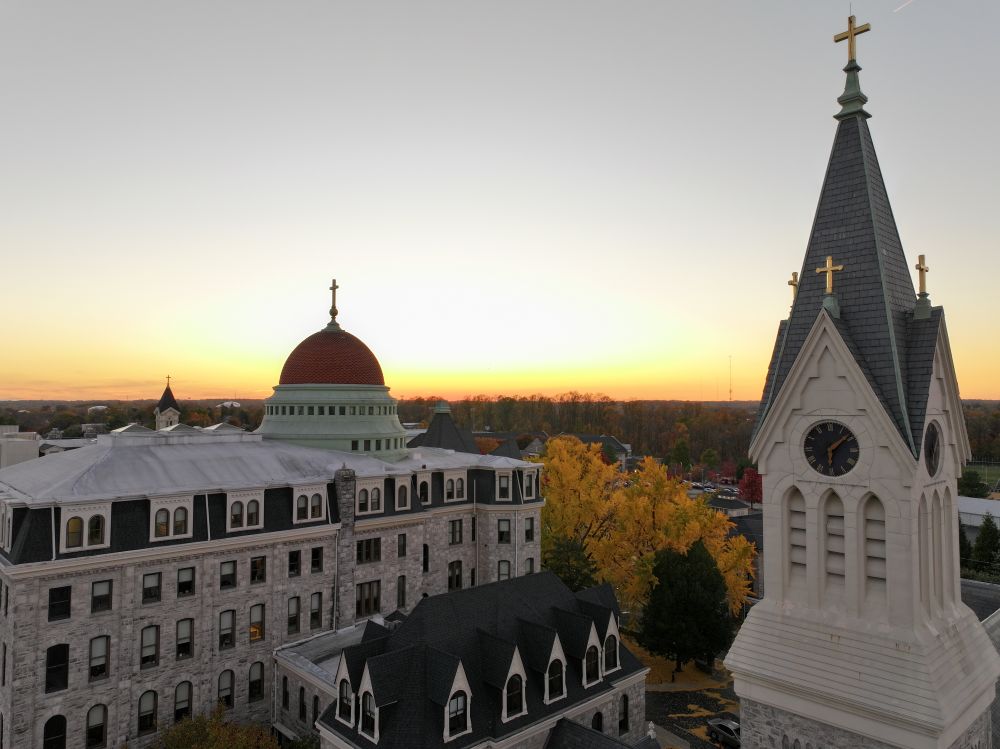
The motherhouse of the Sisters of St. Francis of Philadelphia (left) is seen at sunset. The sisters sold the motherhouse, other buildings and 63 acres to Neumann University which rents space to the sisters for an office, meeting space and housing for about 30 sisters. One wing is now student housing for Neumann, with about 60 students residing there. (Courtesy of the Sisters of St. Francis of Philadelphia)
A beloved convent that once hosted cloistered Dominican sisters in Hollywood is set to become a residential substance abuse recovery center.
The Dominican Sisters of the Monastery of the Angels left the historic property, which sits below the famous Hollywood sign, in 2022, when they were down to five members. Neighbors, who loved having the Spanish Colonial Revival buildings and idyllic, 4-acre grounds nearby — not to mention the nuns who had prayed for them and their city for 90 years — petitioned to keep it open.
But Homeboy Industries, the ministry famous for getting people out of gangs and into healthy, productive lives, says it will maintain the exterior and even continue to sell the nuns' popular pumpkin bread and candy. They hope to eventually allow the community back in to pray in the chapel. The sale was announced in February.
Sr. Joseph Marie of the Child Jesus, the order's prioress, said in a statement to the Los Angeles Times that in choosing whom to sell the site to, the nuns "felt a deep responsibility to entrust it to a steward whose mission reflected our own values. In Homeboy, we recognize an ally who honors the spirit of this place and will carry its legacy forward as a refuge of care, restoration, and hope."
Homeboy founder Jesuit Fr. Greg Boyle said the site will be staffed and supervised at all hours of the day.
"If the nuns see [our plans] as really continuous of what their ministry was for perhaps a century, the hope is the neighbors will feel ... it's in good hands," Boyle said, according to the Times. The facility is scheduled to open by the end of next year.
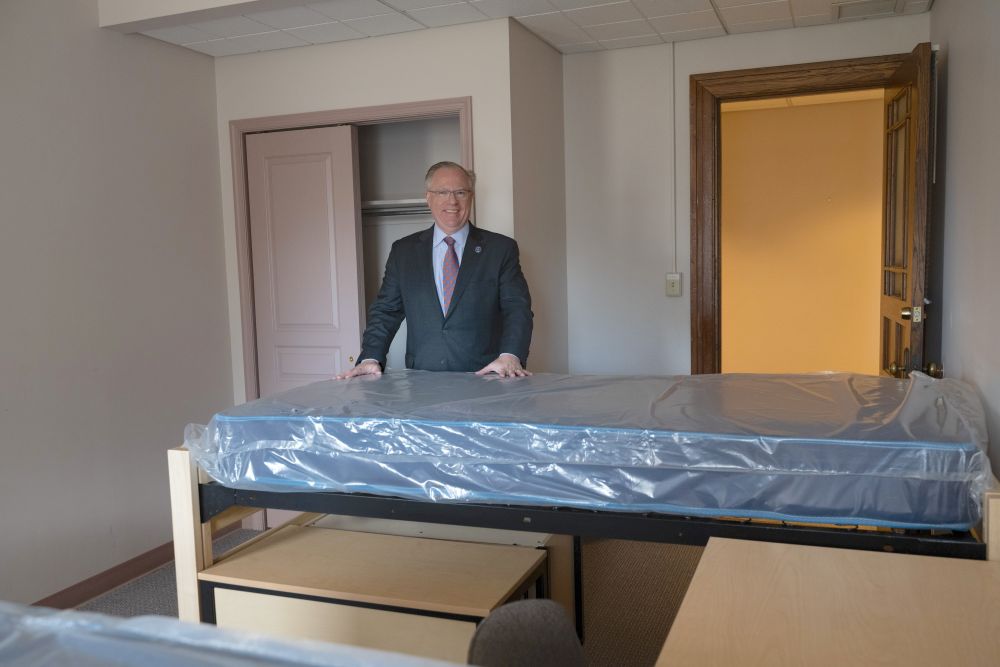
Neumann University President Chris Domes stands in a newly converted room in 2022, when university students were about to move into the Sisters of St. Francis of Philadelphia's motherhouse for the first time. (Courtesy of Andrea Cipriani Mecchi)
'A pleasant relationship'
Dougherty said there was never any intention to gain vocations by housing Neumann students in the community's motherhouse, and none have happened so far, but the young men and women have found a new appreciation for religious life.
"One or two attend Mass all the time with the sisters," she said. "They've developed some nice friendships."
And the sisters are fine sharing a building with students six decades younger — Dougherty said she has found photos of sisters dancing at students' parties. Even though the students are separated from the sisters' living spaces, they're respectful, doing things like turning down their music at night, she said.
The university also uses the motherhouse chapel for major events such as the baccalaureate Mass, which brings hundreds of students and parents to its sacred space.
"It's really a pleasant relationship," Dougherty said. "Much better than I ever anticipated."