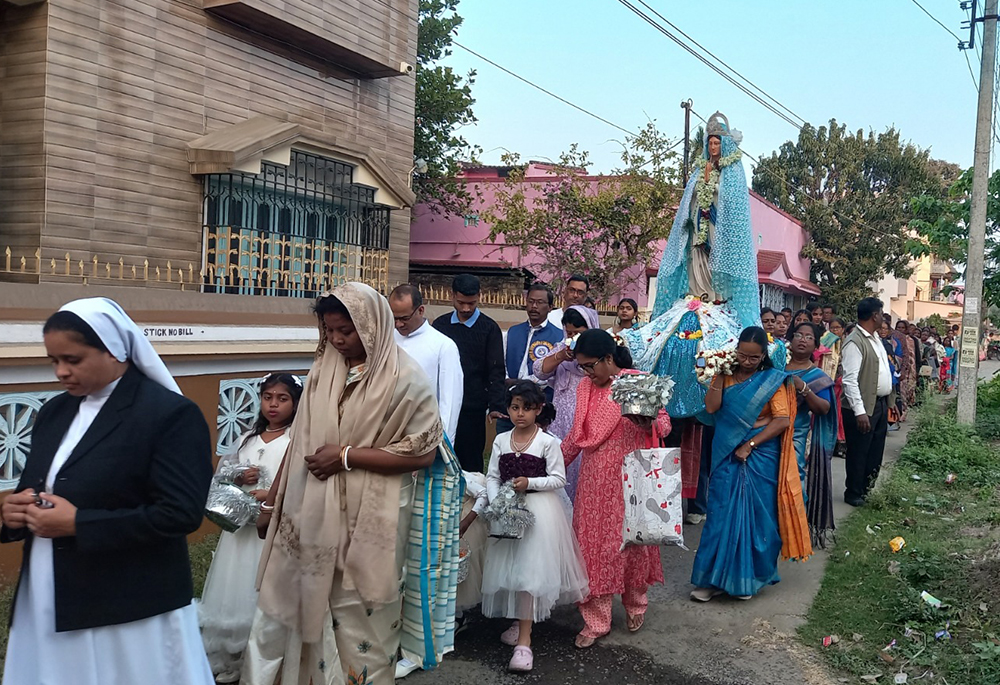
Salesian Sr. Rose Mary leads a Marian procession in connection with a Marian festival in a village near the Basilica of the Holy Rosary parish at Bandel, West Bengal state. (Courtesy of Fr. John Chalil)

by Thomas Scaria
Nuns from five congregations serve a 16th-century Marian shrine amid Hindu and Muslim villages in eastern India.
"The shrine draws more than a million pilgrims annually, [the] majority of them Hindus and Muslims. The greatest rush is during Christmas, Lent and the two-day Marian feast in May," said Sr. Jesline Rose, one of the six Missionary Sisters of Mary Immaculate serving at the Basilica of the Holy Rosary, Bandel, in West Bengal state.
The shrine, popularly known as the Bandel Church, includes a church and a monastery, both facing the Hooghly River. It is around 50 miles north of Kolkata, the capital of West Bengal state.
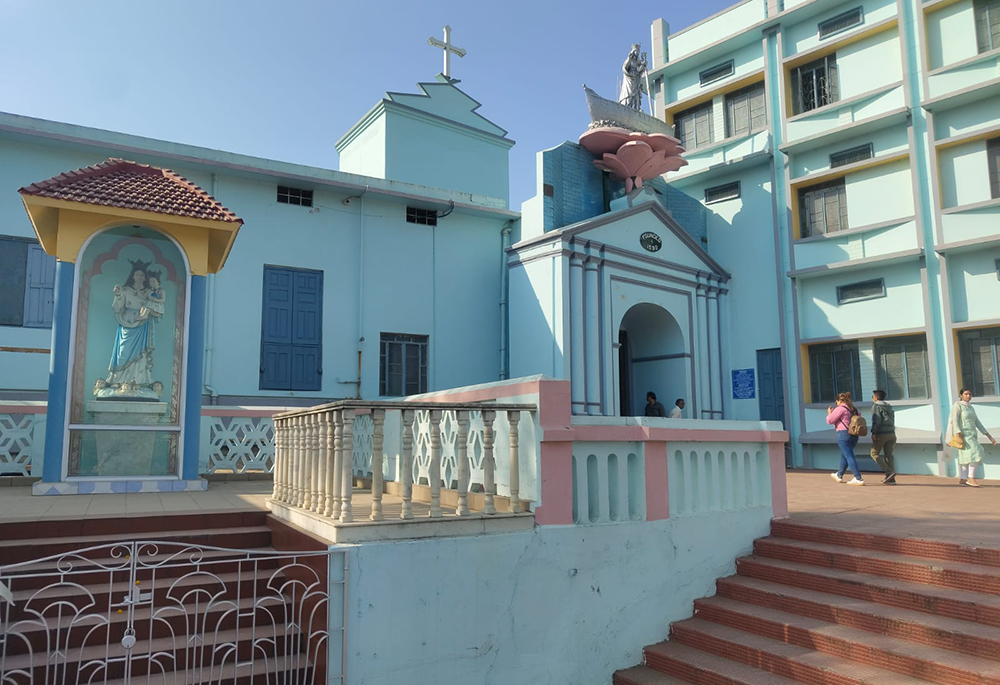
The original structure of the Basilica of the Holy Rosary was built in 1599 at Bandel, West Bengal. (Thomas Scaria)
Salesian Fr. John Chalil, the shrine rector, told Global Sisters Report that Augustinian friars built it in 1599 when the area was under Portuguese rule. He said that pilgrims come from all over India, and the nuns help cater to their various needs.
The Daughters of Mary Help of Christians manage Auxilium High School in the shrine complex, and the Missionary Sisters of Mary Help of Christians conduct counseling for pilgrims and community development programs in neighboring villages.
Mother Teresa's Missionaries of Charity offer pilgrims prayer support, and the Sisters Adorers Handmaids of the Blessed Sacrament and of Charity attend to their health needs, Chalil explained.
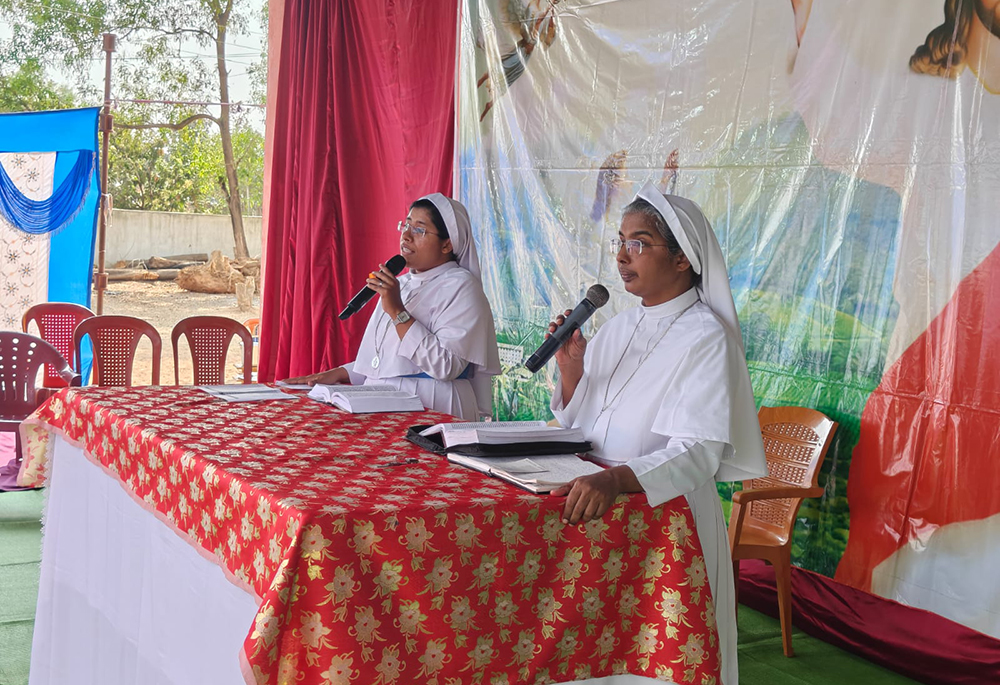
Missionary Sisters of Mary Immaculate Sr. Jesline Rose, right, conducts a prayer session at the Basilica of the Holy Rosary, Bandel, West Bengal. (Courtesy of Sr. Jesline Rose)
Rose, a preacher and spiritual counselor, said her congregation is happy to serve the shrine since Marian devotion is part of their charism.
Pilgrims from all religions attend various spiritual services in the shrine as they venerate Mother Mary as their spiritual mother, the 52-year-old nun told Global Sisters Report on Feb. 10.
"At least 10,000 people attended the Way of the Cross on Lent Fridays," she said, adding that people come to the shrine for spiritual nourishment, and their religious differences do not interfere with one another. The shrine's neighbors also help build an interreligious community that fosters peace and harmony.
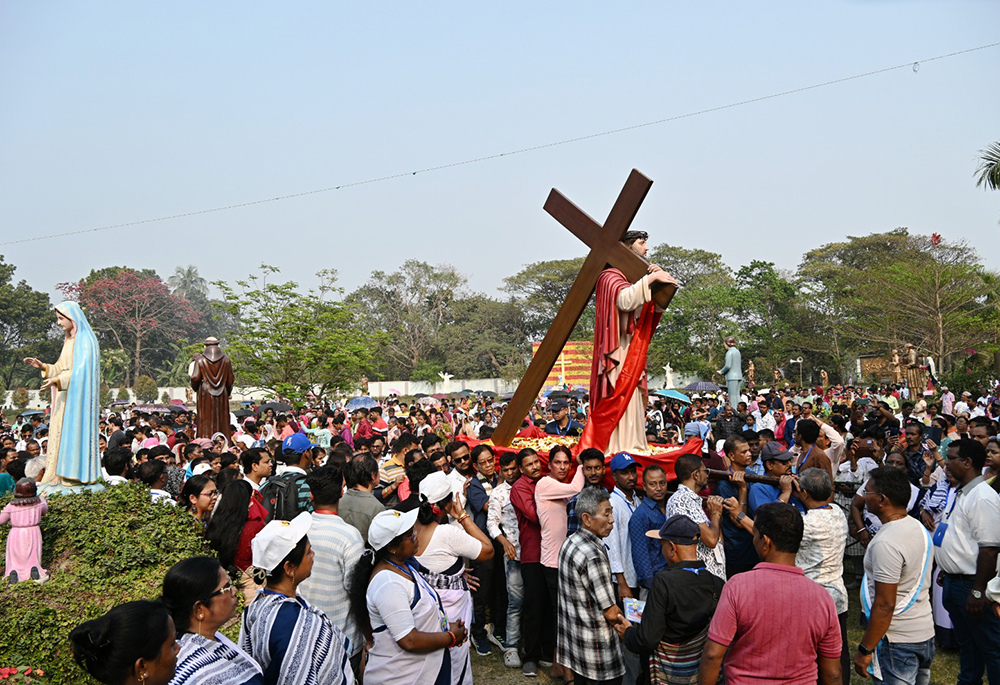
Pilgrims attend the Way of the Cross procession at the Basilica of the Holy Rosary, Bandel, in West Bengal. (Courtesy of Fr. John Chalil)
The shrine's biggest attraction is the statue of Our Lady of Happy Voyage, installed four centuries ago.
"One of our ministries is to facilitate the veneration of the miraculous statue among the pilgrims," Rose said, adding that they usually visit the statue, spend silent hours at the adoration chapel, participate in liturgical services, and interact with priests and sisters.
Other nuns from her congregation manage spiritual animation and retreats, help in liturgical services and provide pastoral care to neighboring villages.
Chalil said the five congregations help promote sectarian harmony among the shrine's neighbors, especially as the country has seen growing animosity between Hindus and Muslims.
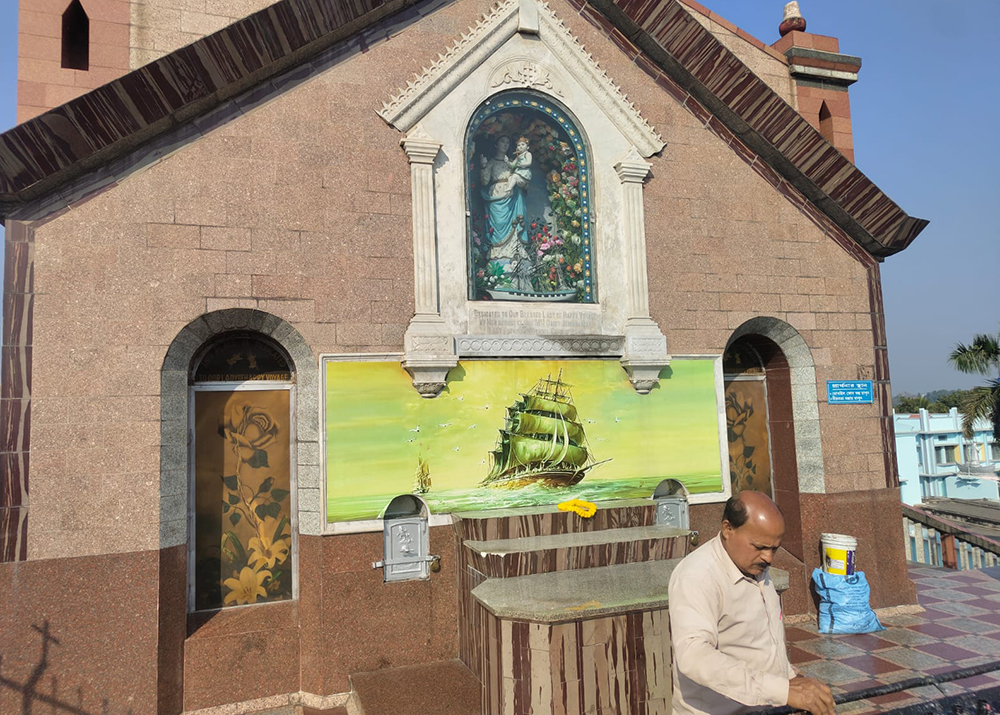
A volunteer cleans a candle stand in front of the statue of Our Lady of Happy Voyage at the Basilica of the Holy Rosary at Bandel, West Bengal state. (George Kommathil)
Sr. Mary Prema, the superior of the Missionaries of Charity's contemplative wing in Bandel, said they promote the rosary among the pilgrims as Mother Teresa was deeply devoted to Mother Mary. Mother Teresa herself visited Bandel Church in 1995.
"Our neighbors have great reverence for Mother Teresa," Prema told GSR, whose convent sits in a Hindu village, two miles away from the shrine.
"We are contemplatives, and we offer prayers for the pilgrims," she added.
Advertisement
She explained that pilgrims write their prayer requests and put them in a box. "Our sisters pick them and pray for their intentions," she explained.
The Missionaries of Charity also visit Hindu families around the shrine and pray for the sick and elderly.
Sr. Philo Parackal, a former superior general of the Missionary Sisters of Mary Help of Christians, said their sisters have served the pilgrims for the past 30 years.
"Our two sisters are in the shrine full-time to help the pilgrims," said Parackal, the current superior of her convent in Bandel.
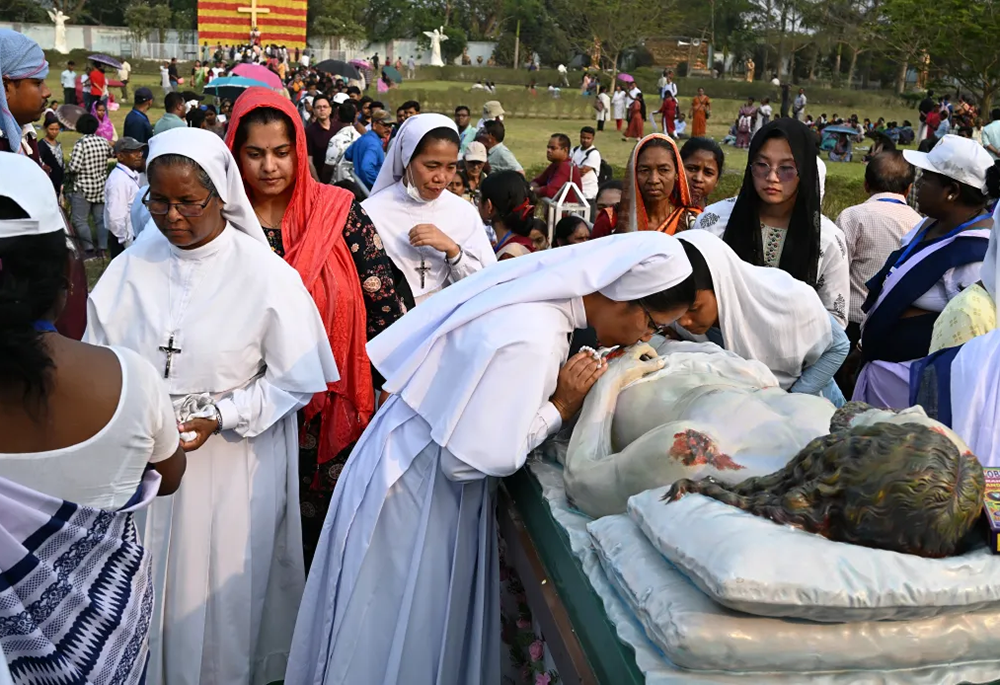
A group of the Missionary Sisters of Mary Help of Christians attends the Way of the Cross at the Basilica of the Holy Rosary, Bandel, West Bengal. (Fr. John Chalil)
Her congregation first came to the shrine in 1995, and since then, their nuns have conducted family apostolates and assisted with the shrine's liturgical life.
She said their congregation has set up a hostel near the shrine for girls from poor families. They also impart vocational training for girls from neighboring villages.
"Most students are Hindus, and we support them until they get a job and settle in life," Parackal told GSR. They also visit families regularly as part of their family apostolate.
The Daughters of Mary Help of Christians mentor students to live out Christian values, organize community rosaries and strengthen lay pilgrim associations.
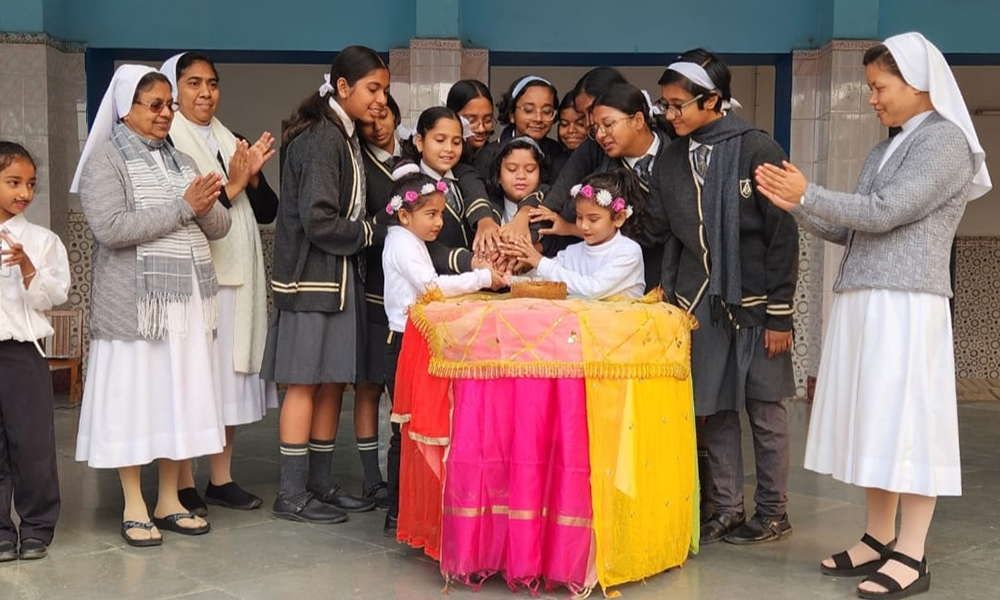
Children celebrate a birthday at the Auxilium High School in Bandel, West Bengal state. Sr. Celine Alexander (second from left) is the superior of the local convent that includes seven sisters. (Courtesy of Sr. Celine Alexander)
Sr. Celine Alexander, the superior of her convent in Bandel, said they have integrated Marian devotion in the curriculum of Auxilium High School and promote community devotion to Our Lady of Happy Voyage.
She said Marian devotion in Bandel Church was popularized by Italian Salesian missionary Fr. Louis Gobetti, who had served in Bandel for 25 years.
"By the time he died in 2011, he had established four new convents around the shrine to serve the pilgrims," Alexander told GSR.
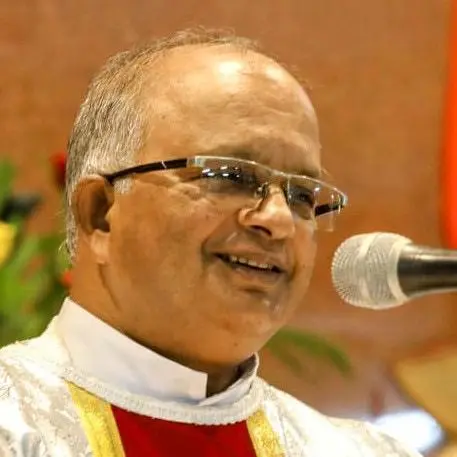
Salesian Fr. John Chalil (Courtesy of Fr. John Chalil)
The shrine community is spread over several villages, and each village is named after one of the Marian apparitions.
"Our students also carry the Marian devotion to their homes," Alexander said.
The Sisters Adorers, who arrived at the shrine in 1992, integrate Marian devotion into their community development work in nearby villages, social service projects, home visits and catechism classes.
"Their Eucharistic adoration, women's empowerment and a contemplative spiritual life are all aligned with Marian veneration," Chalil explained.
He said the nuns attached to the shrine ensure that it remains a "thriving center of pilgrimage and faith for our visitors."
He added that almost 90% of the pilgrims are Hindus and Muslims. The Bandel parish has more than 1,500 Catholic families, and the nuns cater to their spiritual needs.
The priest said that Hindu pilgrims contribute in different ways to support the shrine. The Stations of the Cross in the shrine were designed and installed by Subrata Ganguly, a Hindu. "The 14 stations of the cross attract huge crowds during Lent," said Ganguly, who professed to GSR "an ardent devotion" to Mother Mary.
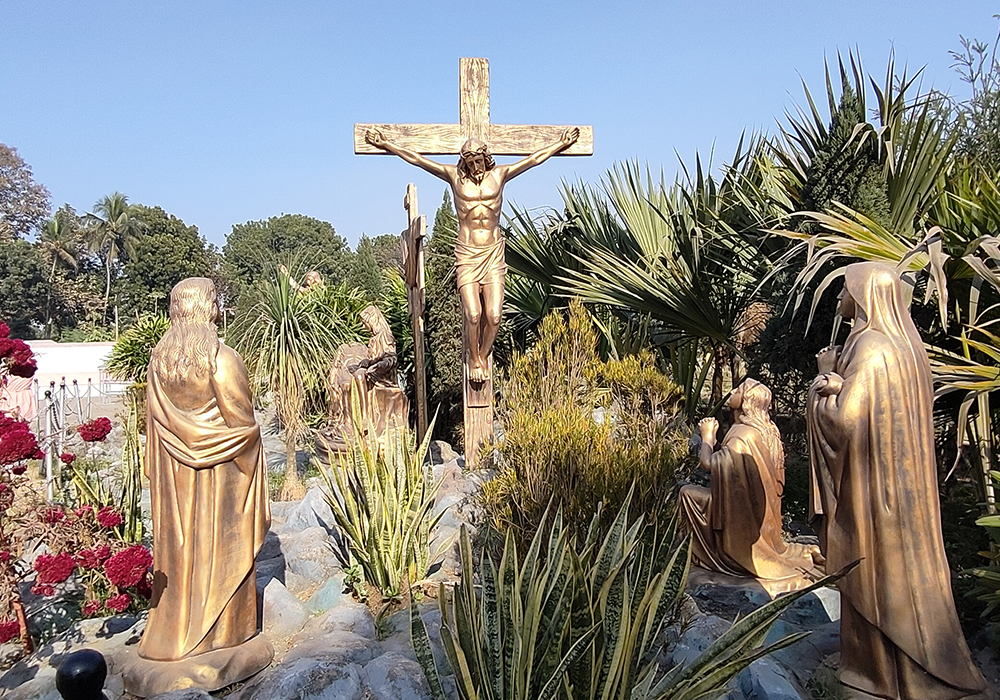
A statue representing one of the Stations of the Cross at the Basilica of the Holy Rosary, Bandel, West Bengal. Almost 90% of pilgrims visiting the shrine are Hindus and Muslims, according to Salesian Fr. John Chalil, shrine rector. (Thomas Scaria)
Chalil said the shrine remains a center of interreligious harmony. The state government decorates the church on both Christmas and Easter, and its tourism department promotes the shrine as a must-visit place.
Sister Lucilla (single name), the provincial of the Daughters of St. Mary of Leuca from Madurai, southern India, who visited the shrine with some 20 members of her congregation in February, expressed surprise at the pilgrims' simple faith.
"We saw people of various faiths pray in the shrine and interact with the sisters," she said.