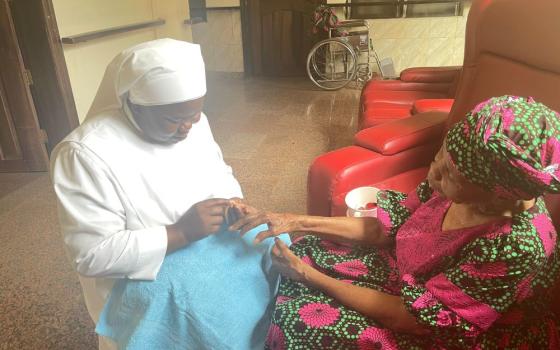
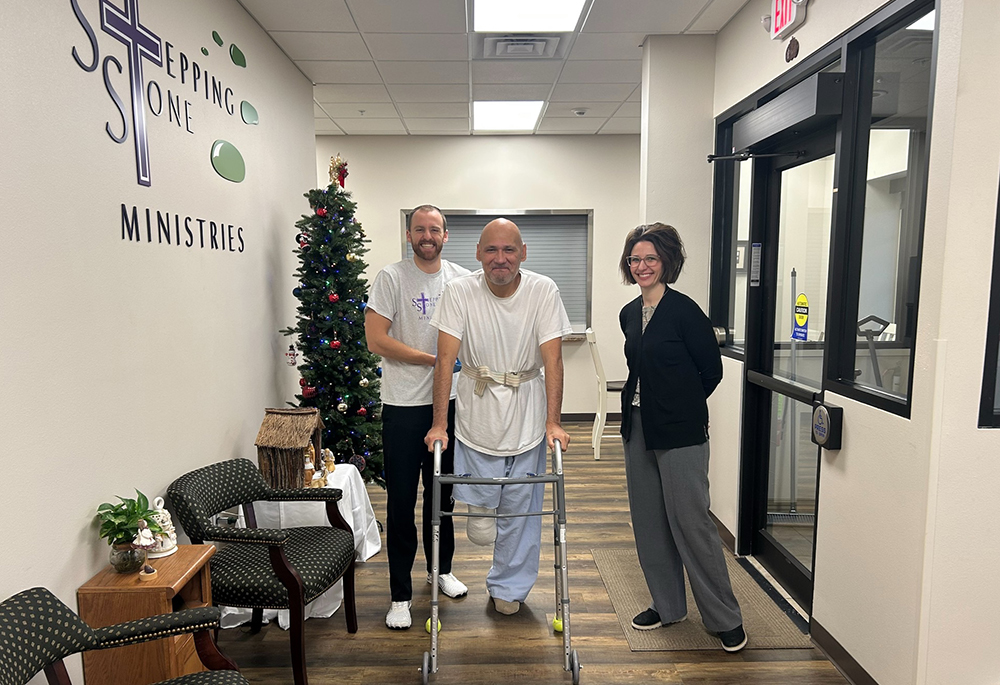
Physical therapy student Major Kelley, left, and physical therapy instructor Michelle Keller assist Stepping Stone Medical Respite resident Marlin Chase. (Courtesy of Sr. Idelle Badt)
by Jennifer Szweda Jordan
Fifty-nine-year-old Lonny Nix lived for a year in a tent in Bismarck, North Dakota, where winter temperatures fall well below zero.
One cold morning, Nix couldn't catch his breath. He took a bus to a hospital, where he underwent a quadruple bypass. He didn't know where he'd go when his hospital stay ended. But his doctor introduced him to Stepping Stone Medical Respite, for people who are homeless and who need to recuperate from illness or surgery. Nix moved to Stepping Stone when he left the hospital.
Stepping Stone is a new ministry led by social worker Sr. Idelle Badt, of the Benedictine Sisters of Annunciation Monastery. Her community also helped start Ministry on the Margins, offering support to people leaving prison and those facing homelessness. Badt noticed that when people who are homeless are discharged from hospitals, "they're going to end up right back in the hospital or sicker than they were because they're still too ill to recover on the street."
This was the case for Nix. He needed more care than he realized after arriving at Stepping Stone. Fluid built up in his lungs. Respite staff took him to the emergency room and then brought him back after the fluid was drained.
"There's no way I could have went out on the street and made it," Nix said.
The area's homeless shelter, Badt said, is not able to medically support people discharged from the hospital or allow them to rest throughout the day. Since the COVID-19 pandemic, the shelter only allows overnight stays.
Medical respite centers exist to confront this need throughout the U.S. According to the National Health Care for the Homeless Council, more than 240 medical respite programs and about 300 Health Care for the Homeless (HCH) health centers serve approximately 1 million people each year. When Badt approached her community, they got on board.
The Benedictine Sisters have a long history of serving North Dakota in education and healthcare.
"We weren't founded to do any particular ministry," said Sr. Nicole Kunze, prioress of Annunciation Monastery. "St. Benedict calls us to respond to the needs of the community, and we've been doing that for almost 150 years."
The demographics of people arriving at Stepping Stone are predominantly those in their late 50s and older. Several moved to the area to work in oil fields.
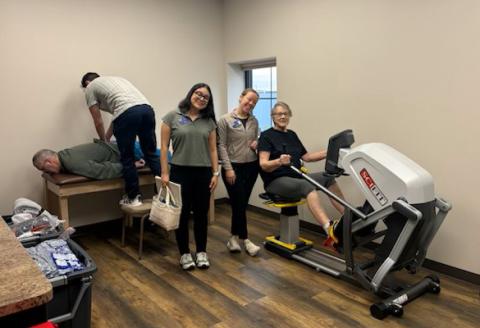
Physical therapy students work with Stepping Stone residents. Therapy equipment was provided by a grant from the Mt. Saint Benedict Endowment, Sisters of St. Benedict, Crookston, Minnesota. (Courtesy of Sr. Idelle Badt)
"The majority of them have worked, but it was a series of medical issues that they can no longer work," Badt said. "We've also seen a lot of elderly people show up to us that have been scammed. They've lost their entire life savings."
Stepping Stone residents have benefited from the proximity of the hospital and college established by the Benedictine Sisters of Annunciation Monastery. University of Mary students provide physical and occupational therapy to residents of Stepping Stone. Catholic Health Initiatives St. Alexius Health Bismarck medical center has referred patients like Nix to Stepping Stone.
The broader community has been supportive of the ministry, too. When the site initially under renovation for the respite center was destroyed in a fire, an anonymous donor offered a new building. And when Stepping Stone's dining room table became too small for those living at the center, a donor responded to Badt's call for a larger one.
Bringing everyone together at the table aligns with the Benedictine charism of hospitality.
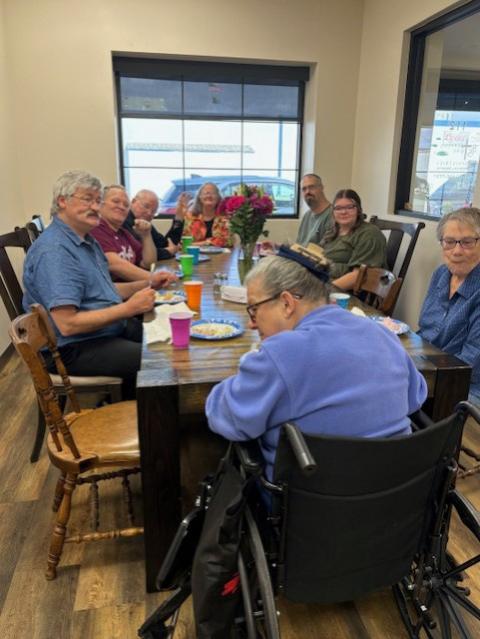
Guests enjoying their Easter dinner at the community's new dining table at the Stepping Stone Medical Respite. (Courtesy of Sr. Idelle Badt)
"We want them to model family while we're here," Badt said. "All the staff eat with them at every meal." The residents, Badt said, are naturally forming cohorts that support each other.
"They do so well together, and they look out for each other," she said. "If somebody's not feeling well, they can notice, 'He's not doing too well today, can you go check on him?' "
Stepping Stone also works to find housing for residents after their stay. Because of the proximity to the lucrative oil production fields, Badt said, housing prices are high. And residents don't always have good credit histories, and may have criminal records. "They're not easily going to be able to get into normal housing," Badt said. But residents are finding they might be able to help each other navigate housing.
"None of them gets enough money to rent an apartment by themselves. But if they pooled it, they could," Badt said.
Advertisement
Stepping Stone has already inspired a similar ministry in Youngstown, Ohio, called Respite of Hope. It was spearheaded by an associate of the Sisters of the Humility of Mary, Dr. Melinda Smith, recently retired from practicing obstetrics and gynecology. She was looking for her next mission when she visited Bismarck and saw a Benedictine sisters flyer about Stepping Stone.
"It was like one of those lightning bolt moments," Smith said. She knew God was at work. Smith brought together leaders of the Sisters of Humility of Mary, Ursuline Sisters, and other Catholic health and social service organizations to bring the program to fruition. Catholic Charities Regional Agency in Ohio now manages the ministry. Like Stepping Stone, it can accommodate up to eight people.
Back in Bismarck, Nix is close to moving into an apartment. He said he doesn't want to leave. However, Stepping Stone hired him to work there a few days a week to sit with the residents and possibly cook for them. He'll be able to offer the Benedictine hospitality he received to others.
"My life's been turned around by them," Nix said. "It's the best experience I've had in probably my whole life."