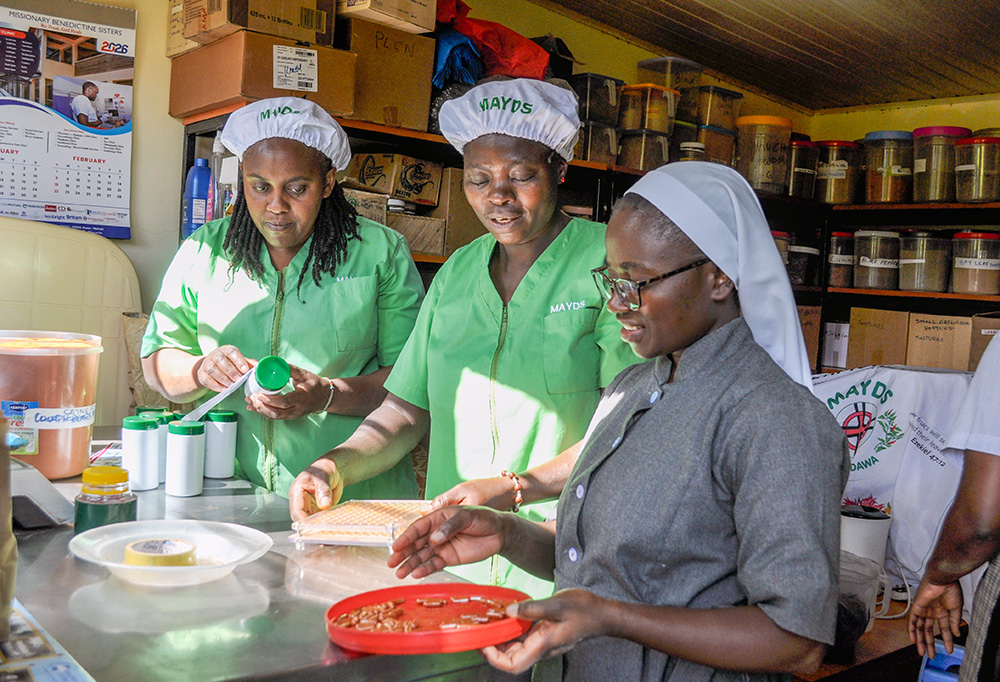
Sr. Mary Grace, a postulant of the Missionary Benedictine Sisters, and staff make cayenne pepper capsules at the Medicine at Your Door Step production unit in Karen, Nairobi, Kenya. (Lourine Oluoch)
by Lourine Oluoch
A small shop right inside the gate of the Subiaco Retreat Centre welcomes visitors to a world of herbal remedies. Essential oils and tinctures, infused honey, baobab powder, ground guava leaves, activated charcoal, stinging nettle powder, moringa powder, rosemary leaves, eucalyptus oils, cayenne pepper, lemongrass, artemisia powder, dates, kombucha, and more are found here as the fragrance of eucalyptus from the attached production unit perfumes the air.
"There is a lot of herbal medicine that we do not know about. Even if we step outside this room, there will be medicine right outside the door, only we may not know that it is medicine," said Sr. Lioba Kibor, the director of Medicine at Your Door Step, a project of the Missionary Benedictine Sisters in Kenya.
Clients arrive on foot, on motorcycles and in cars to visit the center, located in Karen, a suburb of Nairobi.
"We are a bit far from the road, but people still come. Some are referred from the hospital, but the majority are those who want to improve their health and they have heard that we have herbs that can help them," Kibor told Global Sisters Report. "Our presence is mostly spread by word of mouth. Those who have used the herbal medicine tell others, and they keep passing on the word."
'You mean this plant that we have been stepping on at our door step is medicine? This shrub that we cut and use for sweeping the compound is medicine?'
A decade ago, the Benedictine Sisters running the retreat center realized that they were hosting a unique group. Monthly, a team from Trust for Indigenous Culture and Health would come in to train groups from across the country on Indigenous culture and traditions. Some of that training involved herbal medicine.
""Someone would say, 'We are from Mombasa and we use this herb to treat this kind of ailment' and so on," said Kibor.
The late Sr. Francesca Syombesa Kaesa, who founded Medicine at Your Door Step in 2015, asked the trainers about their activities and got sisters invited to the sessions.
"They trained us on how to identify, prepare and use the herbs," Kibor said. "We learned to make the ointments and oils which we would use on ourselves. The trainers would ask us to walk around the compound to collect a certain type of plant. We would be surprised to find that a tree or a shrub that we had just been seeing around the compound could help relieve a condition."
"That is how we came up with the name Medicine at Your Door Step. When they started showing us the herbs, we were surprised. You mean this plant that we have been stepping on at our door step is medicine? This shrub that we cut and use for sweeping the compound is medicine?" she said.
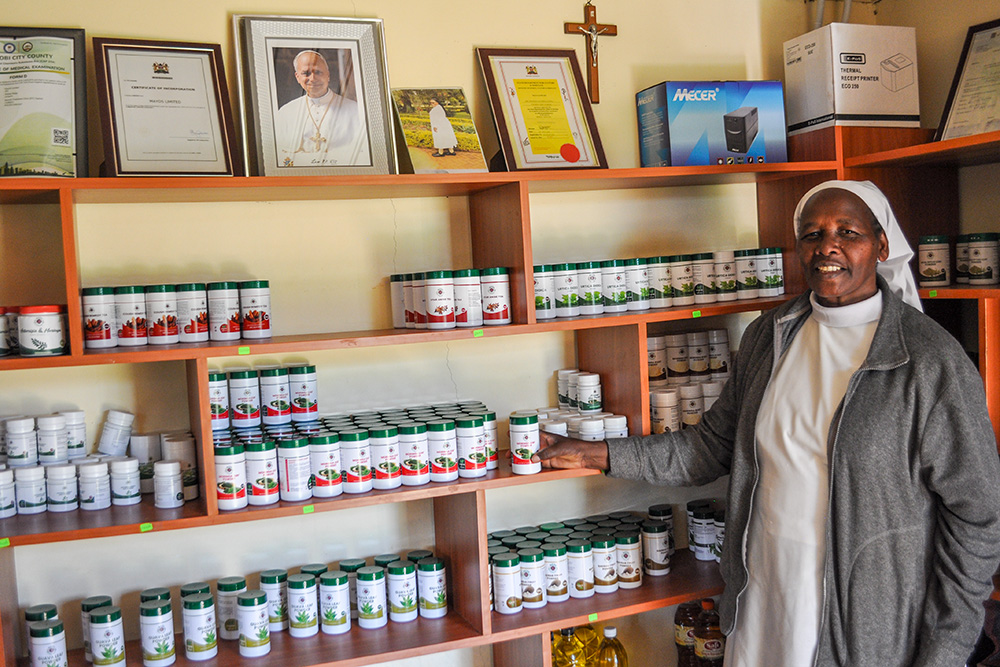
Sr. Lioba Kibor, a Missionary Benedictine Sister in Kenya, shows some of the herbal products at the Medicine at Your Door Step shop. She says all the products are organic and given in the right dosage. (Lourine Oluoch)
Later, Kaesa trained for six months in herbal medicines with Rural Extension With Africa's Poor, an organization that teaches churches and other Christian groups how to help the rural poor. She set up a small shelf where she would display and sell the herbal medicine to those who were coming to the center for retreats.
The Rural Extension With Africa's Poor training helped the sisters get the right dosages for the herbal remedies.
"Traditionally, you would be told to pick and boil a handful of herbs," Kibor said. "Your hand is big, mine is small, so you go and you cannot be sure of the right dosage. ... However, if we dry and process it into powder form it is easy to know the dosage."
Today, Medicine at Your Door Step has more than 50 products and is certified to provide nutrition supplements under Kenya's State Department for Culture, the Arts and Heritage as cultural practitioners in the area of herbal medicine. They grow herbs on a piece of land provided by the congregation at the Subiaco Retreat Centre and at St. Odilia's Dispensary. In the future, the sisters hope to set up a factory on a bigger piece of land in nearby Gilgil.
Advertisement
The sisters process and package most of the herbal remedies on site, and ensure that all of their products are organic and chemical free.
"Our herbs are like food supplements: a blend of herbs, spices and fruits to boost immunity," said Kibor. "We treat by balancing the food in the body. When the body is balanced, you are ready to fight whatever attacks your body."
Kibor noted several herbal remedies, such as pepper ointment, which reduces inflammation and relieves nerve pain; artemisia, which helps treat malaria, hormonal imbalances and respiratory issues; and guava leaves, which balance sugars, help with weight loss, and are anti-inflammatory and antioxidant.
The Missionary Benedictine Sisters, who also run St. Odilia's Dispensary in Karen and St. Scholastica Uzima Hospital in Kasarani, do not discourage people from taking conventional medicine.
"We don't tell people to stop taking their conventional medicine," Kibor said. " Herbal medicine does not work instantly. It slowly repairs whatever is not working, and as it works, you will realize you do not need the conventional medicine as much."
Kibor, a trained nurse, told GSR that she makes sure patients get lab tests or ultrasounds before she dispenses any herbal remedies.
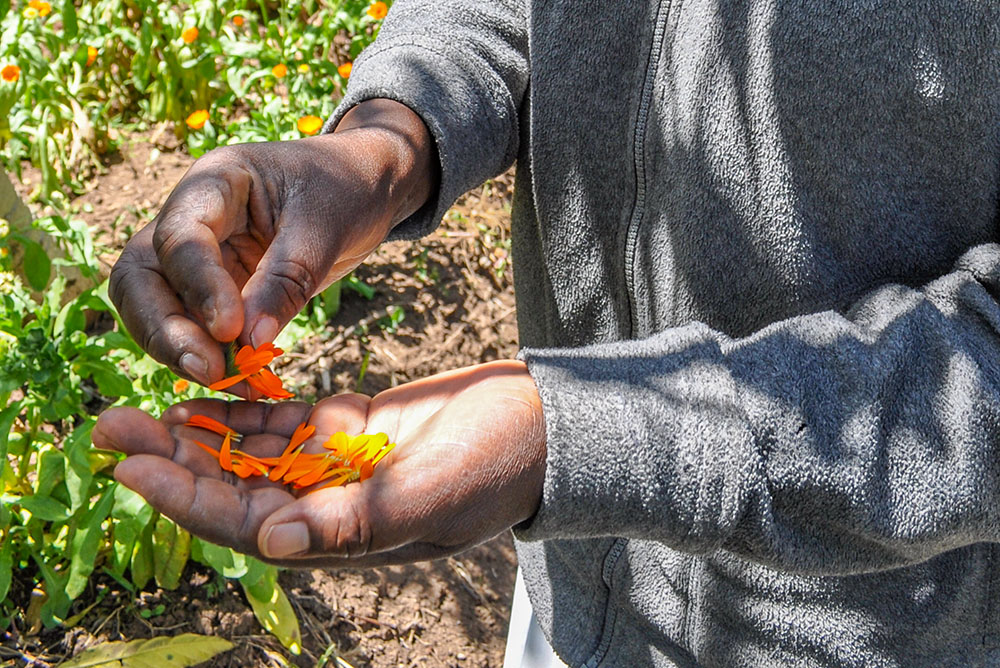
Sr. Lioba Kibor, a Missionary Benedictine Sister, holds petals of calendula flowers that are used to make calendula oil. The oil can be used as an aftershave, as lip balm, and for dry skin. (Lourine Oluoch)
Sr. Mary Joseph Mbula, a Missionary Benedictine sister who works in Uganda, told GSR the herbal remedies have given her relief alongside conventional medicine.
"I am a breast cancer survivor for the last 17 years. Besides the conventional treatmentk, I have also used herbal treatments. I used artemisia after my first surgery in 2009 and it helped me especially with nausea, while undergoing chemotherapy and not to feel so weak," said Mbula, a psychospiritual counselor who journeys with cancer patients. "Because it has helped me personally, when I meet people who have started chemo I will encourage them to take a bit of Artemisia in tea or drinking water to overcome the challenge of vomiting and feeling nauseated. It helps."
She has also used moringa root to help with insomnia, calendula oil to keep her skin, feet and lips moisturized after chemo, and rosella tea as a blood booster.
"I don't stop using my medication to use the herbal [remedies] but when you ... know how to balance, it works concurrently without causing harm," she said.
The Benedictine sisters are continuing to learn new plants. A sister from Bulgaria recently pointed out the calendula plant as a remedy for skin conditions.
"God has given us everything. It is only out of ignorance that we don't know," said Kibor.