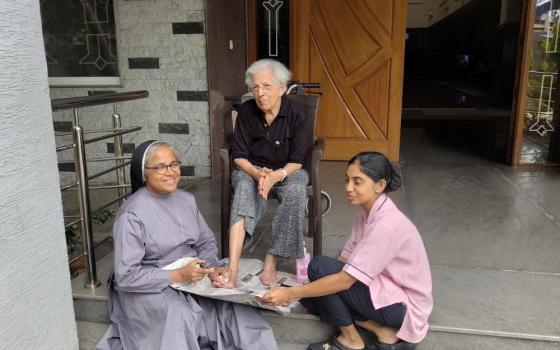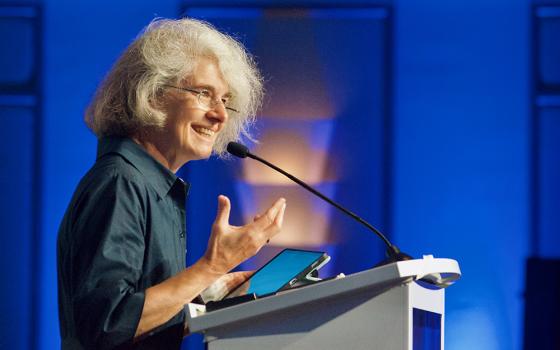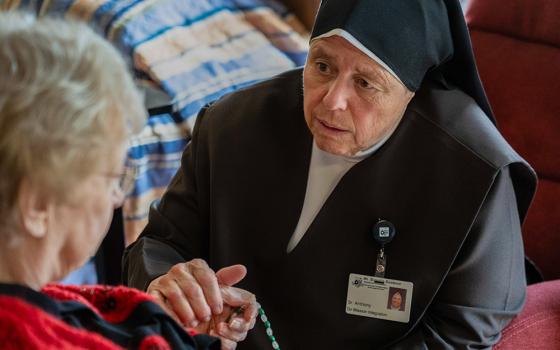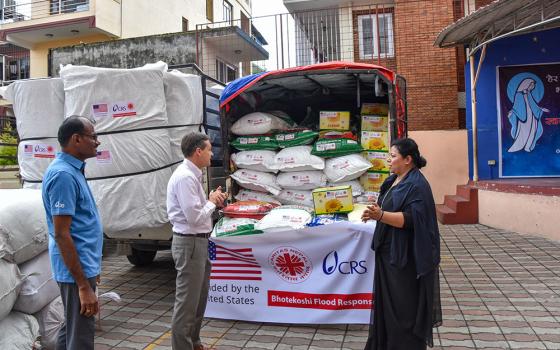
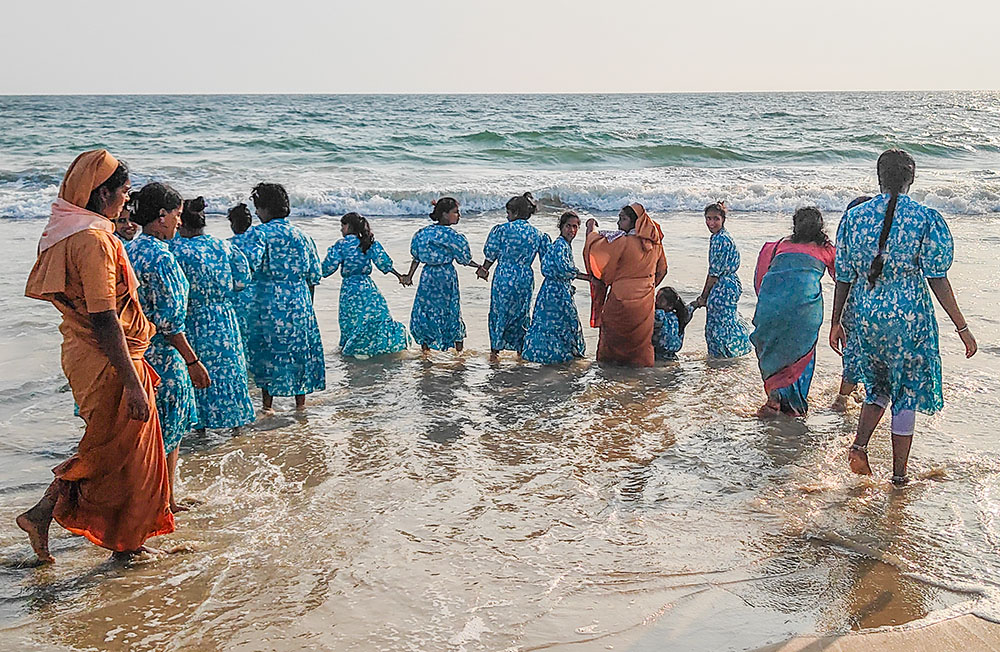
Children from the Infant Jesus Children's Home and Dinasevanasabha nuns enjoy a beach in Mangaluru, southern India. (Thomas Scaria)

by Thomas Scaria
Nuns at the Infant Jesus Children's Home in Bengaluru, southern India, were at a loss this summer.
While most residents of the center for children with HIV/AIDS, managed by the Dinasevanasabha (Servants of the Poor) congregation, went home for vacation, 22 stayed and had nowhere to go.
Sister Veronica, the center's superior, said that no one had sponsored the children's vacation trip this year as in the past.
"These children joined us as infants and grew up with us as our children. Their pain hurts us too," the 72-year-old nun said when Global Sisters Report visited the center in May.
One of the children at the center held the nun's hands and told the GSR reporter, "Uncle, take us somewhere for our holidays. We have no parents, no homes, no relatives."
Sister Veronica said the girl had come to them as a 2-year-old.
The girl, now a seventh-grader at a nearby school, said that she refers to Sister Veronica as "amma" (mother) and that Sister Veronica always finds a way to solve their problems.
Eventually, local supporters unexpectedly pooled money to sponsor the children's trip to Mangaluru, a port town some 220 miles west of Bengaluru, where they spent two days playing on beaches with three nuns.
"We experience such miracles every day as the help comes at the last moment," Sister Veronica said.
The Infant Jesus Children's Home at Kothannur, on the outskirts of Bengaluru, capital of Karnataka state, is a government-approved care home for children with HIV/AIDS.
Sister Veronica said they manage it with local donations and sponsorship.
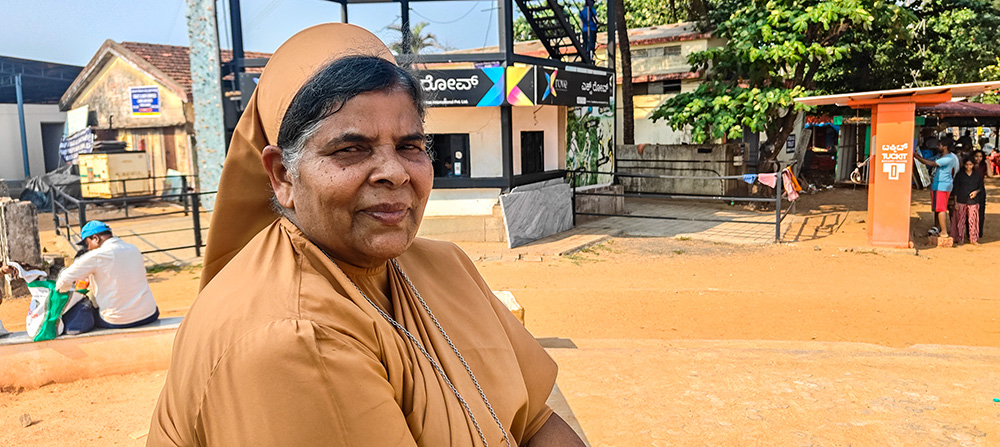
Dinasevanasabha Sister Veronica, superior of the Infant Jesus Children's Home in Bengaluru, southern India (Thomas Scaria)
The home was set up in 2001 by Mother Willigard Dinasevika, a German sister who was the congregation's second superior general.
"Two years after her term, Mother Willigard came to Bengaluru and started this home as no one was willing to shelter HIV children then," recalled Sister Veronica, who served the center first during 2005-2013 and returned in 2023 as its director.
Sister Veronica said their founder, Mother Petra Moennigmann, a German Ursuline nun and friend of Dinasevika, started the congregation in 1969 to help "the most impoverished, vulnerable and marginalized people."
"She had come to Kerala [Karnataka's southern neighbor] as a Caritas volunteer, and was touched by the miseries of villagers there," Sister Veronica said.
Moennigmann changed her surname to "Dinadasi" (handmaid of the poor). By the time she died in a car accident on June 5, 1976, the congregation had 300 nuns living in 20 convents in Kerala.
"Today, we have 600 members in 86 convents, spread over four provinces serving in 10 states of India, Germany, Italy and the United States," Sister Veronica added.
They now serve the physically and mentally disabled, the elderly, women in distress, and children with HIV/AIDS.
Sister Veronica said that at the Infant Jesus Children's Home, they continue the same charism of helping the downtrodden and outcast.
"Our home has successfully reintegrated more than 125 children into society in the past 25 years. Many are now adults, married and settled with jobs."
Sister Ashly, the center's administrator, said that children's relatives refuse to accept them because of ignorance about the disease and stigma attached to it. The nuns at the center also struggle to find schools for the children and jobs after their education.
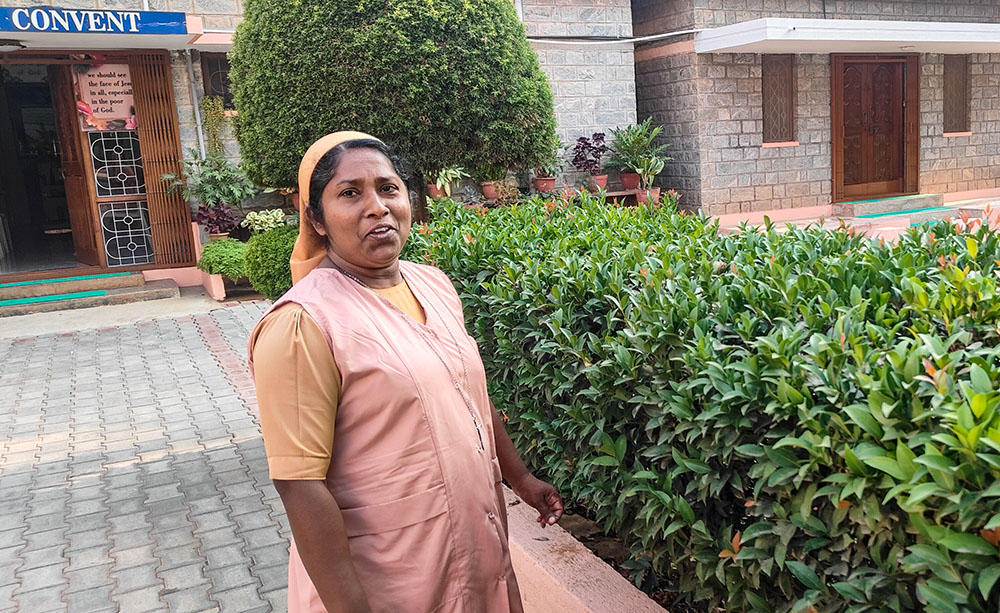
Dinasevanasabha Sister Ashly, the administrator of Infant Jesus Children's Home, at her congregation's convent in Bengaluru, southern India (Thomas Scaria)
"We visit the children's relatives to counsel them about the disease and convince them to accept the children back," she said.
Education and jobs help in the reintegration process, said the nun, who has served the center for the past 10 years. "Our main goal is to make the girls independent with jobs and instill in them self-esteem and confidence," she said.
Currently, the center looks after 76 children and 20 women. Most are HIV-positive.
Sister Ashly said the children at the center are either orphans or have been abandoned by their parents. Many were referred by the state government's Child Welfare Committee, which also monitors the children's growth in the center.
She said the children can remain healthy and active with quality food, antiretroviral therapy and other treatments. However, some experience anxiety disorders and depression.
"We take them to psychiatrists for regular checkups," Sister Ashly said.
"Our children are innocent victims of the dreaded virus as they contracted it at their birth," she added.
According to government policy, centers should not keep children after they are 18. "However, we could not abandon those above 18. So, we started Mercy Home in 2005 for women," she said.
Initially, she said, the nuns kept both boys and girls at the Infant Jesus Children's Home. However, they now relocate boys after the age of 6 to Snehasadan, a center managed by the Camillus Fathers, in compliance with government regulations.
Advertisement
Sister Veronica said federal government rules insist that children in institutional care homes should return to their relatives during vacation.
"[However], our children tell us that they experience isolation at their relatives' homes and ask us to bring them back soon," she added.
The nuns keep in touch with those who have left the center.
One of them, Thulasi Theresa, who had come to the center with an infant, now serves as a caretaker.
"My husband left me when I became pregnant, and to my shock, I found out that he had HIV/AIDS. Soon, my baby and I also tested positive," she told GSR with tears running down her cheeks.
The nuns, she added, not only accepted her but raised her daughter as their own. "They found her a good job and got her married recently," she added.
Sister Veronica said that social integration is their center's motto, and that the nuns recently helped 10 women find marriage partners with HIV-positive men who are receiving treatment.
Sister Veronica said they find matches from places managed by the church or nongovernmental organizations.
The children of these couples, she said, are not affected by HIV and "lead a happy life."
The nuns helped Smitha, Theresa's daughter, find a husband in 2021. "Now I want to raise my girl Kiara the way the sisters did for me, giving her love and care," Smitha said.
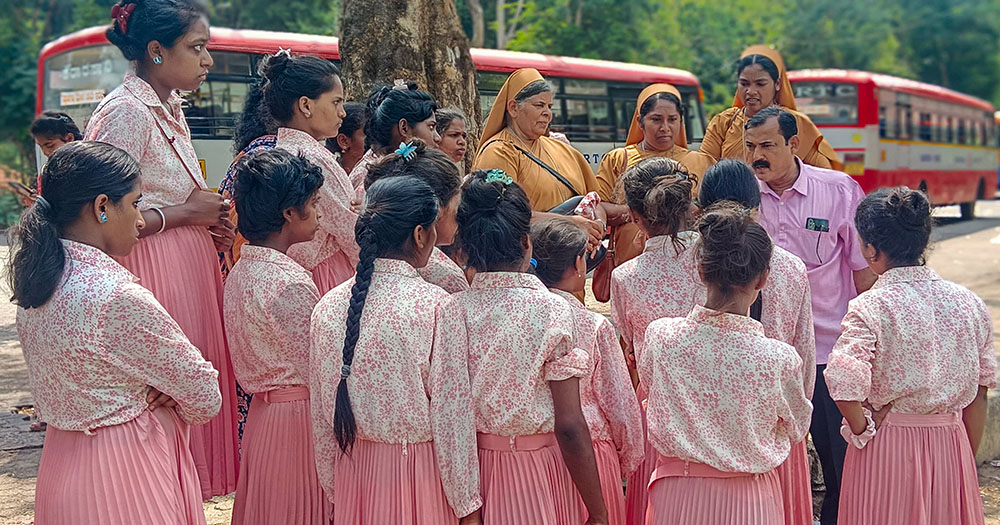
Vivek Vincent Pais, the director of Dharmasthala, a Jain center in Mangaluru, southern India, explains its history to children from the Infant Jesus Children's Home, while Sisters Veronica, Ashly and Aneesha accompany them. (Thomas Scaria)
The girls currently in the home support each other.
"I don't remember my parents, but [I] enjoy the sisters' care and my friends' company here," said the seventh-grader who spoke to GSR about their vacation.
Another girl, 14, said she missed her classmates during holidays.
"Maybe we are happier than those living in small homes with one or two siblings," she said before joining other girls to sing in the local Kannada language, glorifying life as a celebration.
One girl said she considers the Infant Jesus Children's Home as her real home because that's where she plays, prays, eats and spends the night with her friends.
Another girl joined the conversation with GSR after watering the garden. She said the girls are given various chores at the center.
"We like to do these small tasks and keep our home clean and beautiful," she said.
Rani Maria, a physically disabled young woman who is completing a bachelor's degree in computer applications, said she finds the center "a home filled with love, care and hope."
The center has received several awards of excellence.
In 2007, Germany awarded Dinasevika for setting up one of the best centers in India for children and women living with HIV.
It also received recognition for being the best child care institution in 2023 from a charitable trust in Karnataka.