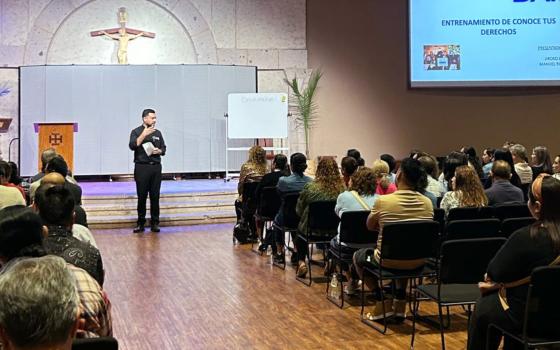
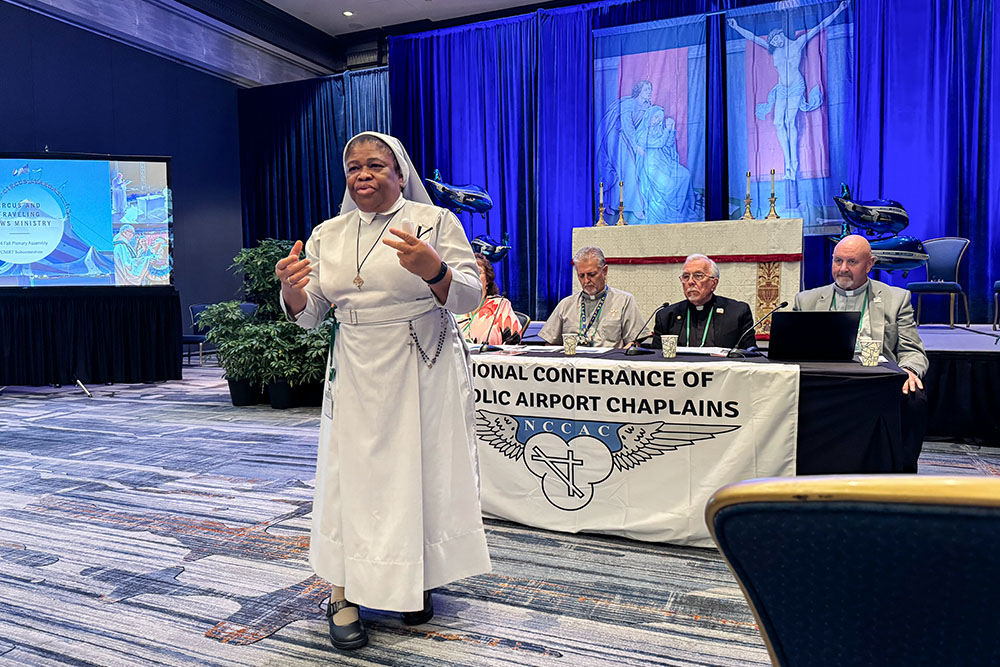
Sr. Joanna Okereke, assistant director of the U.S. Conference of Catholic Bishops’ Subcommittee on Pastoral Care of Migrants, Refugees and Travelers, speaks to a group of bishops Nov. 12, 2024, in Baltimore, about the different hidden communities the subcommittee works with. (GSR photo/ Rhina Guidos)
by Rhina Guidos
Sr. Joanna Okereke, a member of the Handmaids of the Holy Child Jesus, fulfilled a dream her mother was never allowed to pursue: to become a nun.
Captivated by sisters wearing white habits in her native Nigeria, Okereke's ambition in life was always clear, and as a child, she would often tell people, "I want to be a nun."
Now with more than 40 years as a woman religious under her belt, Okereke is the assistant director of the U.S. Conference of Catholic Bishops' Subcommittee on Pastoral Care of Migrants, Refugees and Travelers.
"God has been so good to me," she told Global Sisters Report.
She belongs to an international congregation founded by an Irish Sister of Charity who left England for Nigeria to found the Handmaids in 1923. Many of them are now missionaries like their founder, and serve in education, medical care, and social and pastoral work. In the U.S., Okereke has served as mission director and director of religious education in various dioceses.
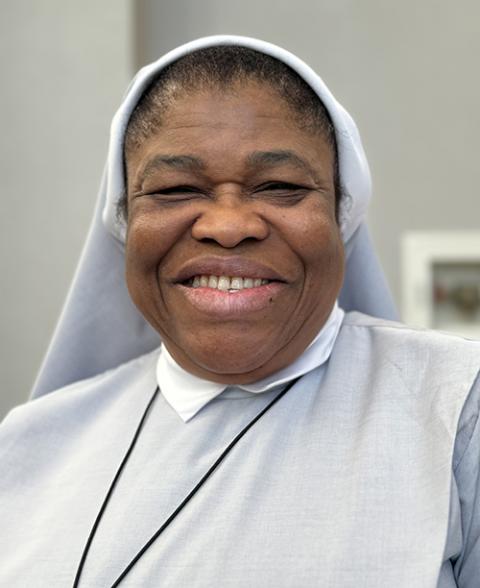
Sr. Joanna Okereke of the Handmaids of the Holy Child Jesus (GSR photo/Rhina Guidos)
"I'm also a chaplain by training. I was able to reach out and join the Leadership Conference of Women Religious to move around in various areas for conferences. And through that, I was able to meet a lot of priests, a lot of bishops who said, 'Oh, we really need your community,' " she recalled.
And during one of those meetings, they told her they were looking for a leader to work with migrants.
When she's not tending to people on the move, Okereke, who also is assistant director of cultural diversity in the church at the bishops' conference, plays an important role in organizing and supporting gatherings for Black and African Catholics in the U.S. She also educates Catholics — including bishops — on some of the hidden communities in the country.
GSR: Tell me a little bit about your work.
Okereke: Many migrants in this country have nobody to care for them in parishes, then you have the refugees. I do a lot of work in trying to reach out to these people, reach out to the parishes to see, "Please, can we help some refugees over here," like refugees from Sudan, from Congo, from all over.
And we also have people on the move. Many people don't understand what we mean by "people on the move." We have a lot of migrant farmworkers that travel here and there, seasonal workers, and we go to them. They don't have churches. They don't have the opportunity to be in a parish. They don't even have the opportunity to take care of their children in a stable home. So, they move around. We go with them.
We have also people who work at airports. We have also circus and traveling show ministries, and people move around, too, in those show ministries. Pope Francis called these people the people in the peripheries, and he told the shepherds and leaders, smell like the sheep. That's what I do.
Advertisement
As a pastoral caregiver, I am committed to these ministries that the bishops have assigned to me. And that's what necessitated us to provide seminars and workshops for bishops to tell them more about this ministry. Many bishops don't know this ministry exists.
What has been their reaction to it?
It was an eye-opener when we started doing this series of workshops for the bishops. I've done it for Stella Maris [an apostolate of the Catholic Church for the people of the sea]. They were so amazed at the nature of the work we do. We've also done it for migrant farmworkers. It was also great and the bishops were so excited.
Now we've continued this series of workshops. We create awareness for the bishops to know these ministries exist, that these people are in need.
How can they help?
If there's a priest available, if a deacon is available, they can assign deacons [to visit the itinerant groups in their communities and celebrate Mass or the liturgy]. They can train lay leaders and put them into these ministries to really help us in accompanying these most invisible people.
There is only so much that our office alone can do because these communities are many. And it's not only one location. So, we need leaders, we need deacons, we need the support of the bishops so that this ministry can continue to go on because these are the children of God and we have to draw closer to them and bring them closer to God.
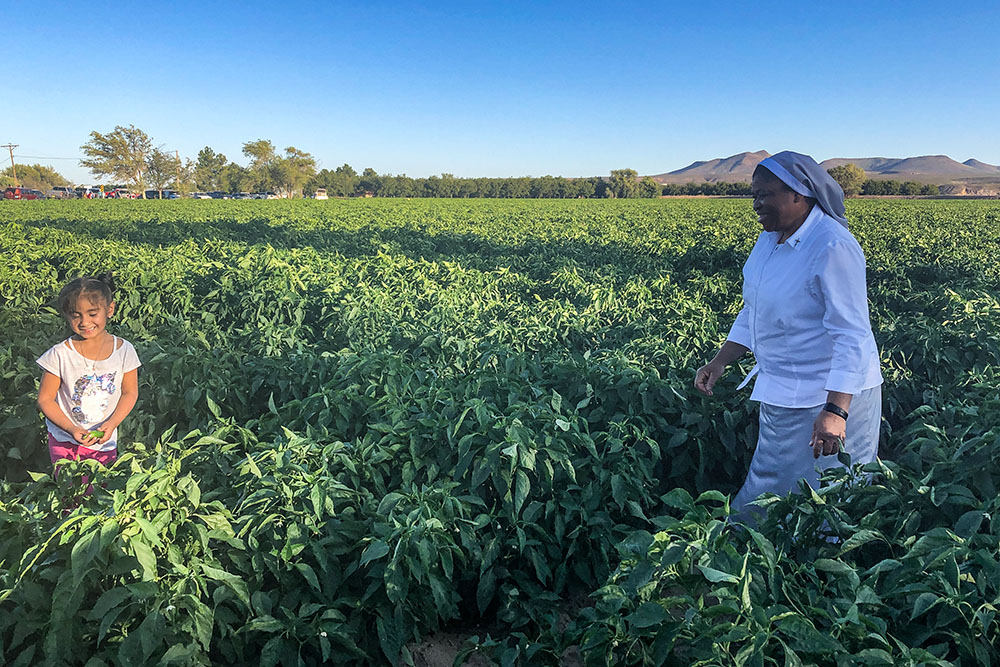
Sr. Joanna Okereke talks to a child in the chili fields of Hatch, New Mexico, Sept. 26, 2019, during a visit by U.S. bishops to farmworkers. (Courtesy of Joanna Okereke)
Tell me about your work with the ministry of the sea and circuses.
These are the people on the move. That's the nature of their lives. I see a lot of seafarers all year round. My subcommittee goes out into the sea, into the fields, into the farms, into ministries in areas like entertainment groups to make sure that we help these Catholics to still remain Catholics. They love it when they see us. They love it when we come and we celebrate Mass. They love it when we bring rosaries and they pray with us. They love it when we send them Bibles from all parts of the world, different countries.
I enjoy that. It's part of the mission of my congregation to be a pastoral caregiver for many people.
Your office also helped some of the ones that were stuck [on ships] during COVID, right?
Yes, during COVID our office mobilized a whole lot of teams of nurses and doctors to help people. Many were stranded in the sea without vaccines, without being able to go out. You can imagine what they experienced, but with our help and mobilizing this team of doctors and nurses, they were able to get them vaccinated.
Many of the migrant farmworkers were out in the field. We did not go hungry. We did not die of hunger because of them. They were back there in the farm, working. Many of them were catching COVID and still working, and nobody was caring for them. They were busy day and night while we were all hiding in our rooms and not coming out, but they were there producing for us.
Has it been difficult to do this ministry because of the sentiments and what's being said out there about migrants, and in this period of time in the country?
Yes, it has been so challenging and there have been a lot of stereotypes, a lot of racism. And these people are not accepted. Some say to them, "What have you come to do in this country? This is not your country." They forget that this is a country of immigrants. And all of us came to this country except the Native Americans. Sometimes we joke about it, but it's a fact.
So, there are a lot of challenges we are having in this area. We advocate for them and make them know that the church cares for them.