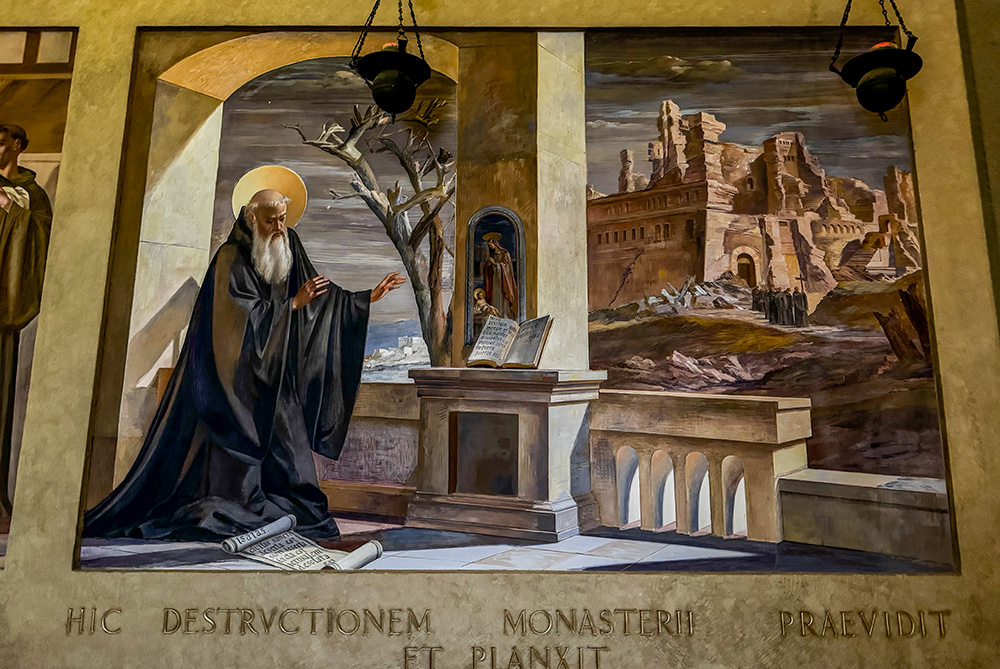
A fresco in the cell of St. Benedict at the Monastery of Monte Cassino in Italy depicts Benedict weeping after foreseeing the destruction of the monastery. The Latin inscription reads, "Here he foresaw and wept over the destruction of the monastery." (GSR photo/Helga Leija)

by Sr. Helen Mueting
Soon, we Benedictines will be celebrating the feast of St. Benedict. Unlike most saints, Benedict is privileged to have two feasts. On March 21, we celebrated his death; on July 11, we celebrate his life and the major influence that he had on monasticism and on the civilization of his time. Benedict is known as the father of Western monasticism and the patron saint of Europe. How did one man become so influential?
Benedict lived in a time of turmoil, probably much like our present time. In his time, his monasteries were preservers of civilization. They were safe havens that preserved literature and established agricultural technologies. They were sources of sustenance and relief for the pilgrims and the poor.
Benedict's Rule became the model for monasteries of his day. Known for its moderation and simplicity, it was easy for other monastic communities to follow. It also reflected a knowledge of the human condition with all its weaknesses as well as its ability to grow in spirituality.
The Benedictine model of ora et labora ("pray and work") has influenced the lives of men and women for more than 1,500 years. Balancing prayer and work is the daily task of each Benedictine monastic. Ten hallmarks help mold the Benedictine life, whether it be for the monastics themselves or for the institutions they have founded.
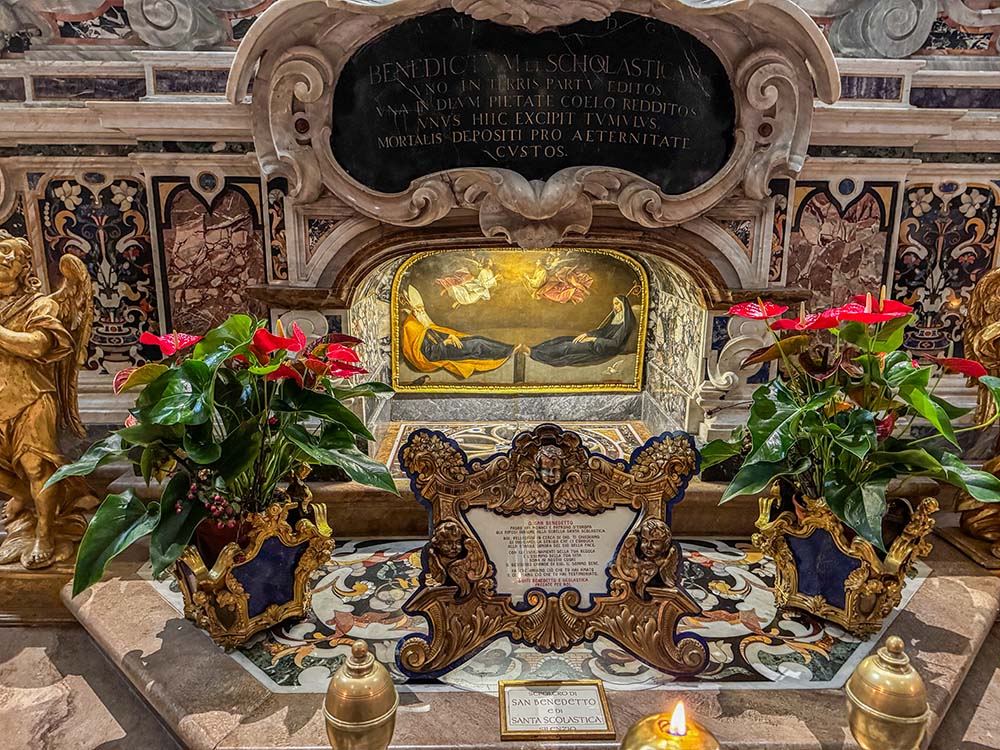
Tomb of St. Benedict and St. Scholastica at the Abbey of Monte Cassino in Italy in June 2026 (GSR photo/Helga Leija)
- Love of Christ and neighbor: Benedict asks his monks to treat everyone they meet as if they are Christ. Every person is to be shown respect, love and mercy.
- Prayer: Benedictine life has a daily rhythm of prayer. This includes scheduled liturgical prayer together as a community, contemplative mindfulness, and meditative reading (lectio divina).
- Stability: Benedictines make a lifelong commitment to a particular community. They seek to foster relationships with others who have joined them.
- Conversatio: Benedictines know that conversion is a lifelong process. Personal growth takes time and perseverance. It doesn't happen automatically when one joins a community. It is a lifelong work.
- Obedience: Benedictines don't follow rules blindly. The key to their life is listening to those in authority, to those they live with, to the signs of the world around them and to their own reflective thinking.
- Discipline: Spiritual growth requires structure and continued effort on the part of the individual. It is a continuous learning process.
- Humility: Spiritual growth is self-awareness and knowing our strengths as well as our weaknesses and being willing to accept help when we need it.
- Stewardship: Benedictines are called to respect the beauty and goodness of creation as a sacred gift and treat all their resources responsibly.
- Hospitality: As Benedictines, our hearts and doors should be open to welcome guests, strangers and all people as if they were Christ.
- Community: Benedictines strive for the common good while respecting the dignity and gifts of each individual person. We support one another in our journey of faith.
Advertisement
These 10 hallmarks continue to be relevant today. Two that stand out for me are hospitality and stewardship.
As our world sees mass migration from one country to another, we are called to welcome those who must leave their homes because of war, discrimination, or environmental impact. Immigrants seeking asylum need a haven to come to, a place where they can get their basic necessities and not live in fear.
The environment also needs our care and concern. In our throwaway culture, we need to be stewards of creation. We need people who value the gifts of the Earth, who respect each living creature, who are willing to reuse what we have rather than accumulate more just to throw it away. St. Benedict asked us to treat everything as vessels of the altar. If we did this, we would have much less trash in our oceans and in developing countries.
Benedict is still a man of our times, a man we can look to for guidance as we embrace our future. If we are to follow his example, we will need hearts that are open to God, to one another and to the needs of our world.
May God, whose heart is love, embrace, center and ground us in that love. May God's healing Spirit of peace transform our fears, indifference and divisions into unity of purpose and ministry. As St. Benedict taught his monks to keep their hearts open, may our hearts remain open to one another and to all whom we serve.