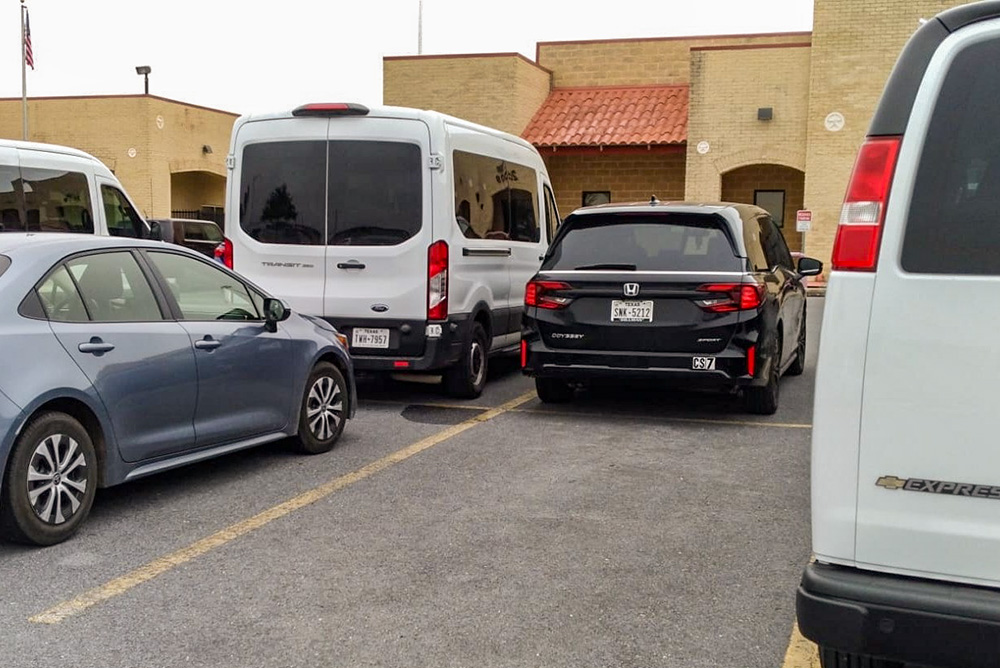
White vans parked outside the immigration courts in Harlingen, Texas, means there are unaccompanied minors with immigration hearings that day. The children travel in the vans from shelters where they stay until they can be placed with relatives or a guardian, or be deported. (Courtesy of Rose Kuhn)

It's the faces, especially the children's faces, that keep Sr. Rose Kuhn awake at night.
They have come from Honduras, El Salvador, Guatemala and Mexico — somehow traveling up to 1,500 miles on their own, some as young as 4 years old, to the southwest border of the United States.
And when they go to court for their immigration hearing, to see whether they will be allowed to stay here or be deported back to their home country, most are alone — without an attorney or even a relative — utterly dependent on the court system and its translators who can say words like "asylum" in Spanish (asilo), but cannot explain to a child who hasn't started school yet what it means and the legal implications it has on their life.
But on Wednesdays at the Immigration Courthouse in Harlingen, Texas, the children are not alone: Kuhn is there with them.
"I just sit in the back row, and I just pray for the kids. I pray for the judge, I pray for the lawyers, and that the children will be treated fairly," Kuhn told Global Sisters Report. "It is very emotional. You look at these kids and you listen to them in court ..."
But Kuhn, of the Sisters, Servants of the Immaculate Heart of Mary in Immaculata, Pennsylvania, keeps it together, staying strong for the children she's praying for. Only in her car, in the parking lot later, can she allow herself to break down.
'They're just children'
Kuhn's ministry in southern Texas began in 2022, when she and two other Immaculate Heart of Mary sisters moved to McAllen as part of a joint project by all three Immaculate Heart of Mary congregations. All three sisters work in various ministries tied in some way to the border and immigration. Kuhn first attended immigration hearings in Harlingen with two Jesuit priests in September 2025, then began going on her own every Wednesday since.
She said Immaculate Heart of Mary sisters believe that one sister's presence somewhere makes all of them present there, and all three communities support the border ministry.
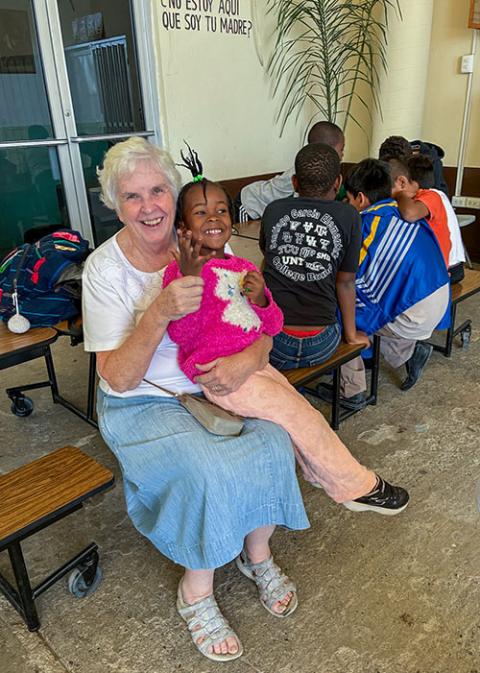
Sr. Rose Kuhn, of the Sisters, Servants of the Immaculate Heart of Mary in Immaculata, Pennsylvania, with a child at an immigrant center in Mexico, just south of the border at McAllen, Texas, where she ministers. (Courtesy of Rose Kuhn)
"We receive so many letters from [other Immaculate Heart of Mary] sisters, thanking us, and they're so grateful our communities sent us, because they can't be here themselves," Kuhn said. "We really believe that us being here at the border is their being here also."
She said that in many ways, her ministry in the courts is simple; she finds groups of children seated outside the courtroom.
"I introduce myself as a Catholic nun, I tell them I went to Mass this morning for you, and I'm not a hearing officer, I have nothing to do with the whole process, I'm here to accompany you, to go in with you if that's OK, and to pray for you during your appointment," Kuhn said. "Most days I go, there are unaccompanied minors. If there's a lot of white vans in the parking lot, I know there are minors that day. If not, that's OK — I'm here for the adults, too."
There is no shortage of unaccompanied minors, even though numbers have plummeted since their peak a few years ago.
Last fiscal year, the Office of Refugee Resettlement, which handles unaccompanied immigrant children in a system separate from the adult system run by Immigration and Customs Enforcement, or ICE, and Customs and Border Protection, had nearly 23,000 unaccompanied minors referred to its services. That was down from more than 98,000 the year before and down from the peak of nearly 129,000 in 2022, the agency reported.
Under a decades-old court settlement known as the Flores Agreement, the government is prohibited from detaining unaccompanied minors the way it essentially incarcerates adults. Instead, children must be processed within days and then either released to relatives or qualified guardians in the United States, or housed in a shelter certified to care for children until they can be placed with relatives or guardians.
The children arriving to court in white vans, Kuhn said, are from a nearby shelter where they are staying until they are placed or deported. Instead of ICE agents, they are overseen by child advocates and certified staff.
Kuhn said everyone — the judges, the attorneys for the government, the staff, advocates and immigrants' attorneys — all appear to want to do what's best for the children, but their hands are often tied by immigration law and administration policy.
She has even gotten to know many of the people working there, including U.S. Department of Justice attorneys, who have thanked her for being there.
"One said he works for the other side," Kuhn said. "I said there is no other side. We're all here for justice, to treat people the way they should be treated. ... He was happy I didn't consider him the enemy. I told him, 'You have to do your job, but do it fairly.' "
Advertisement
Many of the children, she said, do have relatives in the United States, but cannot be placed with them because they are not citizens, even if they are here legally. Most children are encouraged to ask for voluntary departure, she said, and are told they will be flown home at government expense if they agree to leave. Children who do not have an attorney — and most do not — may not understand they have a valid case for being allowed to stay and they take the government's offer.
The Transactional Records Access Clearinghouse, a data research group at Syracuse University, had reported in 2014 that more than 75% of unaccompanied minors without a lawyer were deported, while only 28% of those with an attorney were sent home. The clearinghouse stopped reporting data on juveniles in 2021, citing issues within the government data it was receiving from 2017 onward.
Kuhn said that when the children don't understand their choices, the judge will ask if they want more time so they can get an attorney. But when they come to their next hearing, they have not even asked about getting a lawyer because they didn't understand they could or how to go about it. When Kuhn says this, her voice breaks.
"They're just children," she said. "You wonder what's going to happen to them."
Good people, Kuhn said, are being put in positions where they have to make bad decisions. The Associated Press reported May 6 the Trump administration is pressuring immigration judges to speed up cases and approve fewer asylum claims. Dozens have been fired.
"You can see these judges have been very compassionate with people, but this is what the federal government is saying right now," Kuhn said. "The whole process has to be redone. Congress has to do something."
'It has been a blessing'
Kuhn said the cases of adults she has seen are not much easier.
A recent hearing for a woman facing deportation lasted four hours, she said, and she had to leave to go to another court appointment somewhere else. She had three children between the ages of 8 and 17.
"They were going to deport her to her home country and her children to a different country," Kuhn said. "I can't get her out of my mind, I really can't."
She has seen adults following the asylum process as spelled out in federal law only to be taken away by ICE agents after a routine hearing. She has seen 14-year-olds told they are mature enough to handle their case by themselves and file their own paperwork.
But despite the emotional toll it takes on her, Kuhn said being there has been a gift.
"It has been a blessing for me. ... I just want them to know I am there to pray with them and pray for them," she said. "There's nothing I can do to change the whole system. But I can go and pray with the children."