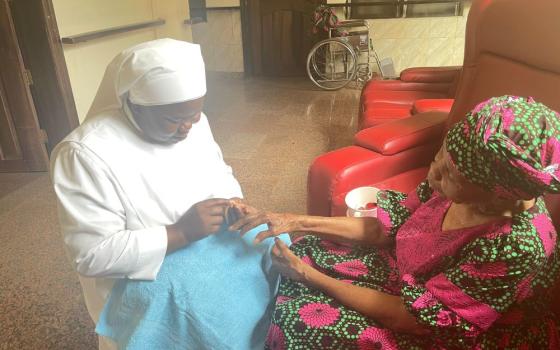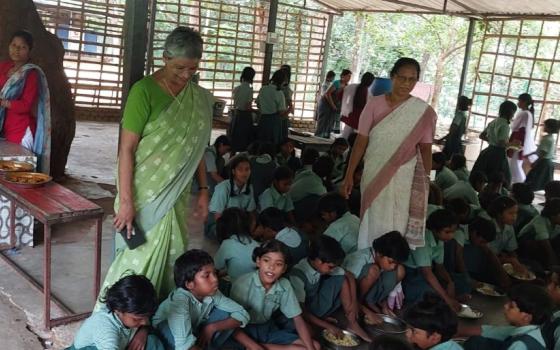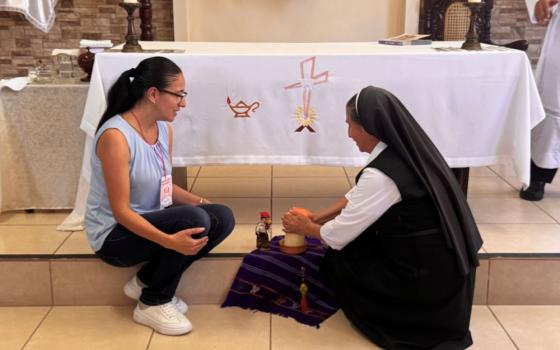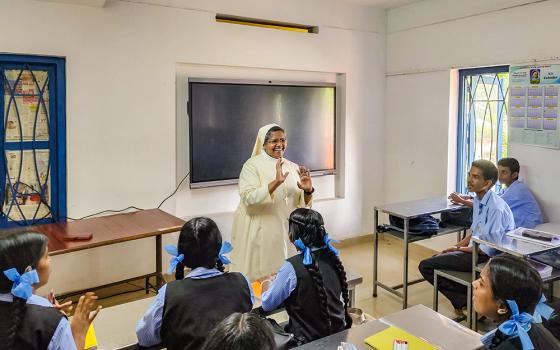
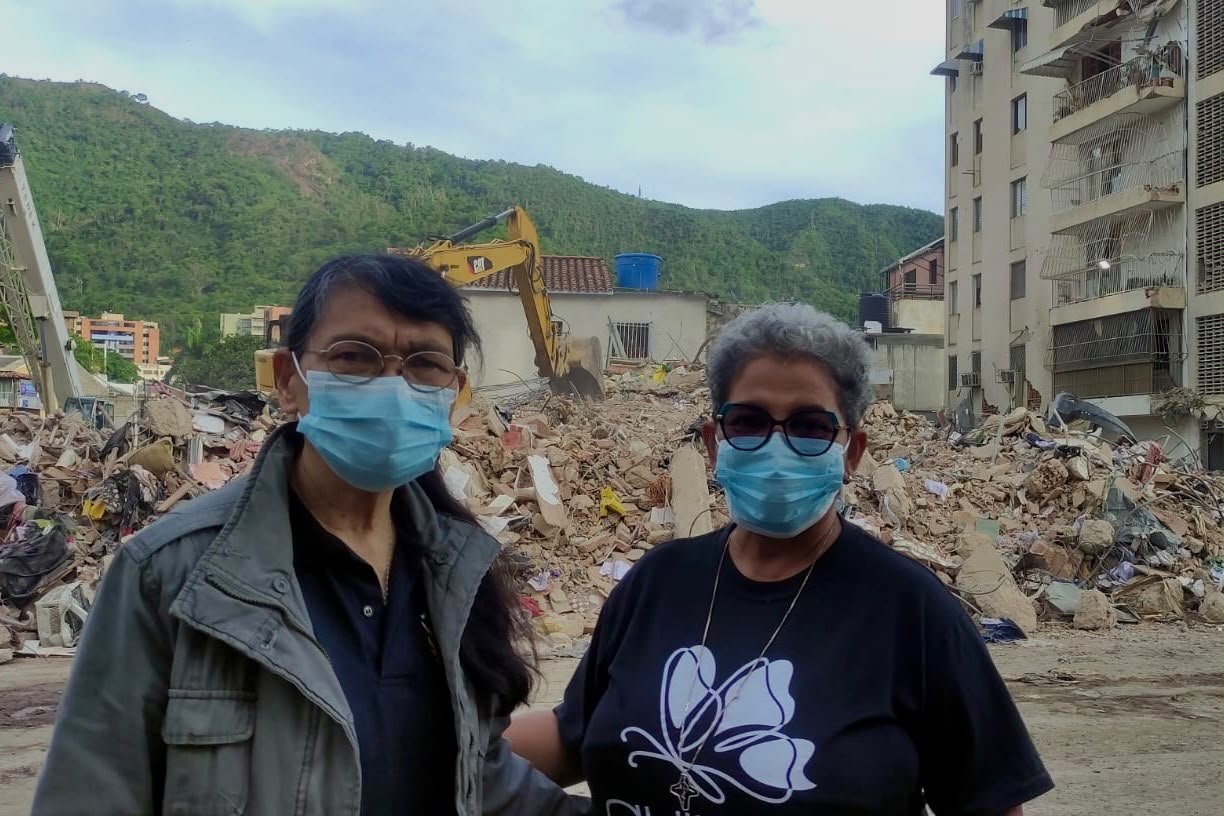
Sr. Emma Panizales, left, and Sr. Maigualida Riera of the Medical Missionaries of Venezuela are pictured during a visit to Caraballeda, an area impacted by the June 24, 2026, earthquakes in La Guaira state. (Courtesy of the Medical Missionaries of Venezuela)
Graciela de los Ángeles Portillo
Grief over an unexpected death. Uncertainty over a missing loved one. Rubble: bodies buried beneath it. A home buried. Gratitude to God for being alive. The street as a refuge. The impact of the two earthquakes that shook Caracas, Venezuela, on June 24, 2026, has not yet been fully assessed, but the number of victims is already in the thousands. No one escaped the fear as the ground beneath their feet ceased to be firm and secure — not even the Catholic sisters, who were also there when the earth shook.
Hours before the earthquake, a spontaneous initiative by the girls at the Hogar Nuestra Señora del Carmen — run by the Carmelite Sisters of Mother Candelaria in La Pastora, Caracas — had led them to sing and pray the rosary for the first time in the chapel.
That afternoon, the sisters and the girls were participating in a Mass at the Church of San Judas Tadeo, where the two earthquakes caught them off guard along with the rest of the congregation during the Lord's Prayer. The church's roof partially collapsed.
Sr. Ana María Montilla, director of the children's home, recalls the composure she had to maintain to keep the girls from panicking as the ground shook. "It was a very difficult moment; we didn't sleep that night," she said.
The next day, the Carmelite Sisters traveled to the Dr. Domingo Luciani and Ana Francisca Pérez de León II hospitals in the Sucre municipality of Caracas to assist the injured who had been transferred from the state of La Guaira. Shortly afterward, they headed to Plaza Miranda, in downtown Caracas, which had been turned into a makeshift camp for those who had to abandon their buildings — whose structures had been weakened — as a precaution against possible collapses.
"Many people couldn't cook, either out of fear or because they had run out of gas. We went to the plaza, opened the van, and began distributing arepas stuffed with mortadella and cheese, along with rice and salad," recalls Montilla.
Due to the magnitude of the tragedy, there have been spontaneous mobilizations of hundreds of people in different parts of the country to rescue victims trapped under the rubble and assist survivors. Sisters from various congregations also joined this solidarity effort.
The figures reflect the scale of this emergency. The Miami Herald reported July 23 that the official death toll from authorities was 5,398. The earthquakes left 16,740 people injured, 17,907 who had lost their homes, and 23,335 sheltered in 107 temporary camps set up to address the emergency. The number of people rescued stood at 6,462. Authorities said that, as of July 22, 856 buildings had been damaged and 190 destroyed.
The most severe damage was concentrated in La Guaira state, as well as in Caracas and the states of Miranda, Carabobo, Aragua, Falcón and Yaracuy.
Advertisement
Added to this are direct economic losses, preliminarily estimated by the United Nations Development Program (UNDP) on June 26, 2026, at $6.7 billion dollars, in a country that was already facing a prolonged humanitarian crisis.
Sr. Shirley Barillas, of the Handmaids of Christ the King, highlighted the importance of addressing emotional well-being and giving a name to the "inner earthquake."
"If we take care of ourselves, we can better care for others. We must allow ourselves to cry; we must drain the pain out, because right now we're operating on autopilot," she said.
Other sisters have lit the stoves in their communities to provide food for the victims. For the Servants of Jesus, the emergency turned into intense days of cooking in plazas and parks that had been turned into makeshift shelters, said Sr. Rosa Lozano.
A week after the earthquakes, the Medical Missionary Sisters visited Caraballeda, one of the most devastated areas in La Guaira state. There they witnessed a reality that made it urgent to coordinate efforts among religious congregations and other church organizations: precarious sanitary conditions, children with skin and respiratory ailments, and a profound psychological impact caused by the destruction.
Networked reconstruction: The shared path
The response to the emergency was not left to each congregation individually.
Religious sisters from different communities began coordinating efforts with the Conference of Religious Men and Women of Venezuela, Caritas, the Jesuits, and dozens of young volunteers to support the affected population and provide emotional and spiritual care, as well as to offer their facilities as collection centers and shelters.
Sr. Maigualida Riera, coordinator of the Medical Missionary Sisters in Venezuela, explained that the new phase of the response aims to go beyond immediate care. In coordination with the conference of religious, the communities are promoting activities for children, youth and older adults to help them process the emotional impact of the earthquakes.
For Riera, the mission consists not only of responding to material needs but also of accompanying people through their grief and restoring hope to those who have lost everything. "In times like these, it is very important for people to feel accompanied by a timely word or a silence that embraces the soul. It is time for solidarity and to set out on the road, like the good Samaritan, to compassionately tend to the wounds of those who today cry out for help," she said.
Caritas Venezuela, as part of the church's Social Action Network, has played a key role in coordinating the reception, sorting and distribution of food, medicine and supplies destined for the hardest-hit areas. With the support of the Consolata Missionaries, the network coordinates the reception and sorting of food, medicine and supplies, which are then distributed to the hardest-hit areas.
Among those participating in this effort is Sr. Aura Arévalo, a Colombian Consolata missionary. "These simple tasks are incredibly valuable, because every mother who receives [food or medicine] feels a sense of strength," she said.
Through Caritas, schools and community centers were converted into temporary shelters and collection centers, while religious communities delivered aid to different regions of the country.
"In places like La Moneda Square in Caracas, support is offered up close: a space to share a cup of hot tea and, above all, to listen," noted Sr. María José González, director of Caritas Los Teques, a member of the Jesús es Señor community, and logistics coordinator.
In a country marked by years of crisis and mass emigration, the emergency highlighted once again the value of collaboration among religious congregations, laypeople and church organizations in responding to the needs of the population.
During the relief effort in La Guaira, religious communities distributed crutches, tents, strollers and hygiene kits to families living in temporary camps, in coordination with other congregations, organizations and volunteers. "We must work together with congregations, groups, NGOs and others to have a greater impact through our service," stated Riera. "We've realized that we can't do this alone."
This story was originally published in GSR en español June 20, 2026.