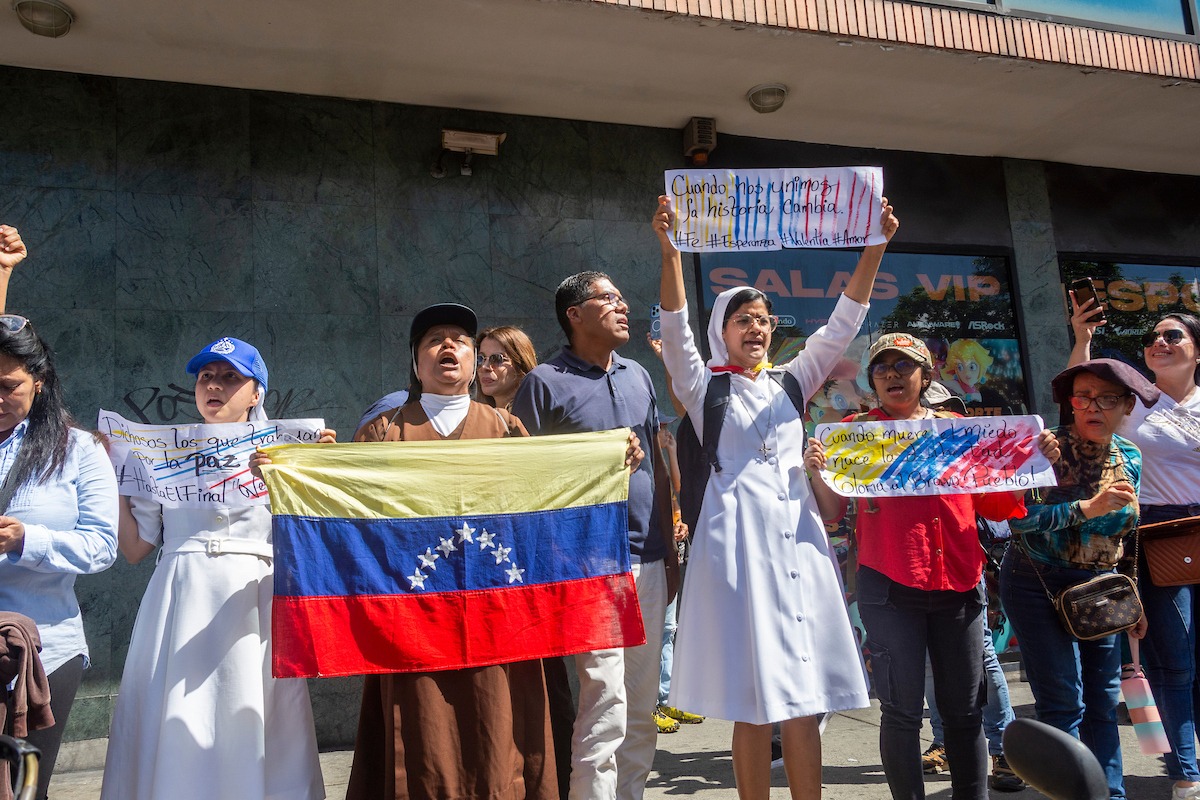
Sisters participate in a rally on Elice Street in Chacao, Caracas, Venezuela, on Jan. 9, 2025, the eve of Nicolás Maduro's inauguration for his third term. Their banners read: "When we unite, history changes," "When fear dies, freedom is born," and "Blessed are those who work for peace." (Courtesy of Jimmy Villalta)
Graciela de los Ángeles Portillo
Since the mid-2010s, Venezuela has been experiencing a multidimensional crisis marked by a profound economic collapse, a severe humanitarian emergency, and persistent political and institutional instability. In this situation, which has now lasted for more than 15 years, women in consecrated life have abandoned neither prayer nor service to the most vulnerable in their various ministries.
Against this backdrop, on Jan. 3, 2026, an event of historic significance unfolded: U.S. military forces detained President Nicolás Maduro and his wife, Cilia Flores, in Caracas. The action sparked mixed reactions: While broad sectors of the Venezuelan population saw it as an opportunity to restore democracy and human rights, several governments in the region described it as a violation of international law.
Global Sisters Report en español consulted Catholic sisters from diverse charisms and backgrounds to understand, from the perspective of faith and action, what steps Venezuela must take to rebuild itself at this moment in its history when citizens perceive a fracture in the social fabric.
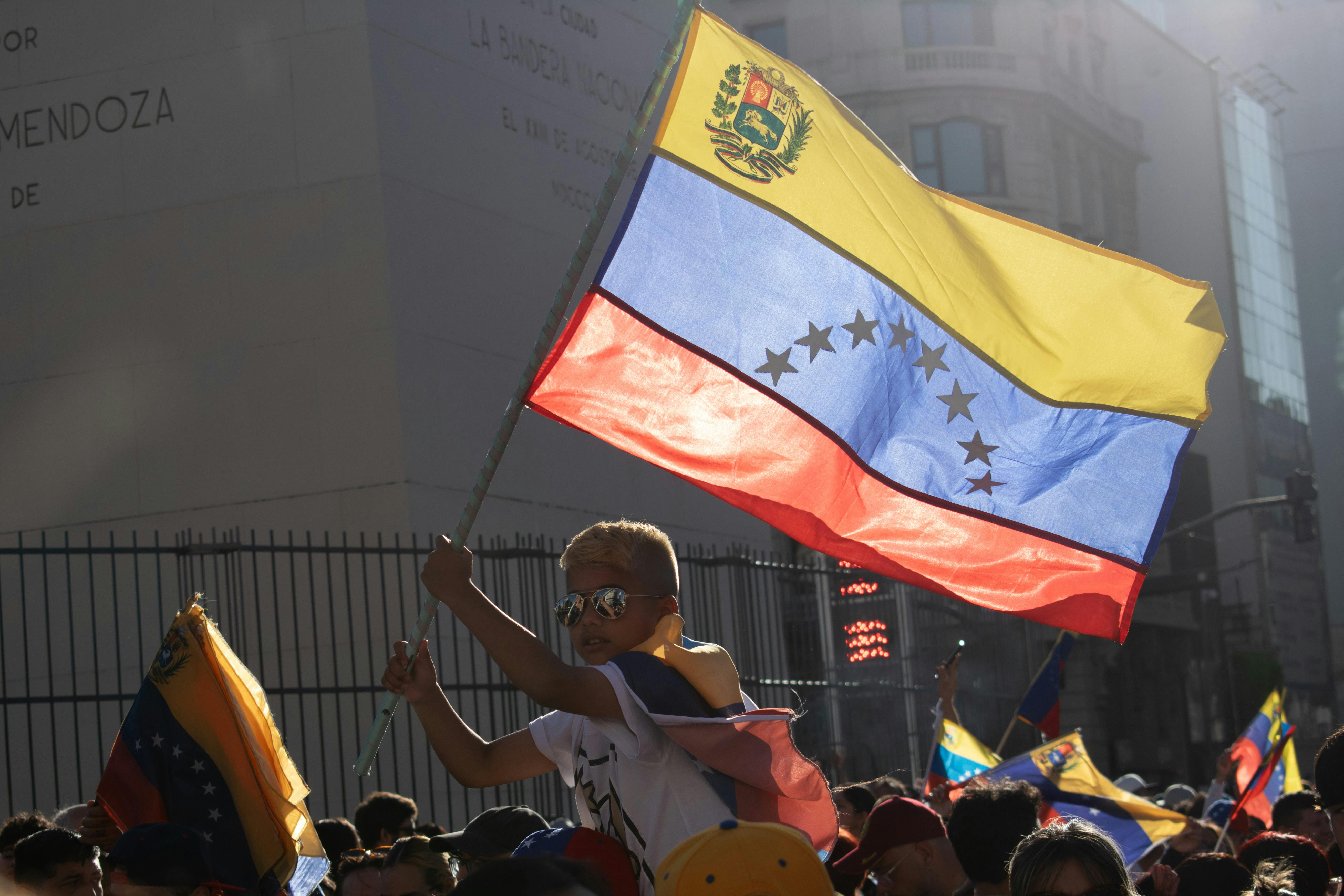
A child holds the Venezuelan flag during a protest in Buenos Aires, Argentina. The Venezuelan crisis has led hundreds of thousands of children to grow up far from their homeland. (Pexels/Renan Braz)
The voice of religious sisters
Servants of the Most Holy Sacrament Mother Marlene Leal (Courtesy of Marlene Leal)
Mother Marlene Leal, superior general of the Congregation of the Servants of the Most Holy Sacrament, believes that no one else can fill the role that religious communities currently occupy. "Our presence is woven into the very fabric of society. Where neither the state nor the market reaches, there is the parish, the prayer group, or the community kitchen," she said.
That presence of religious sisters, she said, takes shape in a central action: becoming what Pope Francis calls "field hospitals" — spaces of listening that heal wounds, offer closeness, and act with mercy rather than judgment, to welcome those most in need.
"Healing the social fabric begins with healing the individual heart. A person who feels heard and supported begins to regain her dignity. Before speaking of reconciliation, we must allow pain to be expressed. Religious communities must be safe spaces where people can mourn their losses and release their anxiety without being judged," Leal said.
Guardian Angel Sr. Ileane Tolosa agreed with this assessment but added another layer: In her view, the country is still going through a "reactionary" phase, a collective attitude that prevents people from recognizing their neighbor as someone different but with equal dignity.
"This reactionary phase is the result of years of misunderstanding and mistreatment in language and gestures. These are historical, personal, and collective wounds that need to be healed in order to rebuild the social fabric," said Tolosa, who believes a collective gathering in favor of reconciliation must be organized.
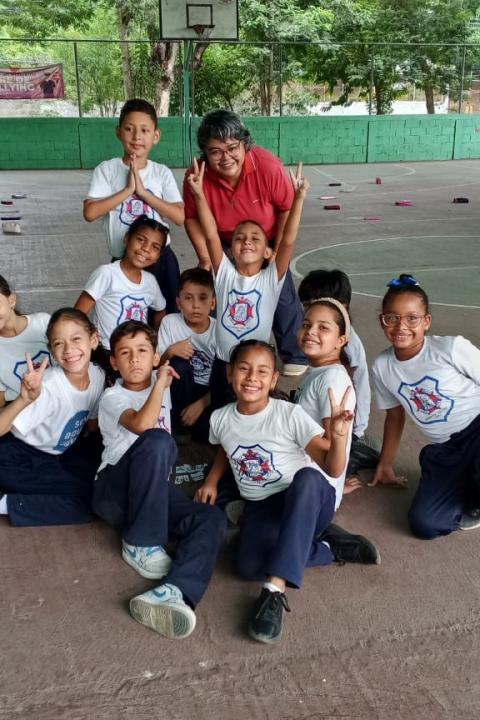
Guardian Angel Sr. Ileane Tolosa (Courtesy of Ileane Tolosa)
Along the same lines, Medical Missionary Sr. Maigualida Riera believes that religious congregations must serve as bridges and mediators — spaces where different actors can sit down, dialogue, listen to one another, forgive one another, respect one another, and recognize one another.
"For me, reconciliation means the possibility of coming together to save the country, [setting aside] our wounds, our interests, our differences. It is the way we can recognize and accept that we are all necessary and important," said Riera, who is also a member of the National Pastoral Commission of the Venezuelan Episcopal Conference.
At the same time, the sister maintains that skills such as active and empathetic listening must be developed, "to help us understand rather than respond, and assimilate rather than react."
'Our presence is woven into the very fabric of society. Where neither the state nor the market reaches, there is the parish, the prayer group, or the community kitchen.'
—Sr. Marlene Leal
What the sisters propose
Leal affirms that the reconstruction of the social fabric begins with the willingness of all social sectors to collaborate, leaving behind resentment and always upholding respect for sovereignty and social justice.
"Fostering listening and encounter among those who think differently requires, above all, a transformation of the will and the heart. The focus must shift from differences toward shared values, such as compassion, justice and peace. It is not simply a matter of speaking, but of cultivating active listening through techniques where the goal is not to convince the other person, but to understand their personal story," she said.
Her concrete proposal moves in three directions: strengthening comprehensive care programs for vulnerable populations under an educational model based on welcoming; training lay leaders for the accompaniment and reintegration of people deprived of liberty; and restoring family purchasing power.
Riera believes the process must also restore democratic practice and freedom of expression, while also fostering personal transformation that leads to an active commitment to justice, connecting local reality with the global context. "We must work as a network to address the needs of the marginalized, adapting the Gospel to complex contexts," she said.
Tolosa, for her part, points to the recovery of truth. In an environment saturated with information, she invites all to exercise "selective intelligence" and prudence. "If there is one thing Venezuela has lost, it is the truth; it seems there are interests at play to keep it from coming to light. If we seek Jesus, we will find the truth, "she said. For her, the historical key is synodality: listening to others with humility, especially where polarization has rendered those who think differently invisible.
'If there is one thing Venezuela has lost, it is the truth; it seems there are interests at play to keep it from coming to light.'
—Sr. Ileane Tolosa
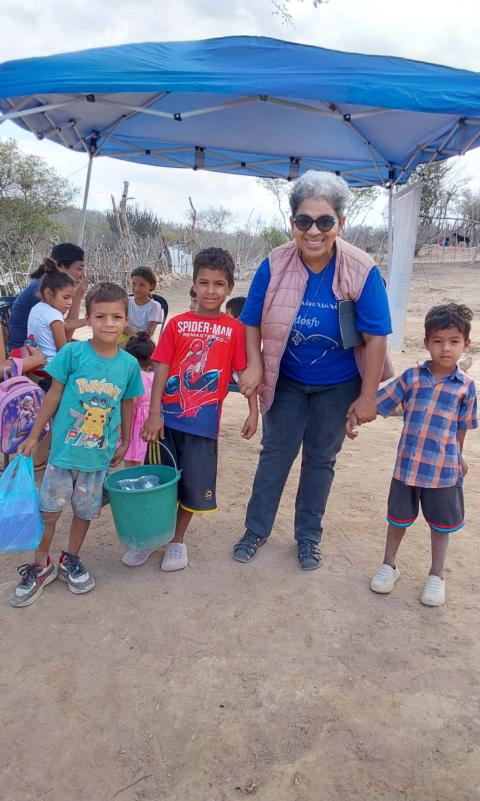
Medical Missionary Sr. Maigualida Riera (Courtesy of Maigualida Riera)
An unprecedented situation
Rita Elena Parra — a political scientist, layperson and facilitator at the Gumilla Center (Center for Research and Social Action of the Society of Jesus in Venezuela) — described the current situation in Venezuela as unprecedented.
"We have an elected government that has been unable to govern — Edmundo González — the leadership of María Corina Machado, the tutelage of U.S. President Donald Trump alongside his secretary of state, Marco Rubio, and the ousted president, Nicolás Maduro. Furthermore, there is the fact that Delcy Rodríguez is exercising interim power. We are not speaking of legitimacy, but of fragmentation," she said.
Parra — also a member of the Neocatechumenal Community — agreed with the sisters on the approach of synodality, of listening to others; she emphasized the active role that corresponds to both consecrated men and women as well as the laity in building reconciliation and believes that the most urgent civic lesson is to assume responsibility for one's vote. "A Christian is not a passive bystander," she noted.
Advertisement
In this vein, Leal asserted that "this path requires healing wounded memories" and considers the church to be "a welcoming home that allows us to close cycles and start anew."
Furthermore, she said that this involves rediscovering the sacrament of reconciliation as an encounter of mercy: "Reconciliation is an act of compassion, putting oneself in the other's place to transform hatred into harmony."
Following the enactment of the Amnesty Law, the nongovernmental organization Foro Penal reported the release of 670 political prisoners, although 526 remain in prison. Given this incomplete reality, the church's leadership takes on particular relevance: According to the study "Religious Sociography" by the Gumilla Center, 53% of Venezuelans believe the Catholic Church plays a key role in promoting national reconciliation.
'Reconciliation means the possibility of coming together to save the country, [setting aside] our wounds, our interests, our differences.'
—Sr. Maigualida Riera
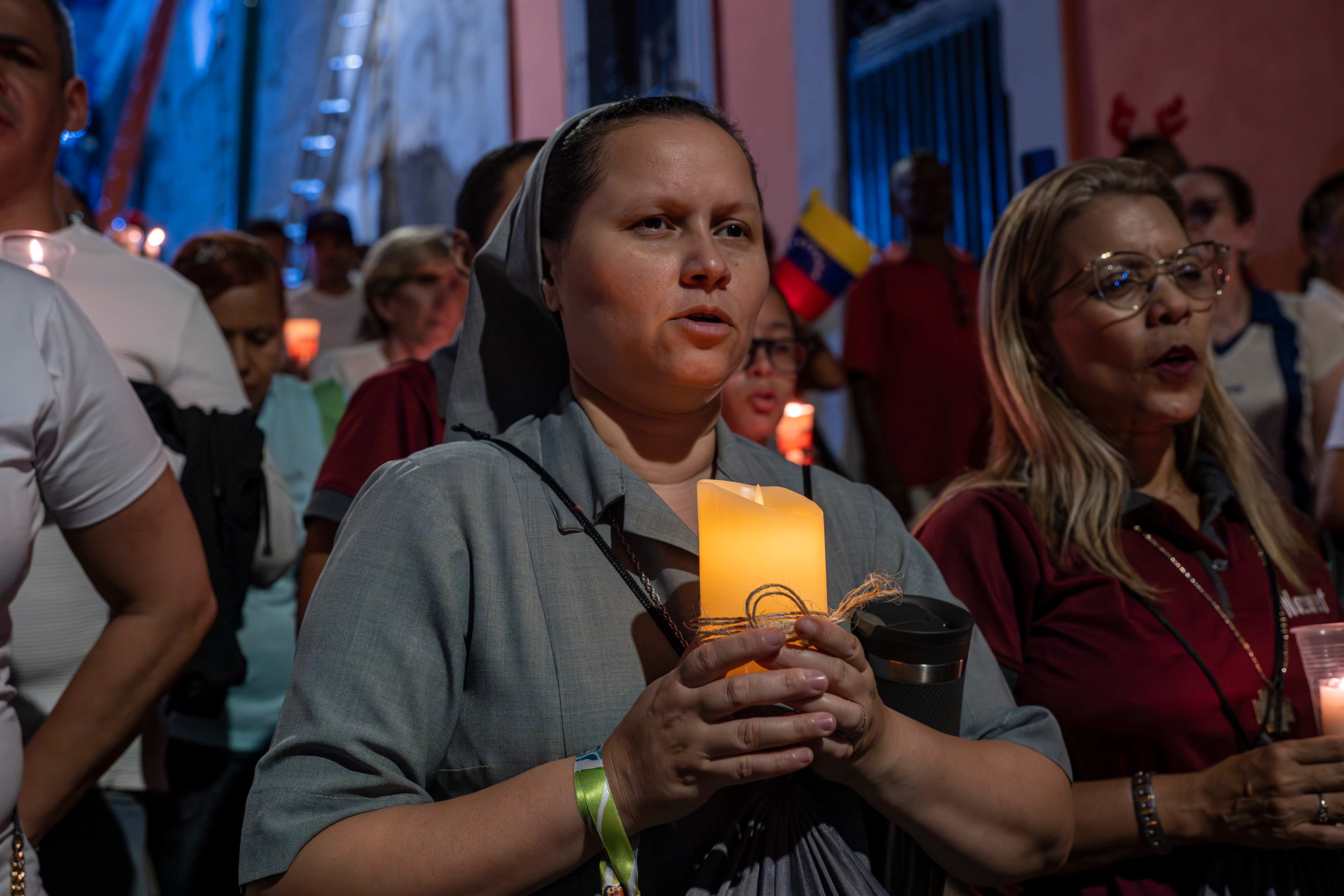
Amid the Venezuelan crisis, religious communities and laypeople continue to promote spaces for prayer, reconciliation and hope, such as the "Night Walk for Peace," held Oct. 4, 2025, in honor of José Gregorio Hernández and Mother Carmen Rendiles, prior to their canonization. (Courtesy of Jimmy Villalta)
A perspective rooted in faith
For Tolosa, the central challenge for Venezuelans is "to try to view everything that is happening through the lens of God," an approach that, in her view, will enable the rebuilding of a citizenry capable of objectively processing the events of Jan. 3, 2026, without "broken hearts or torn garments."
Riera, on her part, has developed concrete initiatives for healing through art with her community. Her most notable project is the Latidos Foundation, which works on inclusion, the promotion of values, and mental health through laughter therapy and cultural activities.
Drawing on her eucharistic charism, Leal extends this mission into public life. For her, rebuilding a sense of citizenship means working to ensure that no one is excluded from fundamental rights. "Faith calls us to transform silent presence into active and responsible participation. This is manifested in understanding the defense of human rights and the denunciation of oppressive structures as a direct mandate of the Gospel," she said.
In a country torn by material and spiritual divisions, the sisters insist that reconciliation will be neither immediate nor simple. But in everyday gestures — listening, accompanying, speaking the truth — they recognize signs of a process that, though fragile, continues to move forward.
This story was originally published in Spanish June 8, 2026.