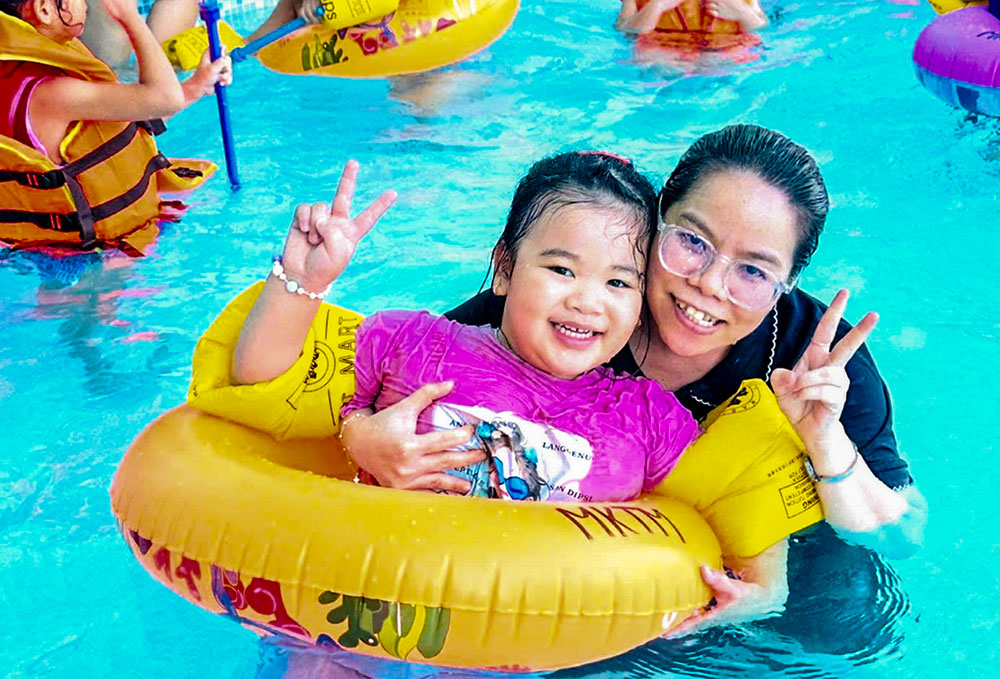
Sr. Mary Nguyen Hong Vy poses with a child after a water safety lesson at a pool in Hue, Vietnam, on July 10, 2026. (Joachim Pham)
"Take a deep breath."
Sr. Mary Nguyen Hong Vy knelt beside a frightened girl who was clinging tightly to the edge of a swimming pool in Hue, Vietnam. Gently slipping one arm beneath the child's shoulders, she encouraged her to lean back into the water.
"Now relax."
For a brief moment, the girl's body stiffened. Then, slowly, she loosened her grip, stretched out her arms and floated on her own for the first time.
"We don't begin by teaching children how to swim," Vy said. "We begin by teaching them how to stay calm. If they can float and control their breathing, they have a much better chance of surviving."
Each summer, the 46-year-old member of the Lovers of the Holy Cross of Hue leads free water survival classes for children in her community. The lessons focus on floating, recognizing dangerous currents, wearing life jackets properly and responding safely in emergencies.
The ministry grew out of a tragedy that Vy has never forgotten.
In August 2024, during one of central Vietnam's intense summer heat waves, two brothers aged 14 and 19 from a local family went swimming in the Bo River. When one of them began struggling in deep water, the other instinctively swam out to rescue him. Strong currents pulled both beneath the surface.
Neither survived.
"We are still living with the shock," their mother, Phan Thi Man, said. "If my sons had learned to swim, perhaps they would still be alive."
After visiting the grieving family, Vy found herself asking a different question.
"I couldn't stop thinking about those boys," she said. "I kept asking myself whether we could prevent the next drowning instead of only comforting families afterward."
The question led her community in Ngoc Ho to launch free swimming and water survival classes in September that year. Since then, Vy and four lay volunteers have helped more than 300 children aged 4-14 complete the four-week program at a local swimming pool and nearby river.
She said local authorities have praised the program, while benefactors help cover the cost of instructors, meals, drinking water and life jackets.
For Vy, who learned water survival skills from her grandfather, a fisherman, the classes have become an unexpected expression of religious life.
"When I entered the congregation, I never imagined I would spend my summers standing in a swimming pool," she said with a smile. "But every generation of sisters is called to respond to the needs of its own time."
Advertisement
Across Vietnam, the need has become increasingly urgent.
Vietnam records nearly 2,000 child drowning deaths each year, making drowning one of the country's leading causes of accidental death among children. The danger is greatest in rural communities, where rivers, ponds and irrigation canals are part of daily life, yet many schools lack swimming facilities and families cannot afford formal lessons.
Vy believes the greatest danger is often not that children cannot swim but that they panic.
"When people panic, they stop thinking," she said. "That is why we teach children to float before we teach them to swim. Learning to stay calm can save a life."
Senior swimming instructor Nguyen Thi Mai, who works with Vy, said keeping the body afloat is a vital survival skill because it allows children to remain calm, assess their surroundings and choose the safest direction to swim.
For many parents, the lessons are reshaping long-held assumptions about water safety.
"I used to be afraid of the river because I was scared of the water. Now I can float and swim," said Tran Le Bao Anh, 6, who completed the course.
"Now I know how to swim, and I can keep myself safe if the floodwater comes," said 12-year-old Michael Nguyen Quang Tien.
Anh's Buddhist mother, Le Thi Quynh Trang, admitted she had always assumed learning to swim simply meant moving through the water.
"I understand that surviving in the water is different," she said. "The sisters teach the children to stay calm, to float and to think before they act."
Her daughter is one of many children from non-Catholic families who attend the free classes each summer.
"When children come here, we don't ask what religion they belong to," Vy said. "Every child's life is precious."
In central Vietnam, with its rivers, ponds and irrigation canals, Vy believes teaching children how to live safely around water is becoming as important as teaching them to avoid it.
"Our children grow up surrounded by water," she said. "We cannot simply tell them to stay away from it. We have to prepare them for the reality they live with."
Her community is not the only one reaching that conclusion.
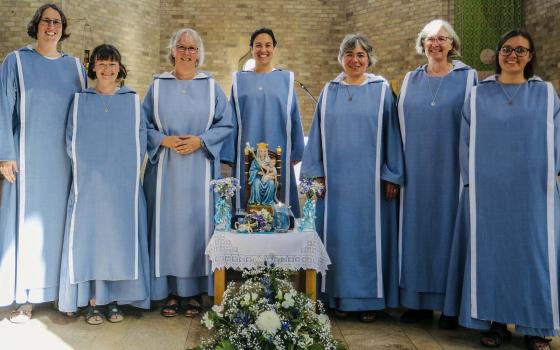
About 120 km north in Quang Tri province, another community of the Lovers of the Holy Cross of Hue began offering river-based swimming classes in 2025 after a series of child drownings in local waterways.
"We realized that warning children was not enough," Sr. Teresa Nguyen Quynh Chau said. "We have to prepare them before they find themselves in danger."
About 70 children have completed the program. Chau called the free classes "a lifeline" for rural families who cannot afford swimming lessons in the city, where each course costs 1.2 million to 1.5 million dong (US$46-57).
"Helping them protect their lives is one way we live our vocation," she said. "Christ came so that all may have life and have it abundantly."
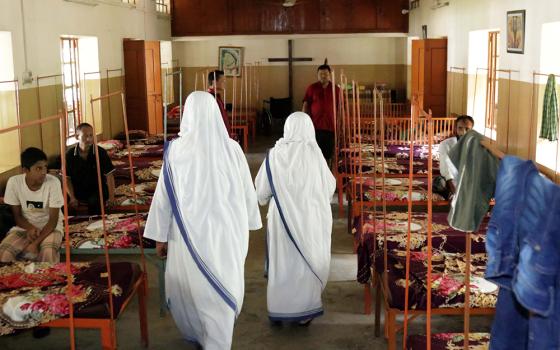
Similar initiatives are emerging elsewhere. In neighboring Ha Tinh province, Missionaries of Charity nuns launched their first swimming classes this summer, teaching 40 children from poor farming families basic water survival skills with support from benefactors.
"We could not wait until another child died," Sr. Teresa Duong Thi Hong said. "Saving a child's life begins long before the emergency. It begins by preparing the child."
For Chau, teaching swimming "has taught me that religious life means accompanying people where they need us most. Through simple acts of service, we make Christ's compassionate presence visible among those who suffer."
For Vy, the classes have become another way of accompanying families.
"Before children learn to trust the water, they first learn to trust the person standing beside them," she said. "That is how God accompanies us, too."
As the afternoon lesson ended, the little girl who had cried at the beginning of class pushed gently away from the pool wall. She stretched out her arms, took a deep breath and floated unaided.
Vy watched quietly until the child smiled.
"Saving a child's life doesn't begin in the moment of an emergency," she said. "It begins much earlier, by teaching them to protect the life God has given them. That, too, is our ministry."