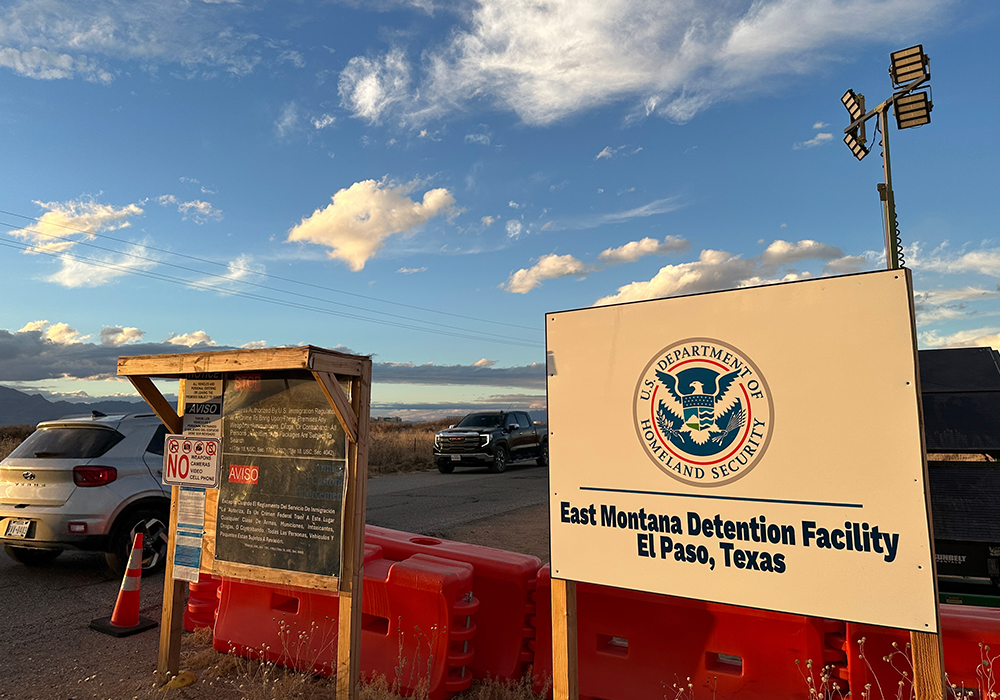
A sign marks the entrance to a series of hardened tents at the Camp East Montana immigrant detention center in the desert at a U.S. Army base on the outskirts of El Paso, Texas, Feb. 13, 2026. (AP photo/Morgan Lee)

by Brian Fraga
Staff Reporter
Every week, sometimes every day, a group of religious sisters and priests visit the imprisoned at Camp East Montana, an immigration detention center that resembles a sprawling tent city in the desert.
Located at Fort Bliss, a U.S. Army installation in El Paso, several Spanish-language newspapers have dubbed Camp East Montana the "Alligator Alcatraz of Texas." The American Civil Liberties Union has described the facility, which can hold up to 5,000 people, as "the largest immigration detention site in the country."
Several media reports and eyewitness accounts from people who have visited Camp East Montana and interviewed detainees describe a series of problems with the facility. The Associated Press, which also reviewed 911 calls and court filings, reported "overcrowding, medical neglect, malnutrition and emotional distress," and said detainees "live in fear of private security guards known to use force to put down disturbances."
"We've witnessed many dramatic situations there at Fort Bliss," said Scalabrinian Sr. Leticia Gutiérrez Valderrama, who is among a group of 15 religious sisters and others who have been visiting the detained migrants at Camp East Montana since September.

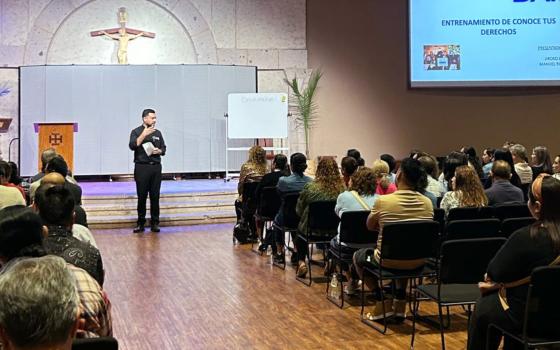
Scalabrinian Sr. Leticia Gutiérrez Valderrama has shifted her ministry from welcoming migrants to accompanying them in the hallways of the courts in El Paso, Texas, and preparing them for being detained or deported. (Courtesy of Leticia Gutiérrez Valderrama)
Valderrama told National Catholic Reporter that she wrote a letter in November detailing "all the human rights violations" she had witnessed at Camp East Montana. She said she presented the letter to Pope Leo XIV.
In December a coalition of human rights organizations in New Mexico and Texas issued a letter calling for the end of detentions at Camp East Montana and a halt of detainee deportations to other countries. The letter cited "reports of significant abuse against detained immigrants," including "repeated instances of coercion, physical force, and threats against immigrants facing third-country deportations, in violation of agency policies and standards, as well as statutory and constitutional protections."
In February The Texas Tribune reported that three people had died at Camp East Montana, during a six-week period from December to January.
"There's all sorts of issues at that facility from every angle," said Imelda Maynard, the director of legal services for Estrella del Paso, a ministry of the Diocese of El Paso that provides free legal services to migrants and refugees.
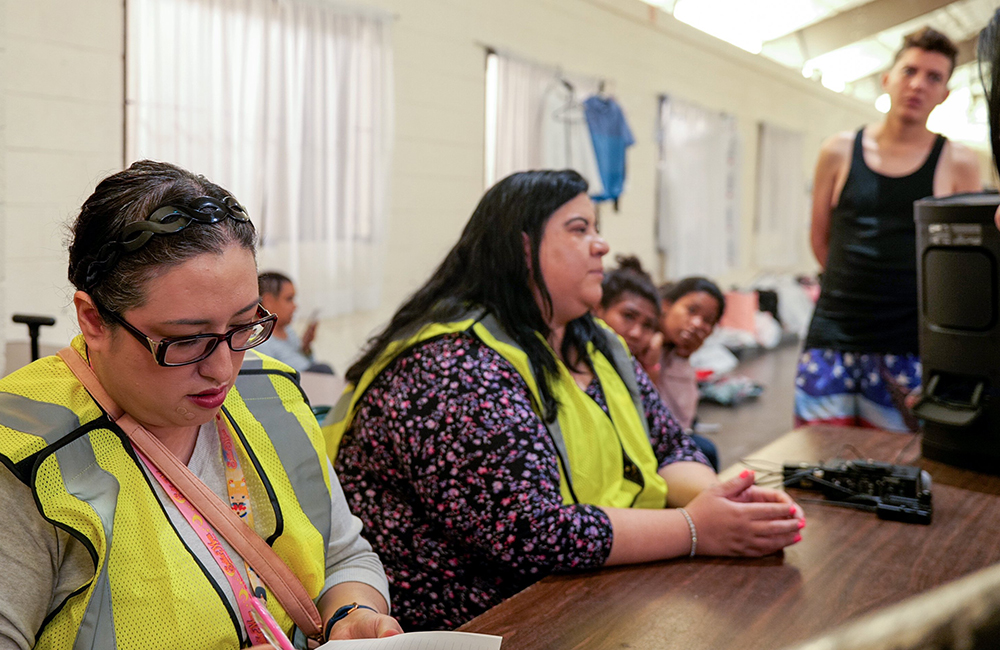
Imelda Maynard, director of legal services of Estrella del Paso (formerly Diocesan Migrant and Refugee Services), and Melissa López, executive director, provide legal information to migrants in a migrant shelter in El Paso, Texas. (OSV News/Courtesy of Diocesan Migrant and Refugee Services, Inc. of El Paso)
Estrella del Paso was among the immigrant rights groups that called for the closure of Camp East Montana, where recent outbreaks of measles, COVID-19 and tuberculosis have been reported. Maynard said medical care has been a long-running concern in the facility.
"People are entering with pretty severe medical issues and are not being seen, not being given medications, or not being given the regular course of treatment," Maynard said.
In early March, The Washington Post reported that U.S. Immigration and Customs Enforcement was planning to close the $1.2 billion facility and end the federal government's contract with Acquisition Logistics LLC, a small Virginia-based company with no listed previous incarceration experience. But El Paso's KFOX14 and CBS4 reported that ICE confirmed to them on March 11 that the center will not close, though it will be changing contractors.
Maynard told NCR in a recent interview that she and other immigration attorneys have often had difficulties meeting with their clients who are detained at Camp East Montana. She said guards there have told attorneys to "hurry it up" or else the detainees would miss lunch.
"That is a training issue," Maynard said. "The federal detention standards clearly state that when you meet with legal counsel, if it's during a meal period, the facility is supposed to provide a bag lunch. They don't just get to tell [detainees], 'You don't eat because you missed lunch.' "

Imelda Maynard (Courtesy of Imelda Maynard)
At other times, Maynard said detention staff have told immigration attorneys that they could not see their clients because either they were in solitary confinement or they had violated one of the facility's rules.
"Again, you can't do that," Maynard said. "The detention standards say people have a right to see their legal counsel regardless. So it's clear that there is a disconnect between how ICE says these facilities are supposed to be run and how the facilities are actually being run."
A spokesperson for U.S. Immigration and Customs Enforcement did not return a message from NCR seeking comment for this story.
Shortly after the Camp East Montana opened in August 2025, Maynard said the staff there said only one immigration attorney at a time could be given access to the facility, and that the attorney would only be allowed to see 10 people per day.
"And it's like, again, you can't limit our access in that way. That's not correct," Maynard said. "People might wonder, why is that an issue? Well, it's an issue because it goes against their own written standards.
"It's a $1.2 billion facility," Maynard added. "How is it that [federal immigration authorities] did not have the time and money to train the staff? It's an easy fix, if there is the will to fix it. The problem is, I don't know if there is the will to fix it."
Advertisement
Even with those difficulties, the detainees at Camp East Montana are at least receiving some pastoral care.
"At first, no one could go in. Only online visits were permitted," said Valderrama, the Scalabrinian sister who accompanies migrants at court and in the detention centers. Since mid-September, Camp East Montana has allowed in-person pastoral visits.
"And we've been there every week since, sometimes every day, continuing our work of accompaniment," Valderrama said.

Bishop Mark J. Seitz of El Paso, Texas, greets a Salvadoran migrant in Ciudad Juarez, Mexico, June 27, 2019, who was deported after crossing the Paso del Norte international border from El Paso. (OSV News/Reuters/Jose Luis Gonzalez)
The priests and religious sisters who visit the detained migrants there sometimes have to wait up to two hours there because the facility is understaffed, El Paso Bishop Mark Seitz told NCR.
"It's very difficult, but we do what we can for them," said Seitz, who added that the diocese sends a team of priests to hear confessions during the week and he often celebrates Mass there on Sundays.
"But the unfortunate part of all of that, in terms of our ministry, is that [the facility] is limited in the number of people we can serve," Seitz said. "They only have one place in this facility that holds 3,000 people, one place where up to 100 people can gather. And it's not a mix of men and women. That's not allowed. So we're hitting only a fraction [of the detainees] in any given week. And we're still lobbying to work out something so that we can serve a larger percentage.
"My heart breaks for the number of people going through the worst moment in their life without any sort of spiritual support," Seitz added. "So it's something we really hope we can resolve."