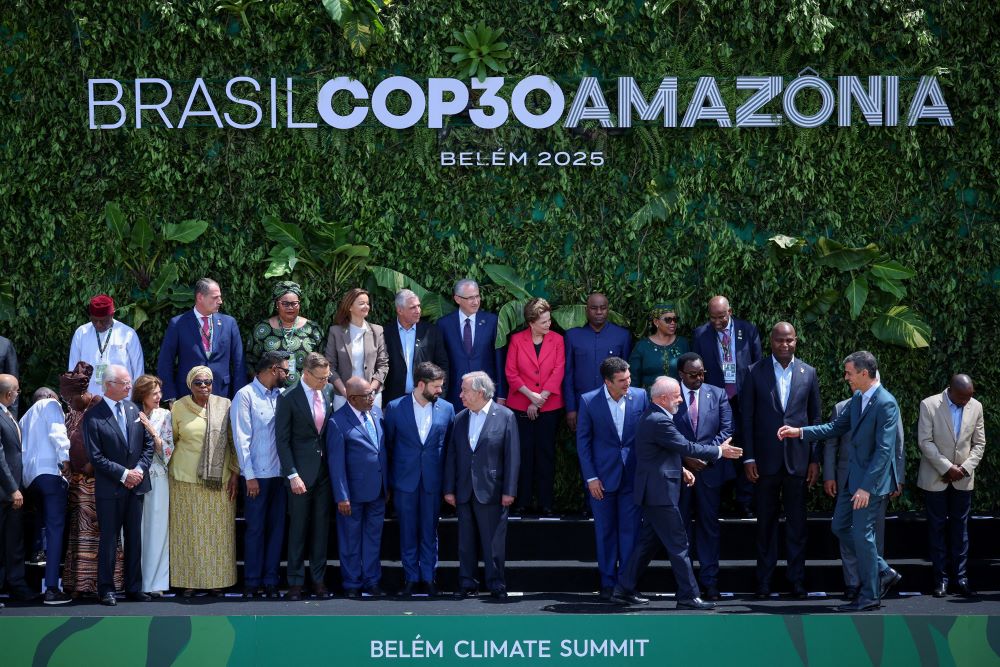
World leaders gather for a photo Nov. 7 at the Belem Climate Summit gather in Belem, Brazil, ahead of the United Nations Climate Change Conference, or COP30. Absent was U.S. President Donald Trump, who did not send an official delegation and has moved to exit the U.S. from the Paris Agreement and its underlying treaty. (OSV News/Reuters/Adriano Machado)


Catholic groups quickly assailed the Trump administration's move to withdraw from dozens of international accords and organizations, including the bedrock United Nations treaty that for three decades has convened global efforts to address climate change.
In an executive order issued Jan. 7, President Donald Trump directed the U.S. to withdraw as soon as possible from 66 U.N. entities and related organizations that his administration deemed "contrary to the interests of the United States." Chief among them was the U.N. Framework Convention on Climate Change, the 1992 treaty that facilitates international climate negotiations and under which nations adopted the Paris Agreement to rein in heat-trapping greenhouse gas emissions, released primarily from burning fossil fuels.
Trump had already moved to exit the Paris accord on his first day back in the White House; it will take effect Jan. 20. Similarly, a withdrawal from the global climate treaty would not take effect until one year after a country gives formal notice to the U.N.
Once it does, the U.S. — the largest source of historical emissions and top user and producer of oil and gas — will stand as the only country in the world not part of the bedrock climate treaty.
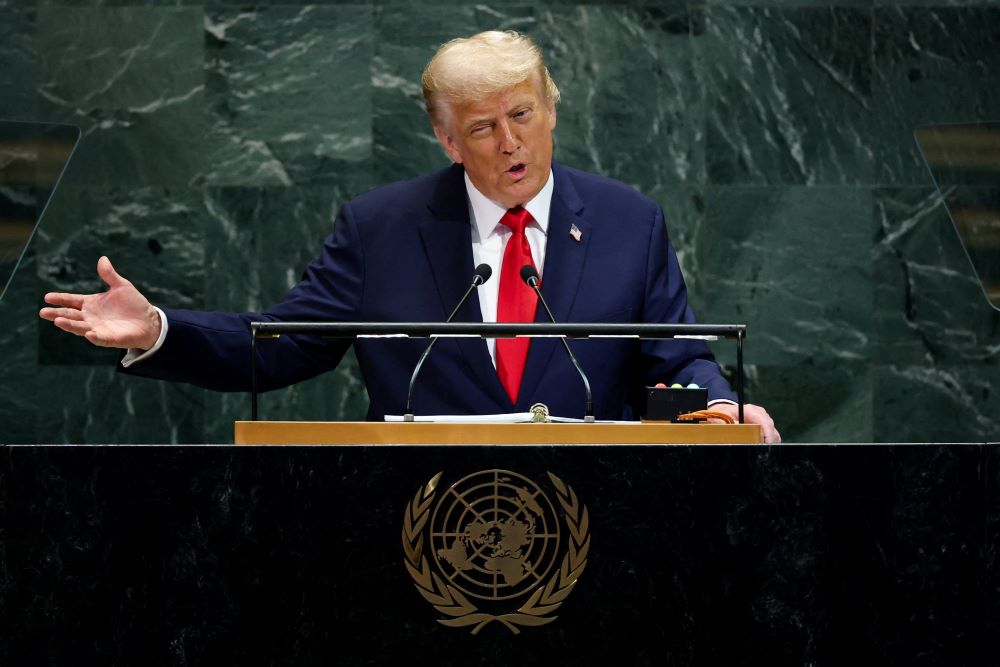
U.S. President Donald Trump addresses the 80th United Nations General Assembly at U.N. headquarters in New York City Sept. 23, 2025. In the speech, Trump called climate change "the greatest con job ever perpetrated on the world." (OSV News/Reuters/Mike Segar)
"These decisions will have painful and direct repercussions on the lives of vulnerable populations and God's creation already suffering from a changing climate," Bishop A. Elias Zaidan, chairman of the Committee on International Justice and Peace for the U.S. Conference of Catholic Bishops, said in a statement to the National Catholic Reporter
The U.N. Framework Convention on Climate Change, or UNFCCC, as it is commonly called, was adopted in 1992 and opened for signatures during the Earth Summit in Rio de Janeiro later that year. It is under the convention that countries have held 30 climate summits — most recently in November in Belém, Brazil, at the edge of the Amazon rainforest — to negotiate solutions to limit rising temperatures and with it suffering of millions of people and other creatures from more extreme storms, droughts, wildfires and flooding.
The U.S. Senate unanimously ratified the UNFCCC in 1992. Then-President George H. W. Bush called it a "historic treaty" and "the first step in crucial long-term international efforts to address climate change."
While the U.S. Constitution requires Senate ratification of any treaties, legal scholars have debated whether a president can withdraw from a treaty unilaterally and the process through which the U.S. could reenter a treaty at a later time.
In a joint statement, Catholic Climate Covenant — the Washington-based group that with 20 national Catholic partners guides church responses to climate change — and the North American chapter of the Laudato Si' Movement said that in withdrawing from international climate and environmental institutions, the U.S. "undermines our responsibility to listen to both the cry of the Earth and the cry of the poor."
"Climate change, ecological degradation, environmental disasters, forced migration, water scarcity, and biodiversity loss do not recognize national borders," the statement said. "Turning away from international cooperation on these issues does not make them disappear; it only leaves the most vulnerable and marginalized people, along with future generations, more exposed to harm."
'We're living in hard times, very dire times. But the hope is that more people are taking responsibility and taking action.'
—Sr. Carol De Angelo
The Maryknoll Office for Global Concerns, which in its missionary work in 25 countries sees up close the life-threatening impacts of intensifying droughts and rising sea levels, called it an "isolationist move" whereby the U.S. "is abandoning its moral responsibility as a leading global power and as the world's largest historical contributor to greenhouse gas emissions."
"Withdrawing from this framework is not just a policy shift; it is a rejection of our duty to protect our common home and the future of all humanity," said Lisa Sullivan, the Maryknoll NGO's senior policy officer for integral ecology.
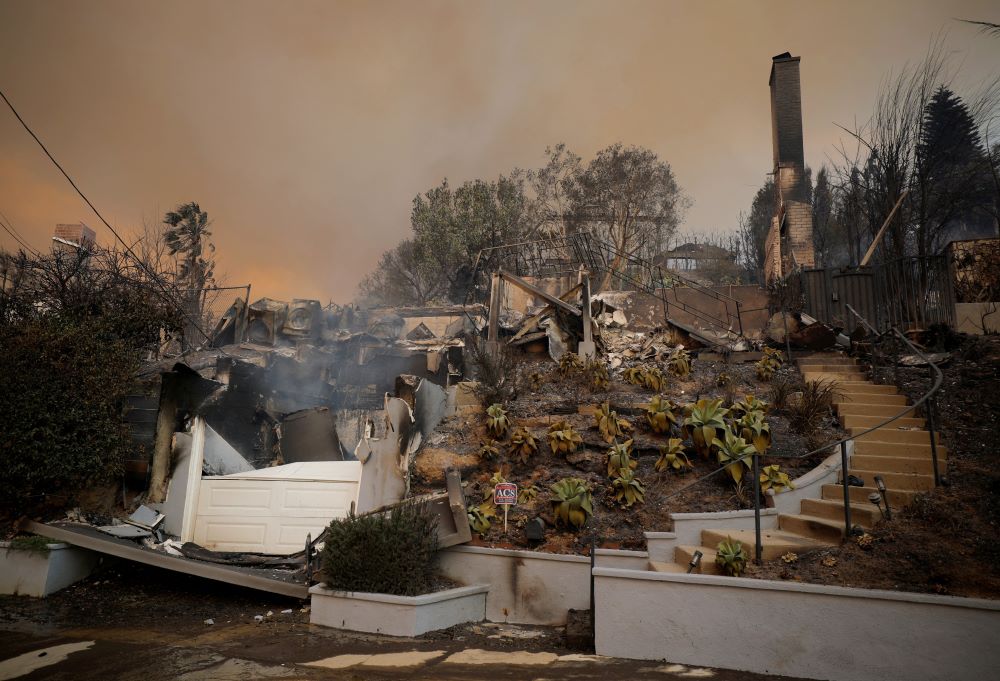
A burned home stands in ruin in the Pacific Palisades neighborhood of west Los Angeles Jan. 8, 2025. Wildfires in the Los Angeles area killed at least 31 people, destroyed more than 16,000 buildings and spread across nearly 80 square miles. (OSV News/Reuters/Mike Blake)
The executive order directs U.S. withdrawal from the Intergovernmental Panel on Climate Change, the leading scientific body established in 1988 that provides regular assessments on the current state and future risks of climate change alongside mitigation and adaptation options to inform policy decisions.
In all, Trump's executive order removes the U.S. from 31 U.N. entities and 35 additional organizations outside the U.N. who work closely with the international body. Others include U.N. organizations on water, oceans and energy; the U.N. Peacebuilding Fund and Peacebuilding Commission; global forums on counterterrorism and migration and development; the U.N. Population Fund; and U.N. offices related to preventing violence against children and children and sexual violence in conflicts.
On Jan. 8, the Trump administration announced the U.S. will also exit the Green Climate Fund, which since its establishment in 2010 has been a priority for the U.S. bishops' conference and other Catholic organizations.
Lamenting the moves, Zaidan in his statement noted the U.S. bishops' past advocacy for the climate fund, which assists developing countries in climate mitigation and resilience efforts, as well as for the Intergovernmental Panel on Climate Change and UNFCCC.
"We remain steadfast in our support for these multilateral organizations and international cooperation to care for our common home," said Zaidan, who heads the Maronite Eparchy of Our Lady of Lebanon of Los Angeles.
U.N. Secretary-General Antonio Guterres in a Jan. 8 statement expressed regret with the U.S. moves, and underscored that all U.N. member-states, including the U.S., hold a legal obligation to contribute to its regular budget and peacekeeping budget.
"The United Nations has a responsibility to deliver for those who depend on us. We will continue to carry out our mandates with determination," Guterres said.
Commenting on the departures, Secretary of State Marco Rubio, who is Catholic, said many of the international organizations were "dominated by progressive ideology" — including "climate orthodoxy" — "and detached from national interests."
In 2022, the Vatican formally joined the UNFCCC and the Paris Agreement after spending years in observer status. Each of the past three popes have regularly engaged with U.N. climate negotiations, including regular messages to diplomats and world leaders.
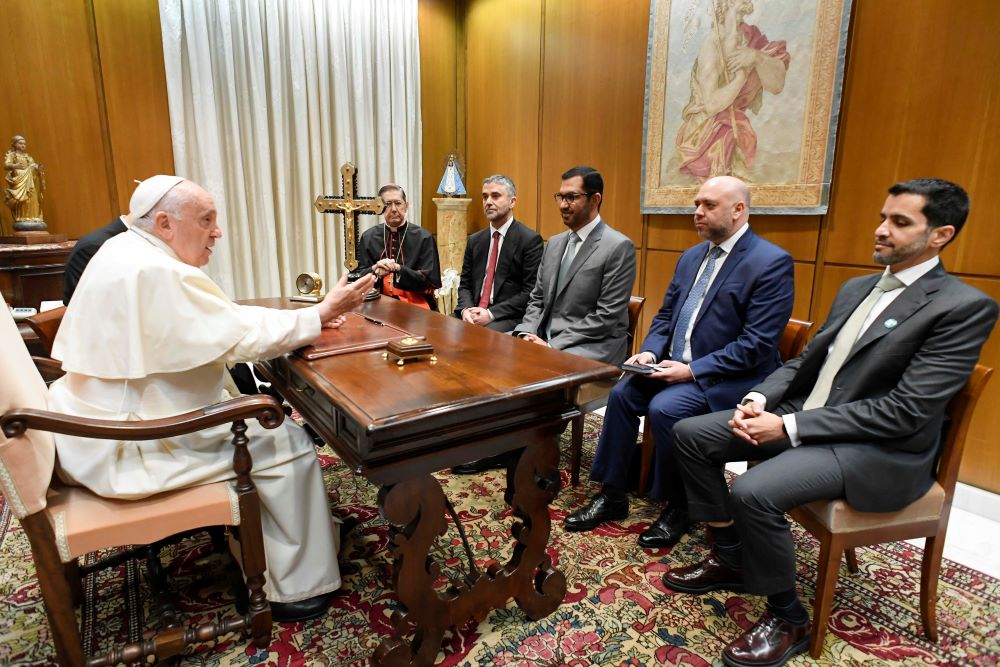
Pope Francis meets Sultan al-Jaber, the president-designate of the 2023 United Nations Climate Change Conference, known as COP28, his delegation and Cardinal Miguel Ángel Ayuso Guixot, prefect of the Dicastery for Interreligious Dialogue, at the Vatican Oct. 11, 2023. (CNS/Vatican Media)
Both Pope Francis and Pope Leo XIV in recent years have stressed the importance of maintaining and strengthening multilateralism in order to address global crises like climate change. Francis stressed it in his 2023 apostolic exhortation Laudate Deum and that Leo reiterated Jan. 9 in his message to the diplomatic corps to the Holy See.
"Due to their global nature, these challenges endanger the lives of everyone on this planet and therefore require international cooperation and a cohesive and forward-looking multilateralism which puts the sacredness of life, the God-given dignity of every human being and the common good at its center," Leo said in one of two messages to COP30. "Regrettably, we observe political approaches and human behaviors that go in the opposite direction, characterized by collective selfishness, disregard for others and short-sightedness."
The moves to withdraw from international treaties, agreements and organizations are the latest by the Trump administration to retreat from international spaces, and follow a year of eliminating federal climate and environmental policies and regulations.
In an interview, Sr. Barbara Bozak, an American sister who represents the Congregations of St. Joseph at the U.N., said the latest U.S. withdrawals were not surprising but go against long-standing commitments made by the United States — commitments she said affirmed multilateralism, the U.N. Charter and "peaceful responses to difficult situations."
At the same time, said Bozak, who attended COP30 in Brazil, the absence of an official U.S. presence at the conference was in some ways a relief because of past U.S. intransigence to multiple climate treaties and agreements, including the Trump administration's opposition to climate-related initiatives.
Still, it is disappointing, she said, that the U.S., a key founder of the United Nations in 1945 and a dominant influence at the world body since, seems intent on opposing and chipping away at global multilateral cooperation.
"The United Nations is about building relationships — relationships that make everyone better off," she said. "That should be in the interest of the United States."
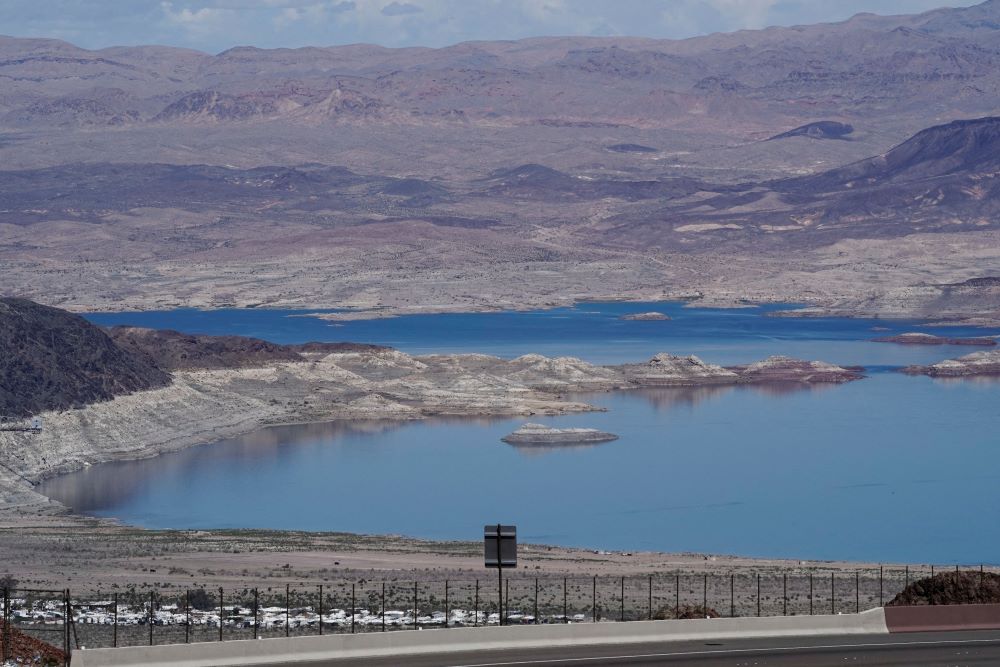
An elevated view shows the dramatic decline of water levels at Lake Mead near Boulder City, Nev., March 13, 2023. At the time, the nation's largest reservoir has reached its lowest water levels on record since it was created by damming the Colorado River in the 1930s. (OSV News/Reuters/Bing Guan)
More broadly, Bozak said, recent U.S. actions in Venezuela and threats being made by Trump against other countries are one type of power that is at odds with the U.N. Catholic social teaching that affirms "listening to people, supporting people and their right to build peace."
"It's about working together," she said. "Power is in our voice, our care, our love, not in military action."
Sr. Carol De Angelo, director of the Office of Peace, Justice and Integrity of Creation for the Sisters of Charity of New York and an NGO liaison for her congregation at the U.N., said she is upset by the Trump administration's moves to withdraw from U.N. treaties and leave U.N. programs, saying that it "goes against [global] coalition and consensus building."
"We don't believe in this anymore," she said of the Trump administration's actions.
At the same time, she finds hope that in the absence of the U.S. government from international events like COP30, more and more grassroots groups are stepping up their activism and perhaps getting stronger.
"There is hope that way," she said.
Advertisement
De Angelo thinks that includes faith-based groups and movements like Laudato Si' Movement and Catholic Climate Covenant, which she said are more energized than ever before. She added that federal abandonment of climate-related initiatives presents an opportunity among U.S.-based grassroots groups to focus on state-level environmental policies.
"We're living in hard times, very dire times," De Angelo said. "But the hope is that more people are taking responsibility and taking action," not only on climate-related issues but concerns over immigration policy and democracy.
She said 2026 will be crucial for grassroots groups to "hold Congress more accountable" in the wake of Trump administration policies, including actions on climate.
De Angelo noted that Francis "put his faith in popular movements" as the way change on climate policy will happen. Still, she said, the abandonment of federal policy on a host of issues, including climate action, "is causing a lot of pain right now."
Editor's note: This article was updated to add the comments from Bishop A. Elias Zaidan, chairman of the Committee on International Justice and Peace for the U.S. Conference of Catholic Bishops.