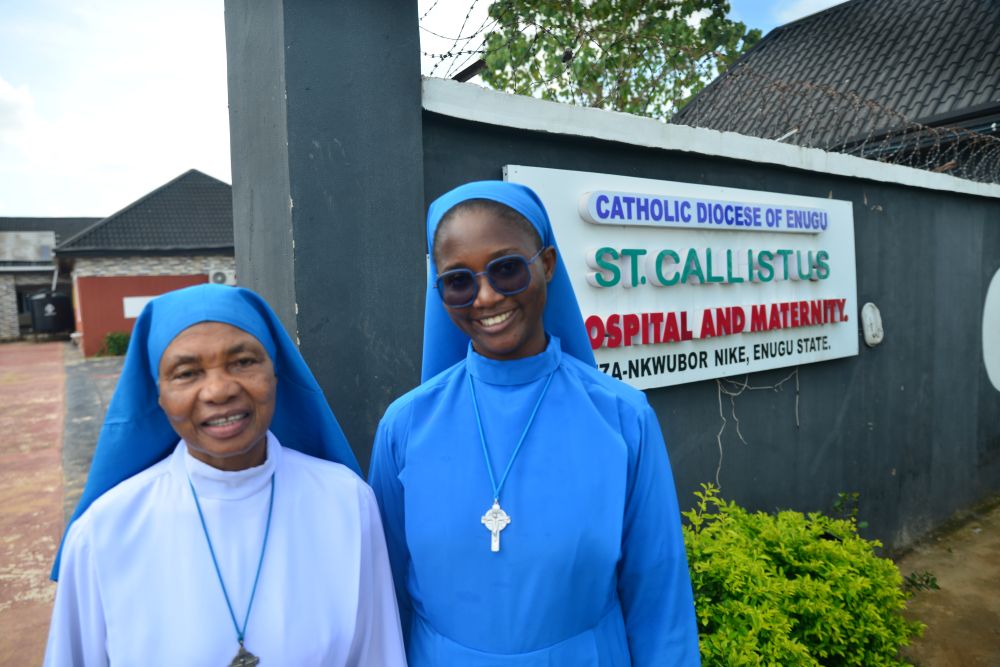
Daughters of Divine Love Srs. Mary Calisata Iwuji and Jacinta Nwankwo pose for a photo in front of the diocesan clinic in Ezza-Nkwubor Nike, a remote village in Enugu State, southeast Nigeria. (Patrick Egwu)

by Patrick Egwu
Tucked away inside Ezza-Nkwubor Nike, Enugu State, a remote village in southeast Nigeria, St. Callistus Hospital and Maternity, a local diocesan clinic, serves a community of about 3,500 people.
Run by the Daughters of Divine Love, the Enugu State clinic was established in 2025 by Nigerian Fr. Richard Uche Ozoude, and built with support from Austrian partners and the government of Upper Austria.
Four sisters of the Daughters of Divine Love congregation live at the hospital, which also serves as their community. The sisters say the hospital's services have been impacted by heavy rains and floods which have damaged sections of the road leading to their community, making it almost impassable for patients, carers and during emergency responses.
"Whenever it rains, we cannot just go out of this community because we don't have any means of transportation," said Sr. Mary Calisata Iwuji, the congregation's superior at the hospital. "The bad roads are affecting our work and patients' flow because most of them live far from where we are located."
The sisters navigate many hurdles to travel outside the community. For instance, to procure medical and food supplies in Enugu, the state capital, the sisters walk for about 2 kilometers (1.2 miles) to then get on two-wheeled motorcycles, a major form of transportation for locals, farmers and traders in the community. With no malls or grocery stores nearby, motorcycle riders charge $1 to $2 depending on the distance. A two-hour ride could cost up to $4 on rainy days.
"It's a terrible condition we have found ourselves in and there is nothing we can do about it," said Iwuji, a staff nurse midwife, who arrived at the hospital recently from Imo State, a border state. "Patients no longer come here like they used to."
Whenever the Daughters of Divine Love congregation in Enugu hosts an event, Iwuji said they cannot attend because it is difficult to travel out of the community.
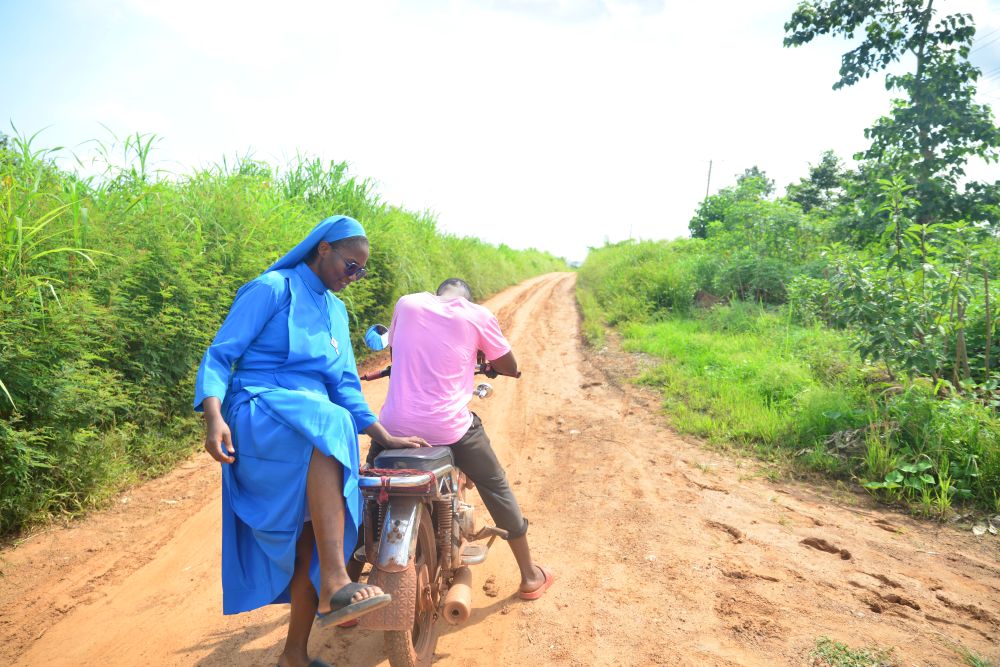
Daughter of Divine Love Sr. Jacinta Nwankwo mounts a motorcycle, which serves as the main means of transportation to Ezza-Nkwubor Nike, a remote village in Enugu State, southeast Nigeria. (Patrick Egwu)
Iwuji works at the hospital with Sr. Jacinta Nwankwo, a nurse who arrived in the community in August after her first profession.
"This was the first community I ever worked in," Nwankwo said. "The first day I came it was raining, which worsened the condition of the road and the car I came in was struggling to maneuver."
But Nwankwo said she came prepared to live in a remote community. Before arriving, she purchased waterproof rain boots to help her navigate the muddy roads.
"The road has made me not want to go out anymore," Nwankwo said. "I only go out to get supplies and I do that once every two weeks. We just have to plan our movements and know when to go out to get what we need."
Nigeria's flood problem
During the rainy season, which typically runs from March to October, thousands of homes and farmlands are washed away as a result of flooding, which also causes power and telecommunications outages. In 2022, Nigeria experienced a devastating flood that killed more than 600 people. An estimated 1.5 million people were displaced and 500,000 hectares (1.2 million acres) of land destroyed.
A study by an international team of scientists at the World Weather Attribution said heavy rains behind the floods were about 80 times more likely because of human-induced climate change.
In August, the Nigeria Hydrological Services Agency issued a flood alert, warning that of Nigeria's 36 states, 33 could experience river flooding as water levels continue to rise. The warning showed that several communities, especially those around rivers and floodplains, are at risk.
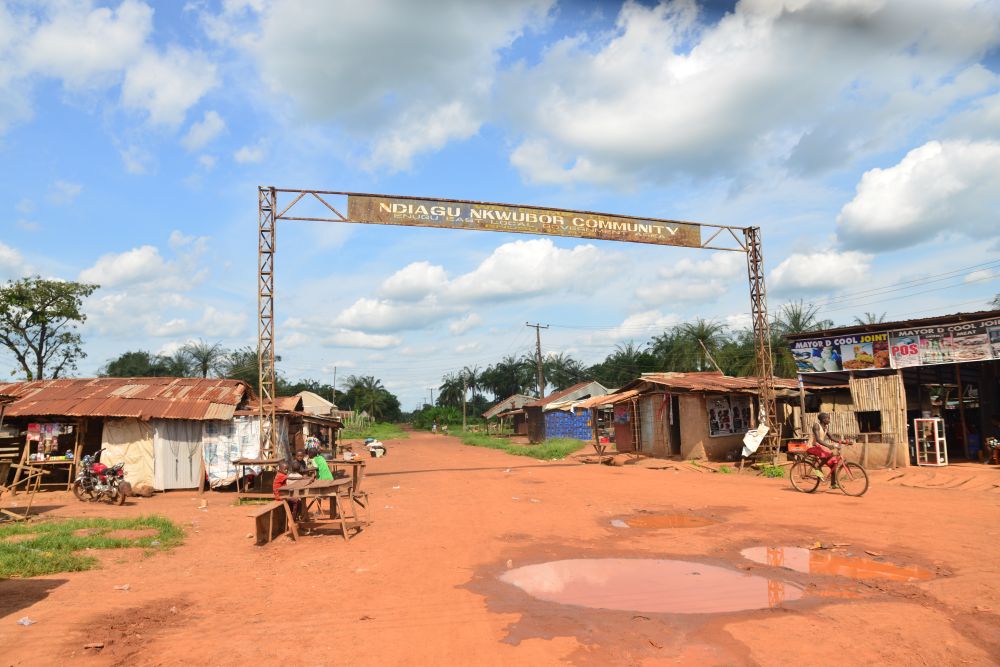
Ezza-Nkwubor Nike, Nigeria, where four Daughters of Divine Love sisters live and minister, has a population of about 3,500 people. (Patrick Egwu)
Sisters from different communities in Nigeria live in some of these areas predicted to be affected by flooding, including Sr. Maria Kamdilichukwu Madubuonwu, a Daughters of Divine Love sister who runs a vocational institute for more than 100 young girls. She said their community has been affected by recurrent flooding and a perimeter fence at the institute is on the verge of collapsing.
"We have been living in a flood zone for many years," she said. "This is a big risk for us and the girls who live with us."
Madubuonwu said she has unsuccessfully lobbied local politicians for intervention on the damaged portions of the roads leading to her community.
"There is no drainage system or water channel to control the water whenever it rains," she said.
Madubuonwu and the girls at the institute are trying to fix the road themselves.
"We collect empty bags, fill them up with sands and stones to place on the damaged road to make it passable for us and others in the community," she said. "So far it has been helpful but not sustainable."
Advertisement
As Nwankwo was checking files and responding to patients' queries, a middle-aged woman feeling weakness, dizziness and loss of appetite was brought into the hospital. The sisters rushed to attend to her and administer medication as her carers walked frantically along the aisle. Nwankwo said the woman shows symptoms of malaria and typhoid.
Despite the challenges they face, Nwankwo said she is determined and motivated to continue her work in the community.
"I like it here because it's a peaceful and quiet place for meditation," she said. "My joy working here is the opportunity to take care of our patients and see them recover and be happy."