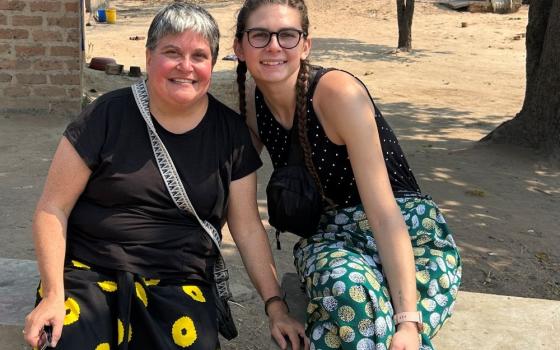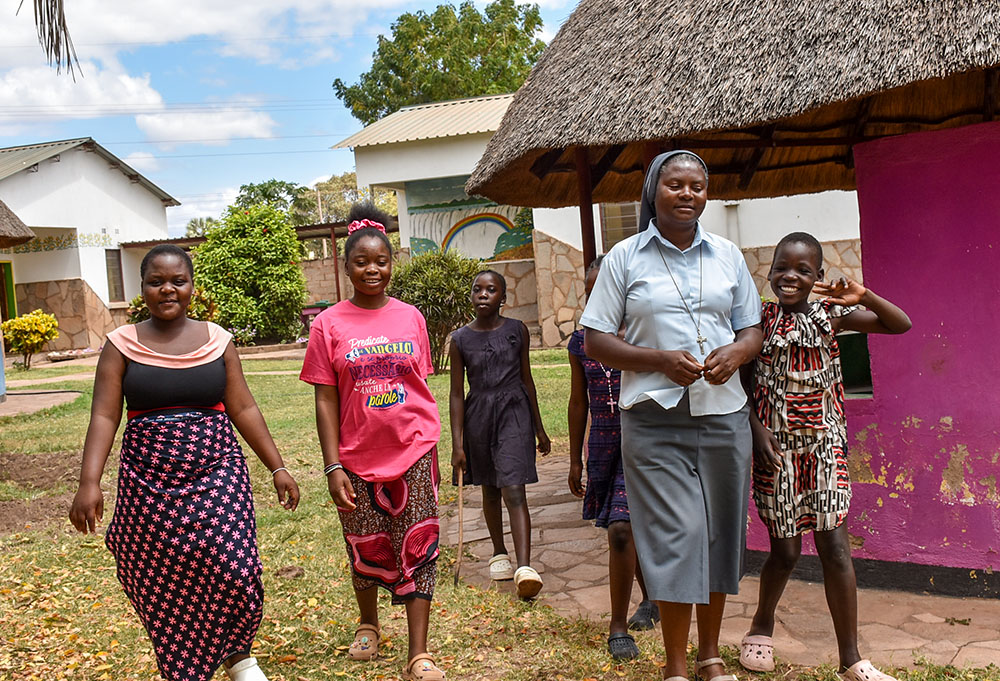
Sr. Sharon Shabolyo of the Sisters of Charity of Sts. Bartolomea Capitanio and Vincenza Gerosa with some of the girls she helps care for at the Mudzi-Wa-Moyo Orphanage in the Chirundu District of Zambia. (Derrick Silimina)

by Derrick Silimina
Along the banks of the mighty Zambezi River, dozens of freight trucks line up at the Chirundu border post between Zambia and Zimbabwe, an important trade gateway between the two southern African countries. However, beneath this major economic artery lies a harsh reality.
Long-distance truckers have turned the border town into a temporary settlement due to customs delays, where an informal economy at the Chirundu frontier has become deeply entangled with transactional sex.
"Out of desperation, I nearly let a friend convince me to give in to truck drivers for quick cash," one young woman, who asked to remain anonymous, told Global Sisters Report. "I thank God that the following day, I met the Sisters of Charity, who saved me from the red-light zone."
Her life first changed when she was placed in the care of abusive relatives after the death of her parents. She said that she experienced severe mistreatment, and a lack of financial support forced her to drop out of school in the eighth grade. She then turned to friends for guidance on how to survive.
During routine outreach in the border settlements, the Sisters of Charity encountered her and offered shelter at the Mudzi-wa-Moyo Orphanage, where she was able to resume her schooling and rebuild her life. She now works at a restaurant in Chirundu.
"Had it not been for the sisters' intervention, I would be dead by now. Their humanitarian work is restoring hope and giving a fresh start to countless vulnerable girls here in Chirundu."
Located about 140 km south-east of Zambia's capital, Lusaka, Mudzi-wa-Moyo currently cares for 60 orphaned and vulnerable girls by meeting their essential needs for shelter, food and clothing.
The Sisters of Charity of Sts. Bartolomea Capitanio and Vincenza Gerosa founded the orphanage (Village of Life in the Chewa language) in 2003 to address a high population influx to the border town, poverty and unplanned pregnancies among transit workers.
Advertisement
For Grace Chindima, her vulnerability began at 3 years old after her mother's sudden death. The Department of Social Welfare stepped in to support her family, relieving her father's constant struggle to afford basic necessities. In 2022, she was brought to Mudzi-wa-Moyo, where she found the support she needed to thrive, enabling her to progress from grade six to 11 at Mandanga High School.
"I was 14 years old when I came to Mudzi-wa-Moyo. Life changed for me, and it was like a dream come true. Everything was good. I had everything I needed: food, school, uniforms, clothes and care," she stated.
Chindima, now 17, said widespread poverty and proximity to the border town have exacerbated and exposed girls in Chirundu to high risks of sexual exploitation.
She said the sisters' efforts are essential, as they empower at-risk girls through transformative education. She told GSR that she aspires to become a surgeon and hopes to one day give back and support vulnerable communities just as the sisters did for her.
"My heartfelt gratitude also goes to the sisters for lifting girls out of poverty by transforming our lives."
Working with the Zambia Police Service and the Department of Social Welfare, the orphanage aspires to break the cycle of intergenerational poverty in the border town. Through holistic care and formal education, young and at-risk girls are equipped with the social, psychological and academic tools needed to build self-sustaining futures.
Mudzi-wa-Moyo administrator Sr. Sharon Shabolyo told GSR that her work relies on close collaboration with government agencies, local communities, and families to address the immediate needs of affected girls.
"The institution is aimed at taking care of vulnerable children who are deprived of basic needs, and we see to it that they go to school so that one day they may be independent and responsible people," she said.
Shabolyo said that while the facility has achieved significant success, funding deficits restrict operations. She added that reintegrating long-stay children into family units requires greater resources and specialized adolescent care, without which vulnerable young girls face increased risks, including teenage pregnancy.
She expressed gratitude for the orphanage's impact, sharing that numerous graduates are now gainfully employed, happily married, and living stable, secure lives.