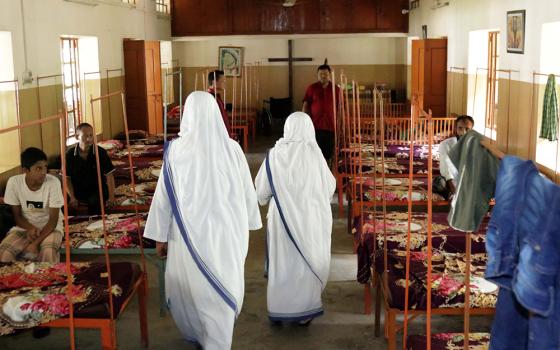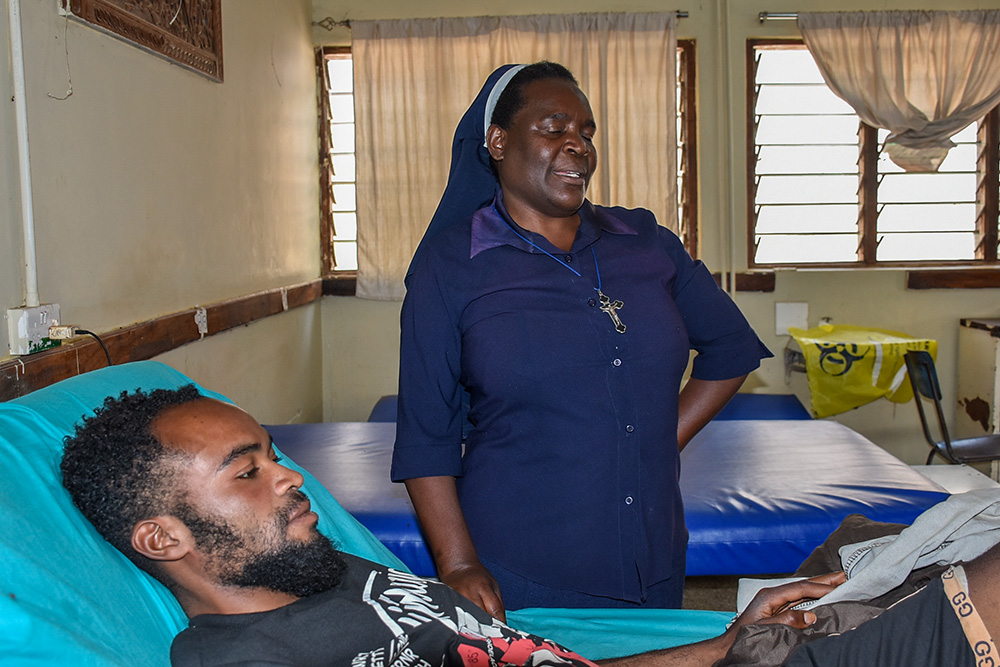
Sr. Prisca Chuzu of the Handmaid Sisters of the Blessed Virgin Mary checks on traffic accident victims admitted to Nangoma Mission Hospital in central Zambia. (Derrick Silimina)
by Derrick Silimina
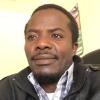
Left gasping for air in the dust of Central Zambia after a horrific car crash, Mweemba Mazuba's life hung by a thread until Nangoma Mission Hospital pulled him back from the brink.
"I remember looking at the sky through shattered glass, I felt my life fading. Waking up moments later in Nangoma Mission Hospital, I realized God had used those doctors to give me a second chance at life," Mazuba told Global Sisters Report.
He vividly recalls surviving a near-fatal crash along the notorious Lusaka-Mumbwa highway. After casting his vote in the recent general elections in Itezhi-Tezhi, he caught a lift back home to Lusaka. However, near the Nangoma area, the driver lost control while attempting to overtake two heavy freight trucks, causing the small car to flip four times.
Mazuba, 22, recounted how nearby villagers and passersby rushed to the scene within minutes of the crash and swiftly freed him and the unconscious driver from the wreckage. He and the driver were rushed to their nearest lifeline — Nangoma Mission Hospital.
Founded in 1987 by a Jesuit priest, the facility was built to serve nearby Nangoma communities, saving residents a 50 km journey to Mumbwa district for medical care.
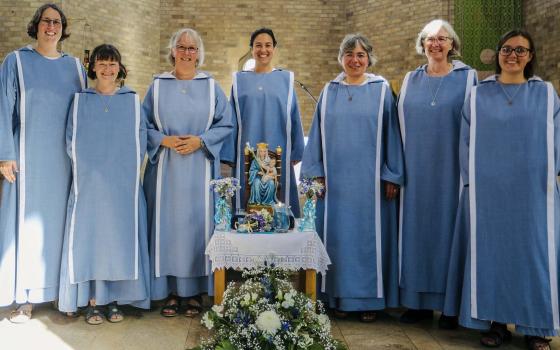
Managed by the Handmaid Sisters of the Blessed Virgin Mary, the 150-bed facility is now owned by the Lusaka Archdiocese. Hospital administrator Sr. Prisca Chuzu noted that the health center serves a rural population of roughly 158,000-210,000 residents, significantly easing the pressure on public health resources.
Road traffic accidents in Zambia increased by 18.1% in the second quarter of 2026, with the Zambia Police Service recording more than 11,000 crashes countrywide, a sharp rise compared to the same period in 2025.
Beyond the daily toll of road traffic accidents overwhelming its casualty bays, Nangoma Mission Hospital faces another growing crisis. Driven by a rush of fortune seekers flocking to Mumbwa District, a surge in illegal gold mining activities has brought a steady wave of crushed limbs, severe trauma and chemical exposure to the hospital.
Advertisement
"My friend and I had teamed up to dig at an informal gold mine near our home when the earth above us suddenly collapsed. We were fortunately rescued from under the rubble, though I suffered fractures in both legs," said Gift Moonga.
Moonga, 30, noted that his complete recovery stands as a true testament to the exceptional, life-saving care provided by the medical team at Nangoma Mission Hospital.
Motorcycles have also fast become a lifeline in this rural community, bridging the gap between scattered farms, central markets and schools. But mobility comes at a heavy cost as basic road safety has been widely ignored and helmet compliance along Nangoma's feeder roads is virtually nonexistent.
This safety vacuum hits Nangoma Mission Hospital hardest. In the acute care ward, staff constantly manage severe traumatic brain injuries, facial fractures and skull fractures. These daily emergencies push the rural facility's limited resources, blood supplies and surgical capacity to the brink.
"We are deeply concerned about the near-daily accidents because we receive at least one casualty per day from vehicle and motorbike crashes along the main road, as well as injuries linked to the local surge in illegal gold mining around here," Chuzu told GSR.
Nestled 112 km from Zambia's capital along a bustling transit highway, Nangoma Mission Hospital's daily operations highlight its essential role, whether that is routine medical attention for patients like nursing mothers and elderly farmers, or a maternity ward equipped to handle critical deliveries.
Following her vows in 1992, Chuzu, 56, served at several mission posts in her congregation and worked briefly in private school administration and later transitioned into healthcare, studying nursing. After being posted to manage Nangoma Mission Hospital in 2011, she faced a severe shortage of midwives, an experience that inspired her to pursue further specialized training at the Kabwe School of Nursing and Midwifery.
"Our fully equipped maternity and antenatal wards maintain a zero mortality rate and a 100% successful delivery rate. More local mothers are choosing our facility over home births, significantly reducing maternal and infant mortality," she said.
Esiya Mutoya, 38, traveled 30 km from her home to the health center, where she has spent five days at a "mother's shelter" waiting to give birth.
"I have full confidence in the care at this facility because of the efficient antenatal services that I and other mothers have experienced since it opened," said Mutoya.
Grace Kamwendo is delighted after the safe, complication-free C-section delivery of her baby girl at the mission hospital's maternity wing.
"I was terrified of having complications after my cesarean delivery," said the 21-year-old Kamwendo. "I'm so relieved the operation was a success, my wound is healing well and my baby boy is healthy. I can't wait to go home!"
Chuzu said that the hospital operates with five medical doctors, 12 clinical staff and 54 nurses and serves as a referral center for eight government-managed rural health centers. The facility also manages an active anti-retroviral therapy clinic supporting approximately 3,000 patients.
Chuzu also highlighted the daily struggles of managing the complex health center, citing major obstacles such as a broken-down X-ray machine and high fuel expenses for frequent ambulance trips to Lusaka's main referral hospital, University Teaching Hospital, driven by a high number of accident cases.
Three days after his admission to the Nangoma Mission Hospital, Mazuba is still traumatized and remains in disbelief that he made it out alive from the horrific car crash, especially after seeing the mangled wreckage at Nangoma Police Post.
"I would like to thank the medical staff and management at Nangoma Mission Hospital for their swift medical expertise. Had it not been for their quality emergency healthcare, I would have died," he said.