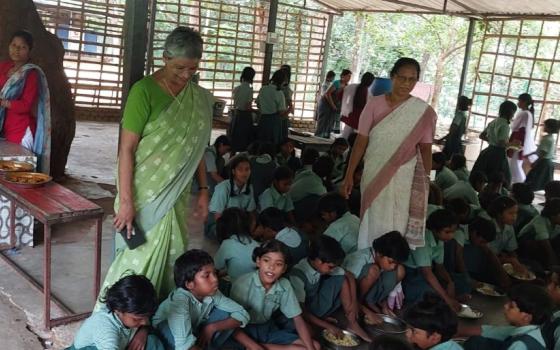
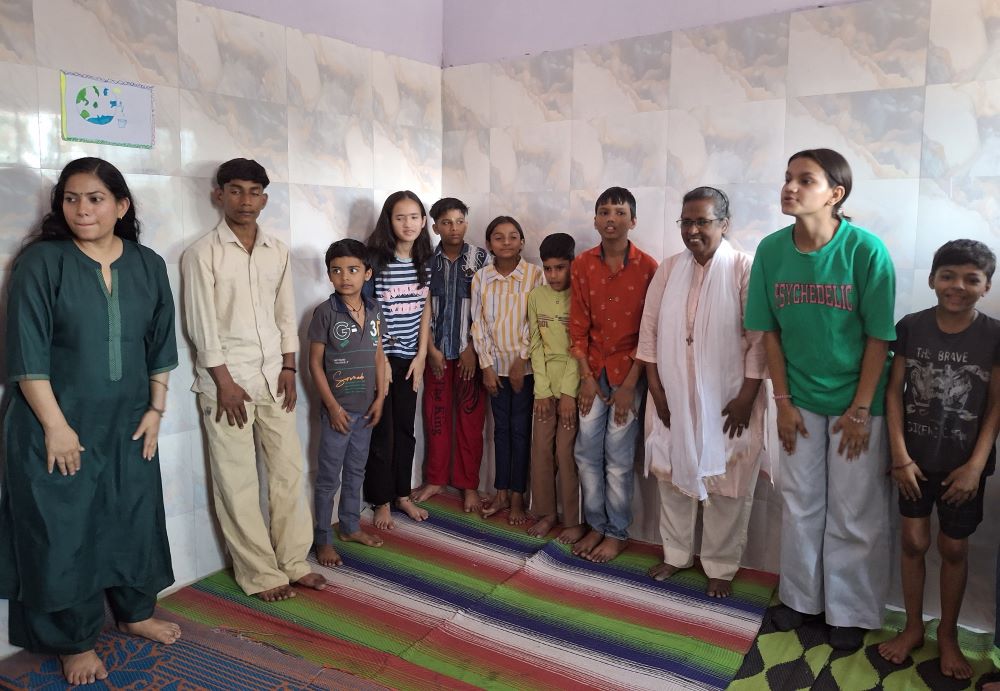
Sr. Connie Callista, a member of the Holy Cross Sisters of Chavanod (third from right), works with children doing indoor training at Trilokpuri, an enclave in East Delhi, India. (Lissy Maruthanakuzhy)
by Sr. Lissy Maruthanakuzhy
Sr. Connie Callista, a member of the Sisters of the Cross of Chavanod, is dedicated to educating children at the margins.
Callista was born into a family with five sisters and one brother in Mandre, Goa (western India). She was inspired by her mother, who was hard working, generous, and shared shelter, food, and clothing with those in need. As a child, she felt drawn towards the poor and marginalized, especially those on the peripheries.
She joined the congregation at 23, after a few years of teaching. She spent 32 years as a teacher in schools the congregation manages in remote villages. She has helped many students "come up" in life.
After she retired from teaching, Callista began working with PRATYek (Presence and Right-relations for Advocacy and Training of the Young in Earth-rights and Kids-rights), an NGO founded by a former member of the Congregation of Christian Brothers. The NGO uses a play method that instills in children an interest in education and helps them focus on what they want in life and achieve it.
Callista, 67, spoke with Global Sisters Report about her work.
GSR: How and why did you join Pratyek?
Callista: I learned about its founder, Steve Rocha [a former Christian Brother], through the Conference of Religious of India. I closely watched how the NGO worked for children and communities on the margins.
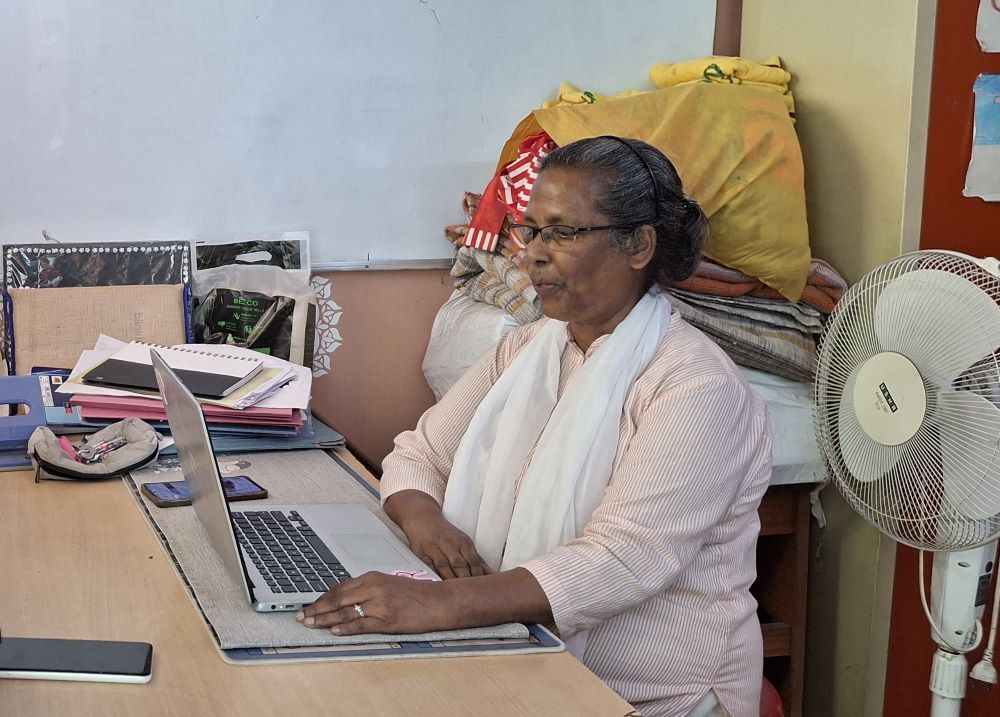
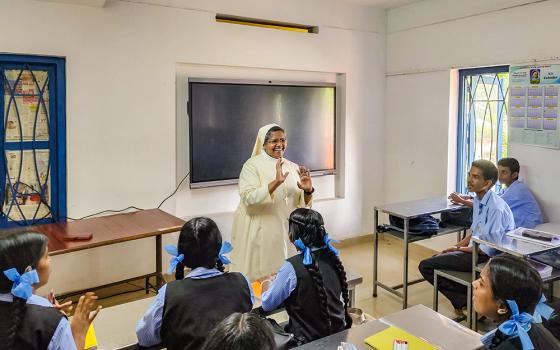
Sr. Connie Callista, a member of the Holy Cross Sisters of Chavanod, sits at the Praytek office in Mayur Vihar on the outskirts of New Delhi, India. (Lissy Maruthanakuzhy)
What inspired me was the NGO's efforts to develop and empower children, particularly the children's parliament system started by Steve. It helps children learn responsibility and encourages them to participate in decision-making processes that affect their lives.
What are Pratyek's objectives?
To ensure a happier and more dignified childhood for every child, by ensuring every right for everyone. Steve founded Pratyek in 2013, inspired by the teachings of Edmund Rice, the founder of the Congregation of Christian Brothers.
Pratyek works with more than 100 NGOs and 300 schools in 28 Indian states, impacting more than 2.5 million children. It empowers marginalized children through the promotion of education and programs that promote children's rights, protection of the earth, climate change initiatives, participation in sustainable development goals, and justice.
What is your role in these efforts?
I work mainly with children. After school hours, they are trained at our center. We promote a play method called SOCUS (Circus for Social Causes), which uses art as a tool for social change. For us, art is not mere fun, but a tool for the holistic development of children.
I also participate in Pratyek's outreach activities. Corporate houses donate money and we buy blankets to distribute among the homeless. Various NGOs and Catholics also support us. We work with visually challenged people and their children, and promote justice and fairness within schools.
Please elaborate on the SOCUS program.
We use circus skills for social change. It is a powerful child rights initiative that uses circus skills such as juggling, stilt-walking, unicycling and traditional street performances to empower poor children. Through stage performance and storytelling, children gain confidence and advocacy skills to address inequity, marginalization, climate change and social injustice.
This program promotes the U.N. global goals and aims to influence the Post-2030 Agenda by centering the voices of child-citizens, or kidizens, in local, national and global policy-making conversations. We had a flagship production, "Christmas For All," in November and December 2025. It featured "kidizens" of all faiths, socioeconomic backgrounds, and dis/abilities who used circus art to demand a just, sustainable and inclusive world.
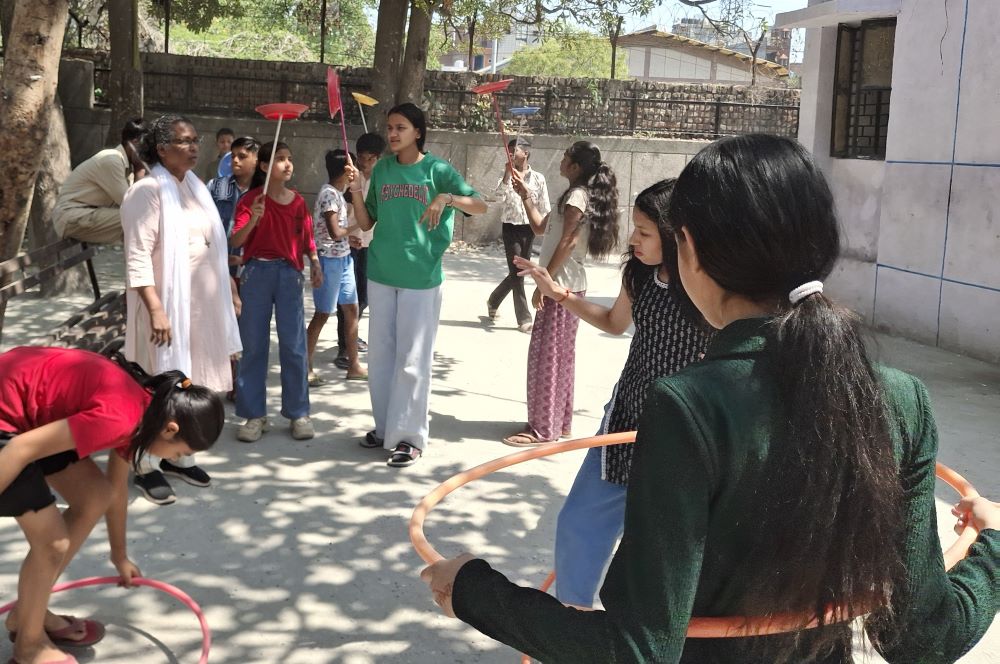
Sr. Connie Callista, a member of the Holy Cross Sisters of Chavanod (second from left), supervises children practicing SOCUS art at Trilokpuri, an enclave in East Delhi. (Lissy Maruthanakuzhy)
What are your daily activities?
We have an hour of meditation every morning to understand each other and accept each other. It also helps us to thank God for giving us life to serve others. Following this, I plan office activities as the administrator. We have school-embedded justice — we organize programs with schools for teachers and students. I spend my time in the office as well as in places where children are trained.
What are some success stories?
Souran was 10 when he joined Pratyek in 2013. Now, he is our program coordinator. He choreographed the "Christmas for All" program, connecting the 17 global goals with Christmas. He has traveled to Australia with Steve Rocha for programs. He teaches SOCUS Art in various schools in Mumbai now.
Nikky and Ruskar also joined us as 10-year-olds. They are now studying for a Bachelor of Arts in social work through distance education. At the same time, they work as our trainers for school students and earn 20,000 rupees (US$212) a month. They are paid so that they recognize their self-worth.
Does your congregation support your work?
This is a very meaningful question. Initially, it was not easy for me to explain how I would work in an NGO setting after many years of teaching in our schools. I underwent discernment and sought my superiors' permission. There were times I had doubts, but I trusted that God would guide my path.
Finally, my superiors permitted me. I believed that if the work is for the greater good, especially for children and the marginalized, God would bless my journey. I joined Pratyek four years ago with a desire to serve children and communities in need.
Has your involvement with Pratyek helped your religious life?
Indeed! It has shaped my daily living and my relationship with God and others. It has helped me realize that my mission is not separate from my spirituality, but a living expression of it.
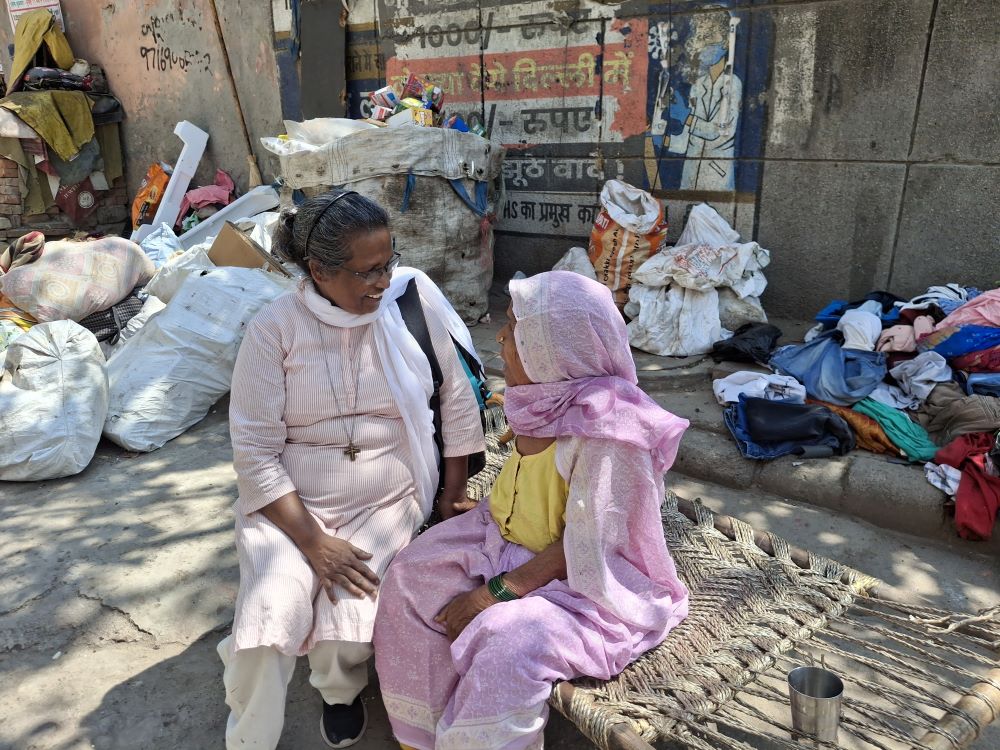
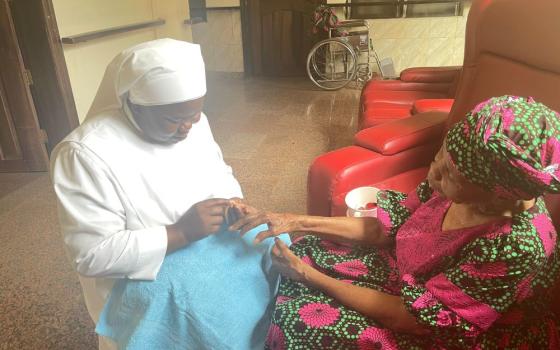
Sr. Connie Callista, a member of the Holy Cross Sisters of Chavanod (left), sits with an elderly woman at Trilokpuri, an enclave in East Delhi. (Lissy Maruthanakuzhy)
Engaging with children and the marginalized has helped me encounter God in a real and tangible way. I have begun to recognize the divine presence in each person, particularly in the innocence, struggles and resilience of the children I serve. This awareness has transformed my outlook, making my faith more alive and grounded.
My work with Pratyek has made me more mindful and compassionate. It has deepened my relationship within my religious community, fostering greater understanding, patience and acceptance. I have learned to listen more attentively, respond with empathy and value each person's dignity.
I have also discovered a deeper sense of the divine within me. I experience God not only in structured moments of prayer but in action, silence and relationships. This has brought a sense of inner peace, purpose, and integration between my faith and mission.
Advertisement
My work has helped me live my religious vocation more authentically, where prayer, service and relationships come together, leading me towards a deeper union with God and a more meaningful commitment to others.
The option for the poor, which is clearly stated in our Rule of Life, is central to my mission. My work with marginalized children and communities gives a concrete shape to my commitment to "make the good God known and loved."
Our founder, Mother Claudine Echernier, reached out with compassion to the poor. The emphasis on education for social change is also reflected in my involvement.
Moreover, the spirituality of finding God in all things is experienced in my daily activities. I encounter God in the children, the poor and in every moment of service.
My guiding inspiration is from the Scripture: "Whatever you did for one of the least of these brothers and sisters of mine, you did for me." I am convinced that my mission and daily life are a true expression of the charism of my congregation.