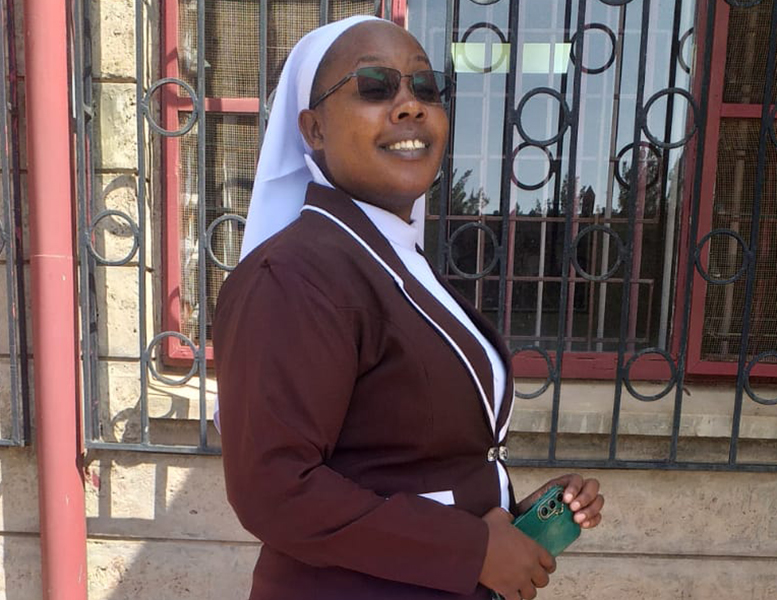
Sr. Immaculate Muthoni is a Kenyan sister of the Little Sisters of Saint Francis and a practicing lawyer who weaves her vowed life with legal advocacy for human rights, governance, institutional accountability and compliance. (Courtesy of Immaculate Muthoni)
Sr. Immaculate Muthoni is a Kenyan sister of the Little Sisters of St. Francis and a practicing lawyer who weaves her vowed life with legal advocacy for human rights, governance, institutional accountability and compliance. Inspired by Kenya's post-election violence in 2007 and 2008, when vulnerable people without legal recourse sought refuge in her formation house, she felt called to make justice "lived, not just preached."
After encouragement from her novice mistress, she decided to pursue studies in law to uphold truth, dignity and justice. She says that she only handles civil and rights-based cases, avoiding divorce and criminal matters due to Catholic teachings on marriage and life. She provides pro bono services, referrals and free legal training on social media to empower communities.
Muthoni agreed to an interview with Global Sisters Report and shared her journey.
GSR: Please describe your journey from religious formation to practicing as an advocate.
Muthoni: My journey into law was not a departure from religious formation. During my formation, I was constantly exposed to human vulnerability, conflict, injustice, inequality and silence where voices could not be heard.
In 2007-08, when Kenya witnessed post-election violence, we had a church where our formation house was situated, and victims of the clashes would take refuge there. The church reached out socially and spiritually, but in terms of justice, nobody advocated for those individuals. It struck me that suffering was not only spiritual and social, but also legal.
These were key moments, when accompanying vulnerable people who did not even understand their rights, and witnessing institutional decisions that deeply affected their lives without accountability, that I had a conversation with my mentor and novice mistress, Sr. Teresiah Muthoni. She challenged me to think of how I could make justice lived, not just preached. Thus, law emerged as a concrete way of serving truth, dignity and justice.
Advertisement
You have chosen not to take on divorce, murder or criminal cases. What principles inform that boundary?
My decision not to pursue divorce and criminal matters is shaped primarily by the moral teaching of the church and my formation, alongside my professional discernment. The Catholic Church teaches that marriage is a sacrament and is, by its nature, indissoluble. This is grounded in Scripture and is well articulated in canon law, which affirms that a valid, consummated, sacramental marriage cannot be dissolved by any human power. That's the standing of the church, and because of this teaching, I see no reason I should.
My formation also emphasizes reconciliation, restorative justice and protection of the vulnerable. That's why I focus on civil, institutional, human rights, governance, and compliance-related matters where my moral framework, training and skills align more effectively.
My avoidance of criminal matters such as murder is rooted in the church's strong emphasis on the sanctity of human life, as well as my vocational call to focus on areas where formation best aligns with restorative justice and institutional accountability.
I always explain to my clients the life I have chosen and what values I am supposed to uphold as a nun.

Sr. Immaculate Muthoni is a Kenyan sister of the Little Sisters of Saint Francis and a practicing lawyer who weaves her vowed life with legal advocacy for human rights, governance, institutional accountability and compliance. (Courtesy of Immaculate Muthoni)
When you introduce yourself in court as "Sister Immaculate, advocate," many are surprised. How does your identity as a religious sister influence how clients, colleagues or judges respond to you?
An example of how I introduce myself is, "May it please your court, your honor: My name is Sister Immaculate. I'm appearing for the plaintiff." This surprises people. Others are also curious, wondering what brought this sister to the court [laughs]. Many clients, colleagues and judges feel reassured, and they are very respectful to me. They associate the identity of being a nun with integrity, discretion and compassion.
How does your prayer life or religious formation shape the way you approach legal cases? Are there practices that sustain you through difficult moments in court or in client work?
Prayer and formation ground me. They shape how I listen, how I prepare, how I respond under pressure, and even how I handle difficult matters. Every day, I engage in silent reflection to seek clarity and wisdom.
Discernment, examination of conscience, and reflective silence help me remain calm in the adversarial environment. They remind me that justice is not just about winning at all costs, but it's about truth, fairness and responsibility. This inner grounding sustains me when cases are emotionally demanding or ethically complex.
How do you approach cases where clients cannot afford legal representation?
Access to justice is central to my understanding of law. If you are not in a position to access legal representation, then you can't access justice. When clients cannot afford representation, I often explore pro bono work, legal aid referrals or negotiations. You'll find that not all matters need to go to court.
Generosity is not charity; it is justice in action. The law loses its moral authority when it becomes inaccessible. Service ensures that legal knowledge does not remain a privilege but becomes a tool for empowerment.
What stereotype about nuns or about lawyers would you most like to dismantle through your work? How close is public perception to the reality you experience?
The common perception that nuns are passive and disconnected from the real world is not true.
The other is that lawyers lack compassion. You'll find that lawyers are very humane, help one another and genuinely wish their clients well.
What future do you envision for sisters working in law, governance or other professional arenas?
I envision sisters and religious women as ethical anchors in governance, policy and institutional leadership. Their presence in these spaces introduces long-term thinking, accountability and value-based decision making.
Being a sister in the legal profession is already changing the image of lawyers. If I were to join the bench someday, the perception of judges in the public eye, such as the perception that judges are harsh, would also positively change.
You have expressed interest in advancing your studies to influence policy and empower communities. What specific areas of law or policy do you hope to impact, and why?
I would like to pursue conflict resolution. When it comes to legal matters, advocacy skills cut across the board. I will be in a position to serve better, whether in court, arbitration cases, mediation and any other area of practice. I would also like to pursue my master's and eventually a Ph.D.
What advice would you offer young women who feel called to religious life and professional careers like law?
Discernment is not about limitation; it is about direction. Seek excellence, remain grounded in values, and do not shrink yourself to fit outdated expectations. When vocation and profession are integrated thoughtfully, they strengthen and don't dilute each other.
Outside of court and ministry, what brings you peace or joy personally? How do you recharge?
I have a structured routine and find peace in quiet reflections. I also read structured routines and do a lot of reading, especially books that are encouraging. I'm currently reading Becoming by Michelle Obama. I spend a lot of time with my seniors, which helps me grow.
I also commit some of my time to conducting public trainings on my social media platforms, where I impart legal knowledge for free.