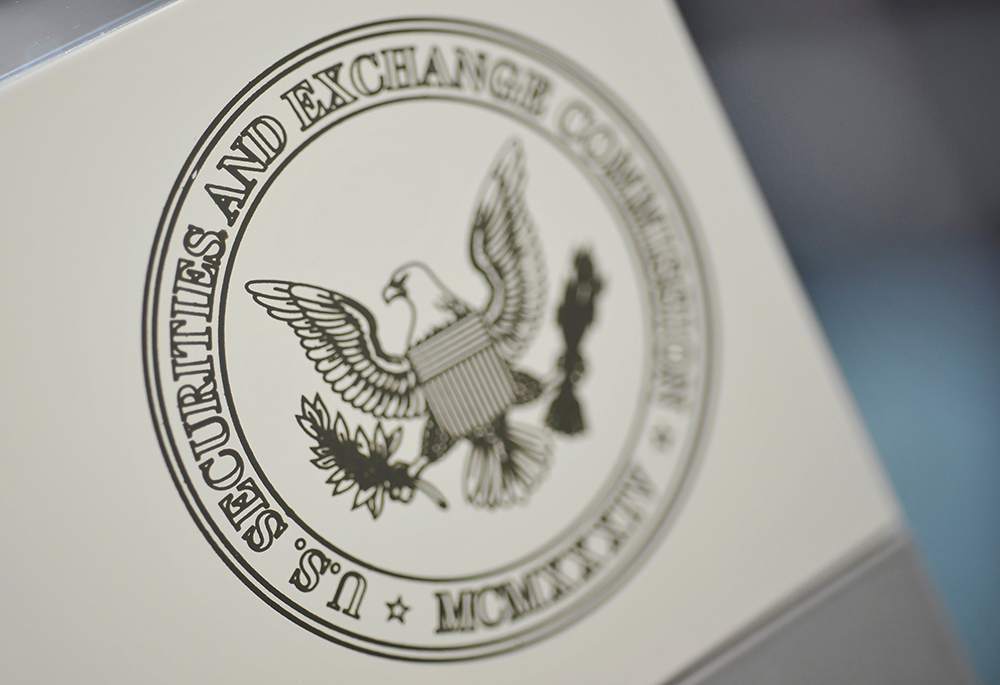
The U.S. Securities and Exchange Commission logo is seen in this illustration photo. (CNS/Reuters/Jonathan Ernst)

The annual shareholder proposal season is complete, and Catholic sisters say the resolutions they put forth scored resounding victories.
Of course, the sisters don't score these things the way average investors do.
All five proposals pushed by sisters in 2026 failed to pass at the annual shareholder meetings publicly traded corporations hold every year. The most successful effort — asking General Motors to report the effectiveness of its policies and practices in respecting human rights for indigenous people — won 14.8% of shareholders' votes, according to Investor Advocates for Social Justice.
But Sr. Susan Francois, assistant congregational leader and treasurer of the Sisters of St. Joseph of Peace, said the proposals are about dialogue.
"Raising the moral questions at the boardroom level is so important because you don't know what the impact would be if those questions weren't on the table," she said in an interview with Global Sisters Report.
And, Francois said, the votes themselves are technically meaningless.
"Every shareholder proposal vote is advisory to the board," she said. "It's not like an election — we could have 100% of the vote and the board doesn't have to do anything."
In fact, most of sisters' efforts to push corporations on social and economic justice issues never get to the shareholder proposal stage, because they are in dialogue with the executives they're trying to sway. Shareholder proposals are only made when that dialogue breaks down or reaches an impasse.
"We were in dialogue with both GM and Palantir first," Francois said. "And in both cases we had substantial shareholder support, and more importantly it took that private conversation public."
The most visible effort this year was a request for Palantir — which sells artificial intelligence tools to the U.S. and other countries, including U.S. Immigration and Customs Enforcement — to assess its products and services' impact on human rights. A protest at the firm's New York office April 6 resulted in 15 arrests. Francois said investors were not part of the protests as it would be counter to their dialogue efforts.
And in one sense, the Palantir proposal passed. Palantir has a three-tiered stock ownership structure where the corporation's founders hold 49.99% of the voting power, making it nearly impossible for shareholder proposals they don't support to ever pass. The overall count had the proposal winning only 13% of the vote, according to Investor Advocates for Social Justice, or IASJ. But IASJ said that if insiders' votes are disregarded, the proposal got 56% of the vote.
"Despite the voting class structure challenges, this 56% vote sends a clear message that shareholders are seeking greater transparency regarding how Palantir identifies, prevents, mitigates, and addresses human rights risks associated with its technologies," said Aaron Acosta, program director at IASJ, in a statement announcing the results. "Support for this proposal demonstrates that investors do view human rights due diligence as an important governance issue and expect Palantir to provide meaningful evidence that their policies are being implemented in practice."
The Sisters of St. Joseph of Peace were the lead filers on the Palantir proposal; a similar proposal to Palantir, which also failed, was filed by the Presbyterian Church of the U.S.A, Portico Benefit Services and the Catholic Missionary Oblates of Mary Immaculate-US, an order of Catholic priests, as reported by Religion News Service.
The Sisters of St. Joseph of Peace were also the lead filers on the General Motors proposal; the Franciscan Sisters of Allegany, New York, were the lead filers on proposals at Chevron and Wendy's, and the Sisters of St. Francis Charitable Trust was the lead filer on a proposal at Tyson Foods. Other proposals tracked by IASJ included filings by the American Baptist Home Mission Societies at Amazon and Wells Fargo. The proposals at Amazon and Wendy's were rejected by the companies and never went to a vote.
Co-filers on IASJ-tracked proposals this year included the Sisters of St. Francis of Philadelphia, the School Sisters of Notre Dame, Mercy Investment Services, the Daughters of Charity, the Congregation of St. Joseph, the Adrian Dominican Sisters, and the Ursulines of the Roman Union Eastern Province.
Advertisement
Katie McCloskey, vice president of social responsibility for Mercy Investment Services, said the vote totals don't matter nearly as much as making the proposal.
The proposals "are important because they are a loudspeaker … all the shareholders of the company," she said. "If a company is harming human rights, now all the shareholders of that company have to contemplate that harm. That witness is an important part of what sisters do in all sorts of advocacy."
McCloskey said a proposal doesn't have to pass to bring about change.
"Low votes might not make headlines, but board members are watching these," she said. "We've seen it many times where even though a resolution never received a majority vote, the board has moved to address the issue."
Francois points out that while sisters usually buy only the minimum amount of stock required to be able to file shareholder proposals, especially in controversial companies or in business sectors they do not invest in, that wasn't the case for her congregation with Palantir.
"We did not invest in Palantir to file this [proposal]," she said. "We did it when we divested from fossil fuels and moved into finance and technology."
That's important, Francois said, because these proposals make good business sense. The economic and social justice policies sisters and other religious groups support help company profits in the long run, not hurt them.
"We do believe it's a better business case that if they have a human rights policy, for example, that they do their due diligence to see if it's effective," she said. "It's the best business case and it's best for people on Earth. They shouldn't be separate."