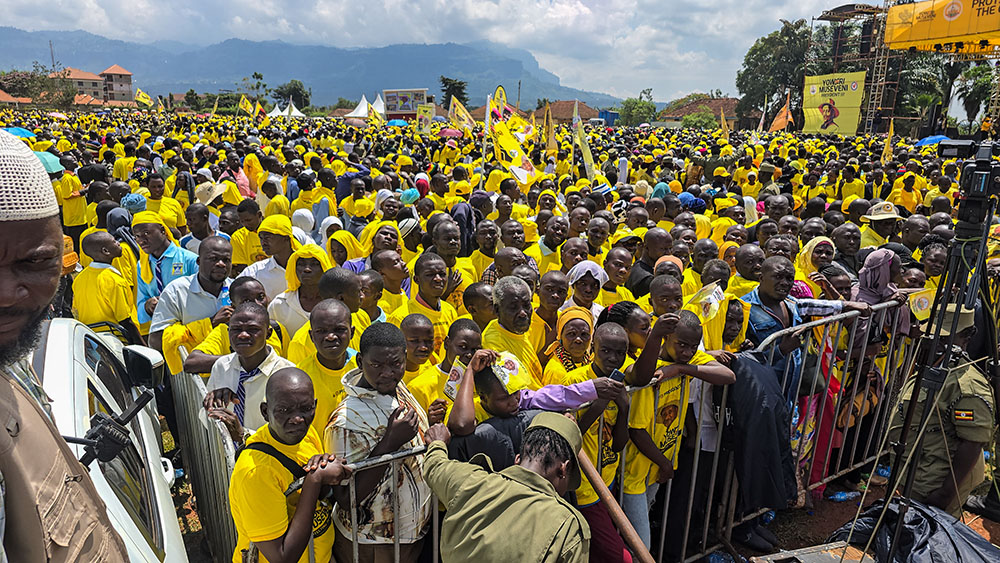
Supporters of National Resistance Movement presidential candidate Yoweri Kaguta Museveni gather at a campaign rally in Mbale City, eastern Uganda, on Nov. 10, 2025, wearing yellow party colors and waving flags as they await his address. (Gerald Matembu)

by Doreen Ajiambo
As Ugandans head to polling stations Thursday amid heavy security, political restrictions and a nationwide internet shutdown, Catholic religious sisters across the country are stepping into a delicate role: steadying communities on voting day while urging restraint, conscience and peace.
From retreat centers in Kampala to refugee settlements in northern Uganda, sisters say their work during the election period has focused less on politics than on protecting human dignity, counseling fearful families, discouraging violence and helping people navigate the vote without turning against one another.
"Our mission during elections is pastoral," said Sr. Mary Pauline Namuddu, a Little Sister of St. Francis who serves at the Uganda Spiritual Formation Centre in Namugongo, on the outskirts of Kampala. "We are not mobilizing people for parties. We are helping them act with conscience and humanity."
That message has filtered quietly into everyday life.
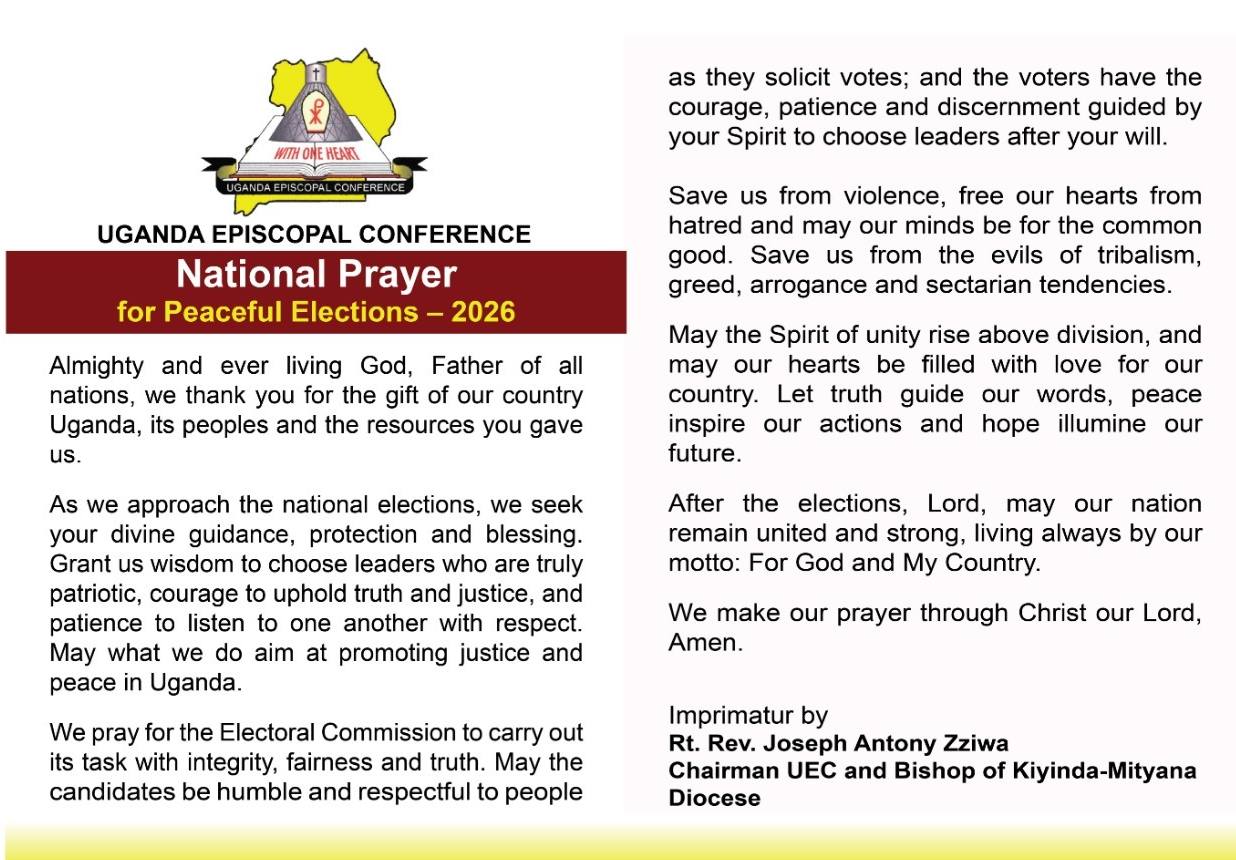
In Kampala's central business district, 35-year-old electronics dealer James Kato keeps a small prayer card taped above his shop counter. Distributed at his parish during Mass ahead of the elections, it reads in part: "Save us from violence, free our hearts from hatred and may our minds be for the common good."
"They keep reminding us not to fight, not to insult each other, not to lose our humanity," Kato said.
Born in 1990, four years after President Yoweri Kaguta Museveni took power in 1986, Kato has never known another leader. Museveni, now 81, is seeking another term after nearly four decades in office, made possible by constitutional changes that removed presidential term and age limits.
Like many Ugandans casting ballots Jan. 15, Kato said he wants political change but fears a repeat of past election violence.
"I will vote," he said. "But peacefully. After voting, we still have to live together."
Namuddu said that posture reflects what sisters are trying to cultivate nationwide.
"Our goal is not to tell people who to vote for," she said. "It is to help them resist fear, intimidation and hatred."
Prayer and restraint in a climate of fear
Uganda's political climate has grown increasingly tense in the days leading up to the vote, as opposition campaigns faced blocked rallies, arrests of activists and heightened security deployments. Authorities say such measures are necessary to maintain public order.
On the eve of the election, the government imposed a nationwide internet shutdown. Officials said the decision was taken in the interest of public safety, citing concerns over "online misinformation, disinformation [and] electoral fraud ... as well as preventing [the] incitement of violence."
The 2021 general elections were marred by arrests, deadly clashes between security forces and civilians, and a dayslong internet shutdown. Human rights groups documented dozens of deaths and hundreds of detentions in the months surrounding the polls.
Fear has been rising again, particularly among vulnerable groups, sisters say.
"Some elderly people are afraid to go to polling stations," Namuddu said. "That is very painful."
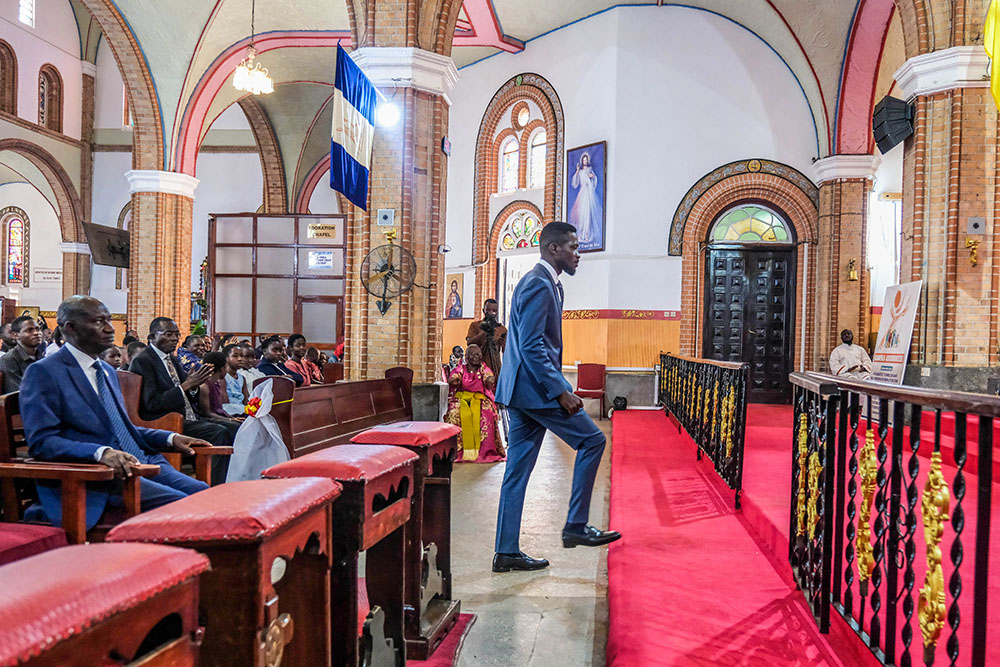
Uganda's leading opposition presidential candidate, Bobi Wine, attends a church service at the Rubaga Catholic Cathedral in Kampala, Uganda, Jan. 1, 2026. (AP/Hajarah Nalwadda)
In western Uganda, some religious sisters say the tense political climate has led them to adopt a deliberately quiet posture.
Sr. Sophia Asiimwe, a member of the Institute of the Missionary Sisters of Mary, Mother of the Church, serves in formation ministry in the Hoima Diocese. She said she has taken what she described as a largely passive role during the election period, focusing instead on prayer.
"I am praying individually, with my community and with the apostolic community around us," Asiimwe said. "I have been advised to be careful about sharing information."
Healing wounds in refugee and post-conflict communities
Elsewhere, sisters say the election season has intensified emotional strain, especially in communities already marked by conflict and displacement.
In northern Uganda, where refugees from South Sudan live alongside host communities still recovering from decades of war, elections carry added emotional weight.
"After elections, there is often fear, disappointment, anger and exhaustion," said Sr. Linah Siabana, a Missionary Sister of Our Lady of Africa working in Adjumani district. "For women, youth, refugees and people with disabilities, the emotional burden can be very heavy."
Siabana, a psychologist originally from Zambia, cannot vote in Uganda but says the period surrounding elections demands careful listening.
"I hear many people say they will not vote because the outcome is already known," she said. "That sense of hopelessness is very real."
Advertisement
Regardless of the outcome, she said, the aftermath often destabilizes fragile communities as anxiety rises and old trauma resurfaces.
"As pastoral agents, our role is to listen, to create spaces for reconciliation and to pass on messages of dignity, hope and nonviolence," she said.
Catholic bishops have echoed that message. In a rare unified national appeal, the Uganda Episcopal Conference issued the prayer on the card Kato got at his parish, urging peace, restraint and moral discernment at the ballot box. The bishops warned against "the evils of tribalism, greed, arrogance and sectarian tendencies." They also urged the Electoral Commission to act with integrity and fairness.
The prayer has been read at Masses nationwide and pinned to church noticeboards. Sisters say it has helped anchor anxious communities.
Uganda has one of the youngest populations in the world, with more than three-quarters of its people under 30. Youth frustration over unemployment and political stagnation has fueled both hope for change and rising tensions.
Religious sisters say they are urging young people to channel anger carefully.
"Language can either calm a situation or ignite it," Siabana said.
As ballots are cast, sisters say they are preparing not only for Election Day, but for what follows.
"Elections pass, but relationships remain," Namuddu said. "Our responsibility is to protect peace, heal wounds and keep hope alive."