(GSR graphic/Olivia Bardo; photo of U.N. by Chris Herlinger)

Halfway through the two weeks of meetings of the United Nations' Commission on the Status of Women, Sr. Isabelle Izika Tsamba sounded frustrated.
"When will gender-based violence end?" she said to a visitor in the small office she shares with other sisters in the basement of the Church Center for the United Nations.
"And when will men stop asking why we are so focused on this issue?" said Tsamba, a sister from the Democratic Republic of Congo who represents the Sisters of Notre Dame de Namur at the U.N.
Such questioning was frequently heard during the March 9-19 Commission on the Status of Women meetings at the world body's headquarters in New York, undergirded by the theme of how to ensure and strengthen access to justice for women and girls.
That included, the U.N. said, "by promoting inclusive and equitable legal systems, eliminating discriminatory laws, policies and practices, and addressing structural barriers."
Such barriers are real, women's advocates say, and create hurdles for those struggling to overcome the challenges posed by violence against women and girls, as well as human trafficking.
In a preparatory report issued by the U.N. secretary-general prior to the meetings, the United Nations noted, "Failures of justice that threaten the lives of women and girls are often met with impunity — and sustained by it."
Advertisement
As one example, it said that 54% of countries "lack consent-based legal definitions of rape, while 72% allow child marriage in all or some circumstances, an issue that disproportionately affects girls."
Such figures were quoted frequently during the meetings, and showed how formidable the challenges are.
"Unfortunately, the needle is not moving enough on this issue," keynote speaker Leyla Sharafi of the United Nations Population Fund said during a March 13 session on strengthening community resilience to end violence against women and girls.
"We know the statistics, but what's holding us back?"
As it turns out, many things.
Not only legal hurdles and impunity, but the continuing power of patriarchy in much of the world; a backlash against women's empowerment and social gains; continued lack of economic independence for many women; and new threats, such as targeting women digitally.
Also: the fact that male-dominated political structures have not represented women well and not taken women's experiences into account.
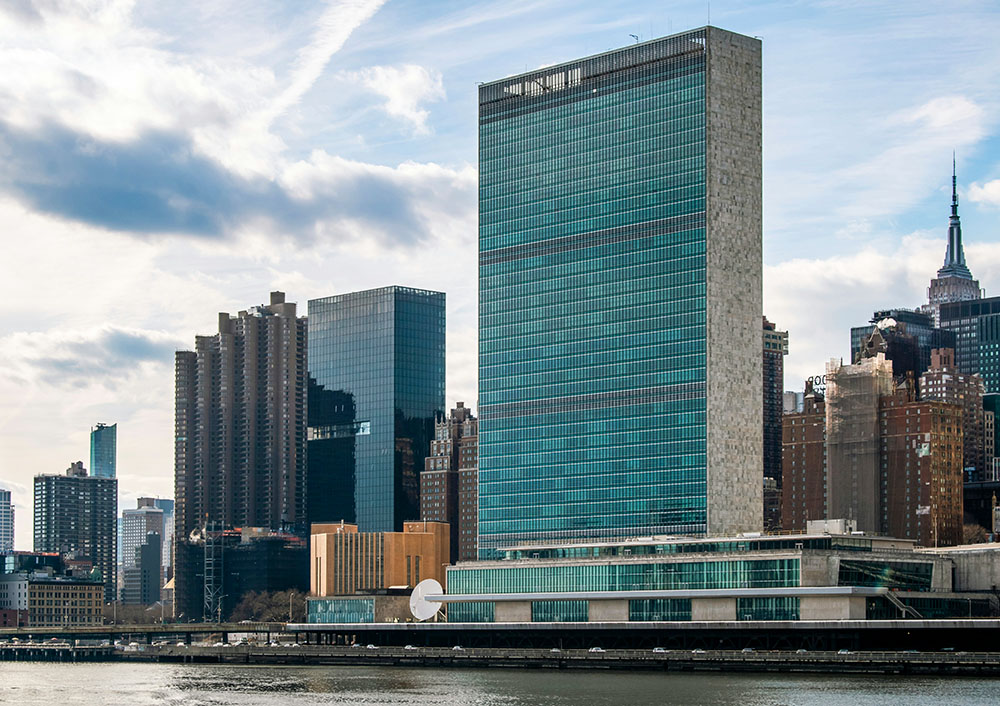
The United Nations headquarters in New York City, the site of the 70th session of the U.N.'s Commission on the Status of Women, which met March 9-19, 2026 (Unsplash/Zoshua Colah)
'Why can't women be at the table?'
For example, during a March 19 online session on the challenges experienced by women in Haiti — a country that has faced fierce political, social and economic paralysis in recent years due to male-dominated gang violence — activists questioned why women continue to be excluded from discussions on solving Haiti's considerable challenges, especially since they are disproportionally affected by the violence endemic to Haiti right now.
"Why can't women be at the table?" said activist Ruth Magdala Marcelin, coordinator of the Haitian Women's Collective. She moderated the session, arguing that women's perspectives and leadership might help Haiti out of its current crisis.
Regardless of such efforts at national levels, advocates throughout the Commission on the Status of Women meetings called attention to the need for survivors of gender-based violence and human trafficking to have access to strongly — and locally — supported programs of care, advocacy and support.
The need for such initiatives "has to be repeated, repeated and repeated," Sharafi said during the March 13 session. It is not possible to help survivors, much less achieve some kind of legal justice for them, "without the support of local communities," she argued.
Sessions with sister participation and support drove home that theme, as well.
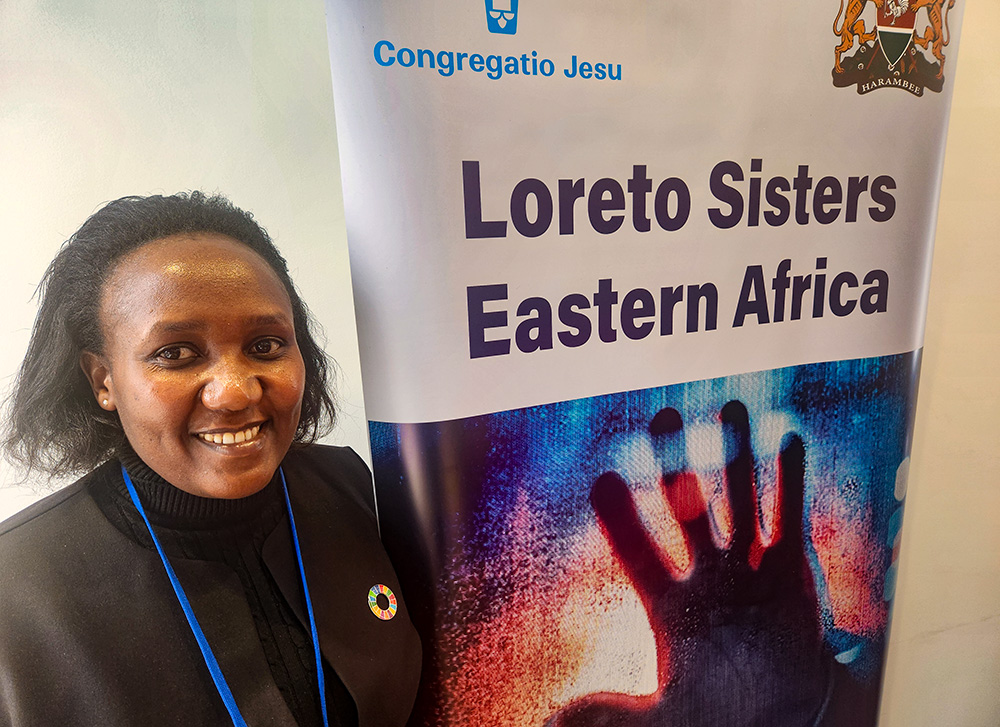
Sr. Jackline Mwongela, a member of the Congregation of Jesus, or Loreto Sisters, spoke during a March 18 event during the United Nations' Commission on the Status of Women that highlighted the theme of developing good practices for ending trafficking of women and girls. She argued that four "P's" are needed in the fight against trafficking: prevention, protection, prosecution and partnership. (GSR photo/Chris Herlinger)
During a March 11 online event sponsored by the Religious in Europe Networking against Trafficking and Exploitation (RENATE), Sr. Imelda Poole spoke about her work in Albania. A member of the Congregation of Jesus, she highlighted a program founded by the Mary Ward Loreto Foundation to assist trafficked migrants. The program is opening a new center in Tirana, the Albanian capital, developing a new mission "out of the shadows of this heinous crime."
Such crimes are endemic in situations of war, as Iryna Maievska of Caritas Ukraine noted during the March 11 event. She said that three-quarters of Ukrainians who have been trafficked because of Russia's invasion of Ukraine, often in captivity or as a civilian hostages in Russian-occupied areas, have survived what she called "mixed forms of exploitation," with many "subjected to sexual exploitation, forced labor, domestic servitude or coerced into participation in the conflict."
There have been at least 385 cases of conflict-related sexual violence in Ukraine since 2022, she said, 23 of them being children.
In the wake of such statistics, efforts to curb trafficking and gender-based violence can seem daunting.
During a March 18 event, Good Shepherd Sr. Taskila Nicholas, director of advocacy and main representative for Good Shepherd International Justice and Peace at the U.N.'s Geneva office, notes that the situation in Nepal, for instance, reflects "a global pattern."
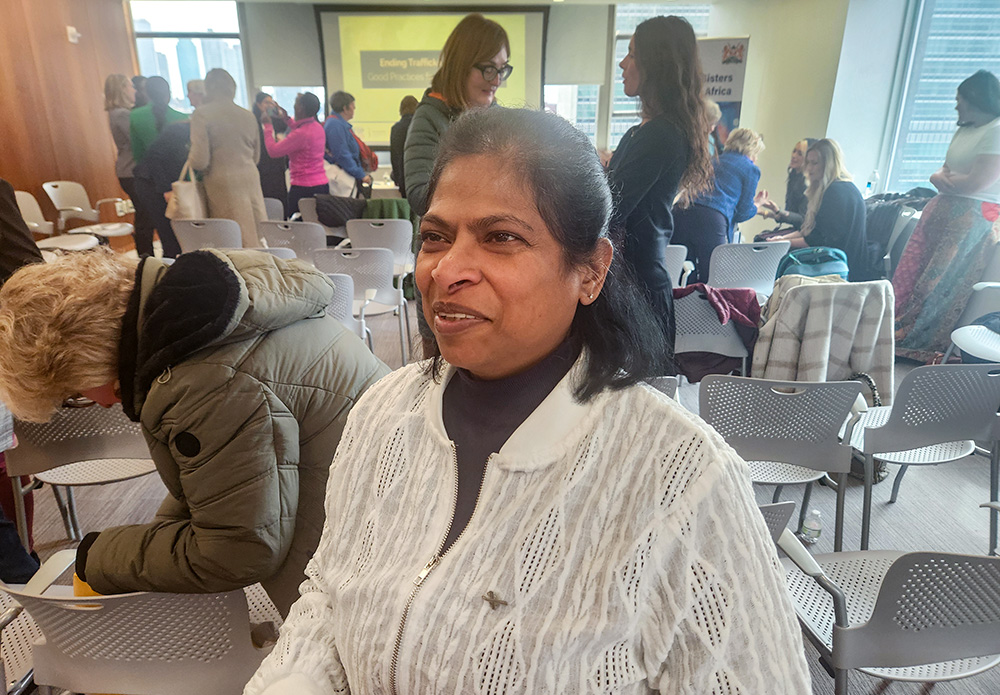
One of the speakers during a March 18 event at the Church Center for the United Nations was Good Shepherd Sr. Taskila Nicholas, director of advocacy and main representative for Good Shepherd International Justice and Peace at the U.N.'s Geneva office. (GSR photo/Chris Herlinger)
There, "it is a daily crisis driven by poverty, unsafe migration, gender inequality, disasters and climate change," Nicholas said. "Trafficking does not start at the border; it begins when a girl leaves school because her family cannot afford uniforms, when a young woman sees migration as her only option, and when debt, discrimination or domestic violence leave families with no real choice."
Yet despite these challenges, Nicholas said, prevention is possible.
Tougher anti-human trafficking measures — including efforts by Nepal's Anti-Human Trafficking Bureau; the creation of crisis management centers throughout Nepal; and community vigilance along the open border with India that helped intercept nearly 170,000 vulnerable individuals in one recent fiscal year — "demonstrate that when institutions and communities act together, prevention works," she said.
Need for reducing economic vulnerability
Nicholas added: "Human trafficking will not end through declarations alone. It will end when economic vulnerability is reduced, justice dismantles exploitative profits, communities act as first responders, and every person's dignity is protected."
Laws, justice and accountability are also paramount in the struggle against gender-based violence, and it is vital that "women are able to have access to courts and justice systems," said Sr. Veronica Brand, who represents the Religious of the Sacred Heart of Mary at the U.N.
But laws remain spotty in many countries, and even if laws are on the books, they are not always implemented, Brand told GSR.
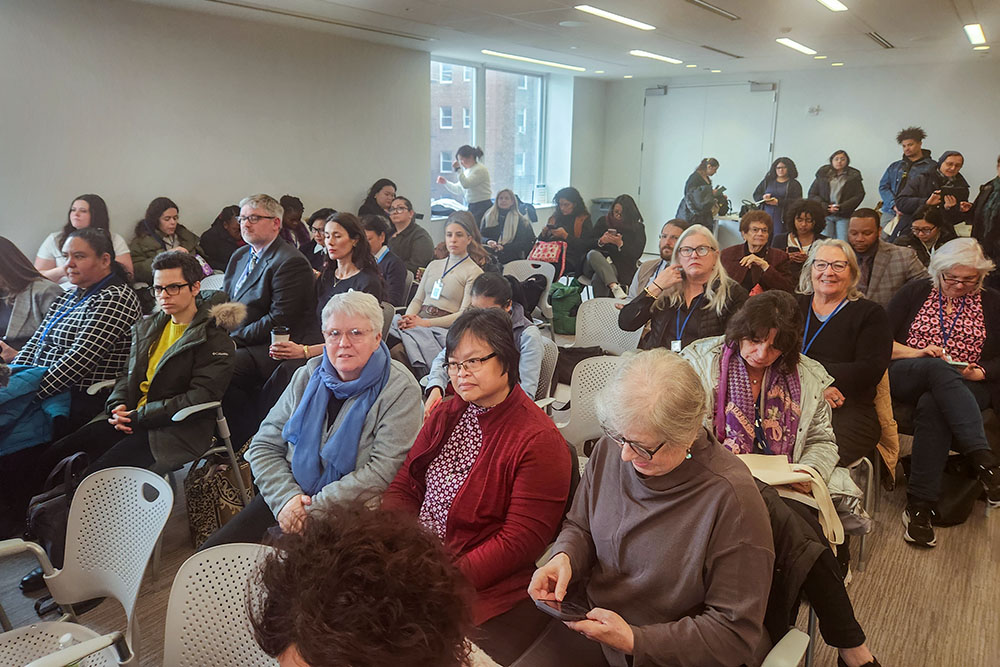
Attendees during a March 18 event during the United Nations' Commission on the Status of Women highlighted the theme of developing good practices for ending trafficking of women and girls. Among the organizers were the Congregation of Our Lady of Charity of the Good Shepherd and the Institute of the Blessed Virgin Mary-Loreto Generalate. (GSR photo/Chris Herlinger)
Moreover, it is also important to look at the challenges faced by women even more broadly to include economic violence, Brand said.
Constant demands on women as caregivers and taking on most of the burdens of households results in "time poverty" — "as if women have an endless amount of time."
Tsamba alluded to those kinds of realities when she keynoted a March 13 online event focused on closing the gap of inequities in housing and health in Latin America, saying it is important "to confront lived realities shaped by structural inequality."
"Across the region, the circumstances into which a woman is born, her race, income, geography and access to essential services, profoundly shape her opportunities and health."
It is in such challenging circumstances, Tsamba said, that gender-based violence and trafficking becomes all-too common.
The path forward?
"I would encourage women and girls to fight for justice," she said. "We must come together to fight. We cannot be waiting for other people to find solutions for our problems. We must stand up for our lives."