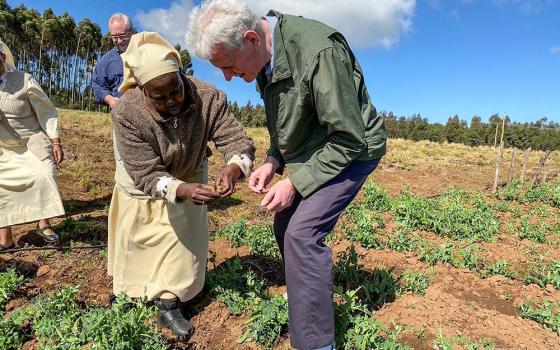
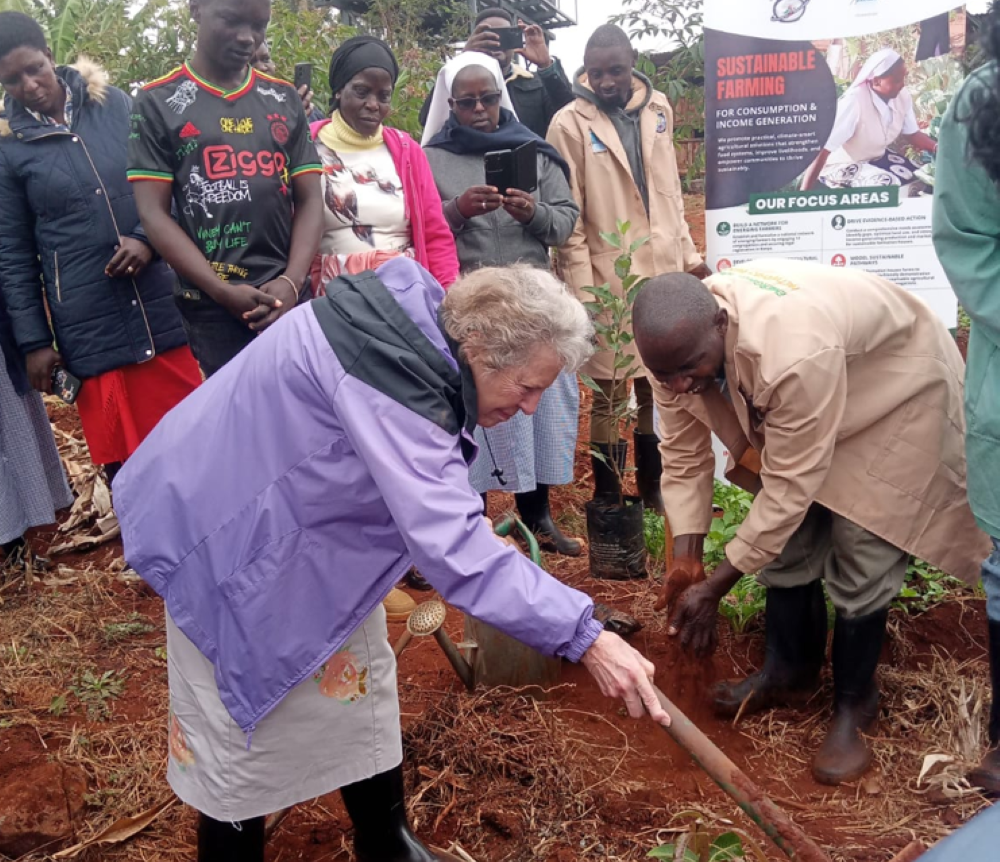
Presentation Sr. Joyce Meyer, international liaison to women religious for GSR and board member of the Conrad N. Hilton Foundation, plants a tree at a community farming project outside Mombasa, Kenya. (Hilton Foundation)
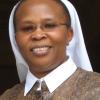
by Sr. Jane Wakahiu
Contributor
Recent site visits in Kwale, Nyeri and Kigali renewed my hope, reaffirmed my commitment and underscored the power of thoughtful, incremental action to advance a hope-filled future for our grantees and the people served by sisters at the margins of society.
Over the past eight months, the Hilton Foundation's Catholic Sisters Initiative has conducted more than 50 site visits across countries and partners. (The Conrad N. Hilton Foundation is a major funder of Global Sisters Report.) In these travels, we seek to understand how programs are being implemented, to assess challenges and opportunities, and to learn what our support is making possible. But site visits offer something that reports and data alone cannot: a culture of encounter.
The late Pope Francis describes a culture of encounter as "not just seeing, but looking; not just hearing but listening; not just passing people by, but stopping with them; and then be moved with compassion, to take action." In this way, we accompany people to imagine the future of their communities again.
In our work with sisters, we apply the Catholic social teaching approach, which begins with the dignity of the human person and asks us to build social, economic and institutional structures that allow every person and community to flourish.
This is why encounter matters to our work: to understand the people's realities and recognize the gifts they already possess.
Francis observed in Fratelli Tutti that those on the peripheries often see aspects of reality that remain invisible to centers of power. A site visit brings us closer to that perspective. We arrive with questions about a program but often leave with a deeper understanding of a community: its strengths, needs, relationships and opportunities for transformation that may not appear in a proposal or report.
From vulnerability to participation in Zambia
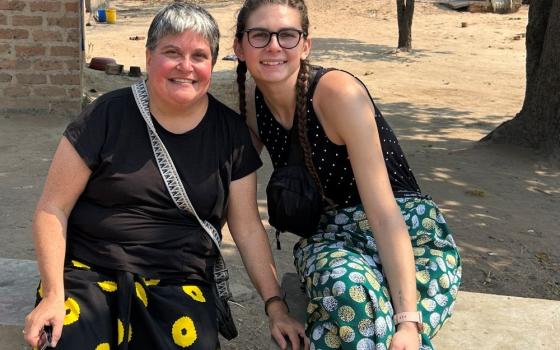
A recent visit to the Emerging Farmers Initiative in Zambia offered a powerful example. In rural communities where poverty can leave girls vulnerable to trafficking under the false promise of employment in cities, Catholic sisters are addressing vulnerability not simply by responding after exploitation occurs, but by helping families build greater economic security.
This initiative connects 10 congregations, each supporting 75 women in income-generating agricultural projects. The sisters have engaged government agricultural extension officers to help women implement better farming practices, while cooperatives (created through the initiative purchase) add value to and market products — including poultry, piggery and vegetables — to larger retailers.
The results extend well beyond agriculture. As household incomes become more stable, girls are remaining in school and becoming advocates against human trafficking in their own communities. Families then stay together, and hope for an education and a future becomes possible.
This is Catholic social teaching in practice. The women are not passive recipients of assistance. Their knowledge, labor and agency are essential to the solution. Sisters accompany them, public sector experts contribute their expertise, and communities develop the capacity to strengthen their own futures. It is solidarity joined to subsidiarity and participation, directed toward the common good.
And encounter allows us to see what might come next.
Building on what was learned in Zambia, the Sisters Initiative has replicated the model in Kenya, involving 10 houses of formation and their congregations and supporting more than 300 vulnerable young mothers and their families. The model helps congregations explore the sustainable use of land while young women discerning religious life develop practical skills for future ministries.
Yet the visit revealed something else. Mothers offered members of our team produce from their farms — not from abundance, but as an expression of gratitude and generosity. Their resilience was palpable. So were needs that could easily have remained invisible from a distance. One child's visible fear and attachment raised questions about whether safeguarding, counseling and trauma-healing support should become part of the program.
That is the value of encounter: It changes the questions we ask.
Rather than only asking whether a program has achieved its stated outputs, we can ask what challenges are emerging, what communities envision for their own future, what risks remain, and what additional relationships or resources might strengthen long-term transformation.
From individual ministries to a culture of collaboration
Across the world, Catholic sisters have spent generations remaining close to people on the margins, often understanding communities in ways that can only come from years of presence and trust.
Historically, much of this work has been carried forward independently by individual congregations. Today, something significant is happening: Sisters are increasingly bringing those experiences together.
Across Sisters Initiative's strategic areas, sisters have built more than 135 networks that enable congregations to collaborate, share expertise and respond collectively to challenges that no single congregation can adequately address alone.
The shift is visible across sectors.
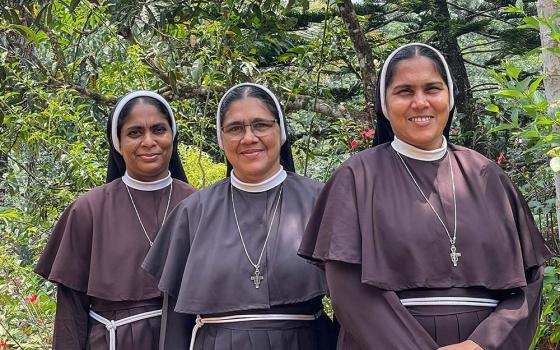
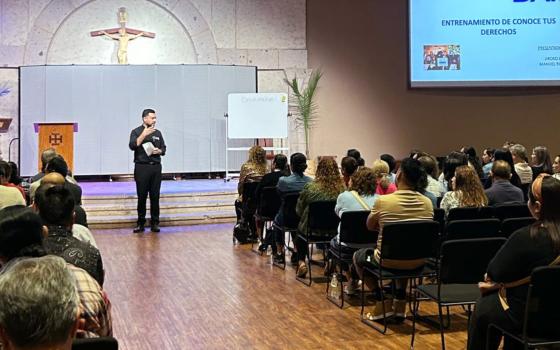
In Africa, sisters working in the legal profession are strengthening regional relationships so that they can better serve women, children, people on the move and communities confronting injustice, with a recent gathering in Kenya uniting more than 200 sister lawyers in Africa. Similar networks are active in India through Streevani, and work is beginning to connect sister lawyers in Mexico.
Sisters in communications are also finding ways to work together. At the first SIGNIS gathering of its kind in Africa, 48 sisters from around the world participated alongside media professionals, underscoring the importance of telling their stories and the communities they accompany with accuracy, respect and dignity.
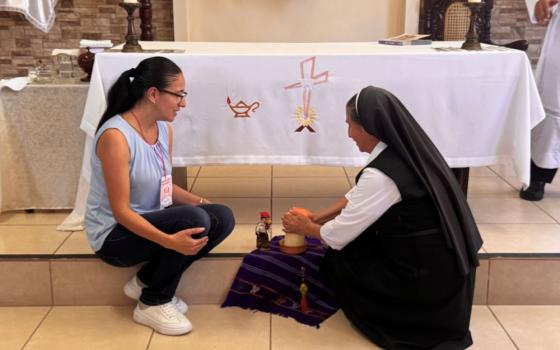
And in Latin America, a visit to the University of Monterrey created space for another kind of collaboration. Conversations with sister students, university leaders, faculty and members of the philanthropic community allowed the Sisters Initiative to explore how the Higher Education for Sisters in Africa model might be adapted to a different regional reality — not simply replicated, but listened to in a new context.
That distinction matters: The people closest to a challenge must be participants in shaping the response. Collaboration does not mean making every community the same; it means bringing together different gifts, experiences and institutions in pursuit of a good that none can achieve alone.
Encounter in service of the common good
This may be one of the most important lessons emerging from our visits: Catholic sisters are increasingly collaborative for the common good.
Their networks are not ends in themselves. They allow knowledge developed in one congregation or country to benefit another, identify successful approaches, adapt them to different contexts, advocate with a stronger collective voice and connect ministries with expertise they may not possess independently.
Advertisement
This reflects what the church means by solidarity: recognizing our interdependence and turning that recognition into responsibility for one another.
This is why site visits matter.
They keep strategy connected to people. Most importantly, they bring us into contact with sisters and communities whose proximity to the margins gives them knowledge that cannot be acquired from a distance.
The impact is palpable: a mother building economic security through agriculture; a girl remaining in school rather than becoming vulnerable to trafficking; a sister lawyer defending those whose voices go unheard; a communicator telling stories with greater dignity; a congregation discovering its land can sustain both its ministry and neighboring families.
Each is a story of human dignity. Together, they reveal something larger, reminding us that beyond pain and struggle, there is joy and humanity: "I am because you are, and because you are, therefore I am," as the philosopher John Mbiti wrote.
When congregations move beyond working independently and begin sharing their gifts, experience and knowledge, collaboration becomes more than an organizational strategy. It becomes a pathway toward the common good.
When we encounter sisters and the communities they serve, we are reminded that our role is not simply to support what is already happening, but to listen carefully enough to recognize what might become possible when people at the margins are brought together, their wisdom valued, and their capacity to transform their communities strengthened.
For the Catholic Sisters Initiative, these insights are vital to identifying effective programs and strengthening the holistic care sisters provide. Their work is sustained by faith anchored in hope and love for those communities.