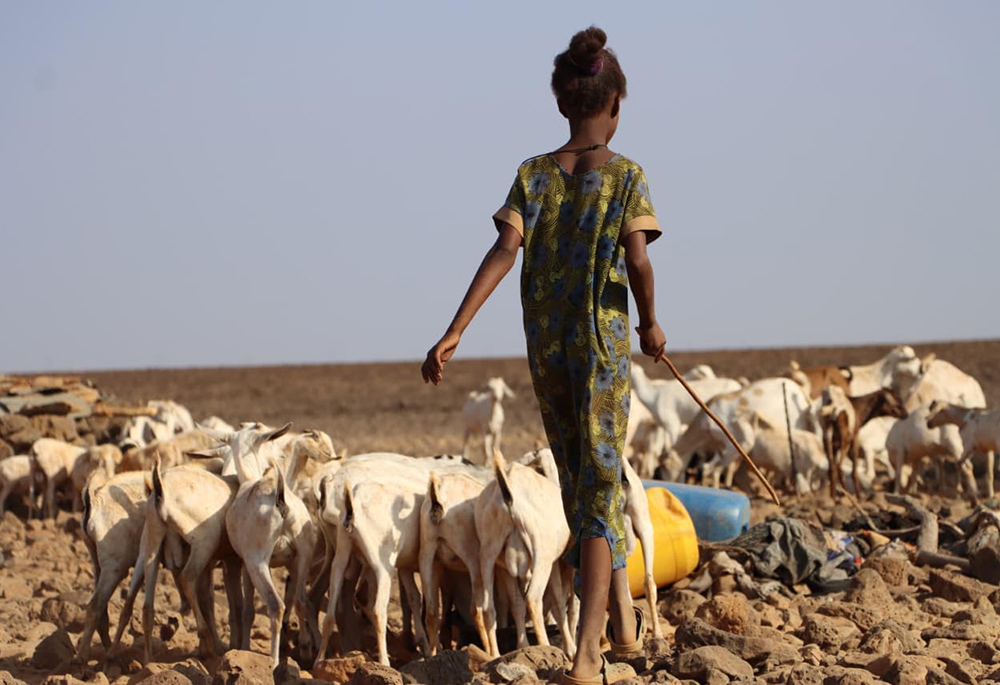
A young herder tends livestock in Marsabit, northern Kenya, where pastoralist families depend on livestock for their livelihoods and children may help care for animals. (GSR/Abraham Fayo)

by Doreen Ajiambo
Twelve-year-old Ahmed should be in grade 3 this year. Instead, he walks with his family's livestock across this arid region of northern Kenya, searching for water and pasture.
He left school last year after drought placed greater pressure on his pastoralist family and his parents needed him to help keep their animals alive. The journeys can last for months.
"I am not in school because when I stay there these livestock will die due to lack of grass and water," Ahmed told Global Sisters Report in September. "We stay for months herding livestock until it starts raining again."
About 500 miles away in Bunyala, western Kenya, 16-year-old Davis also spends his days outside a classroom, but surrounded by water.
After flooding, displacement and financial hardship disrupted his education, Davis dropped out of secondary school. He now dives into the River Nzoia to harvest sand, earning 300 to 700 Kenyan shillings (about $2.30 to $5.40) a day, despite risks that include infections and hearing problems.
"I had to start looking for my survival," he said.
Though their circumstances differ, Ahmed and Davis illustrate how extreme weather, compounded by poverty, can rob children of an education.
Climate-related disruptions impacted learning for an estimated 130 million children across Eastern and Southern Africa between 2005 and 2024, according to a 2026 UNICEF and Dalberg analysis. The study estimated $1.3 billion in direct loss and damage to education systems but $120 billion to $140 billion in projected lifetime income losses from disrupted learning.
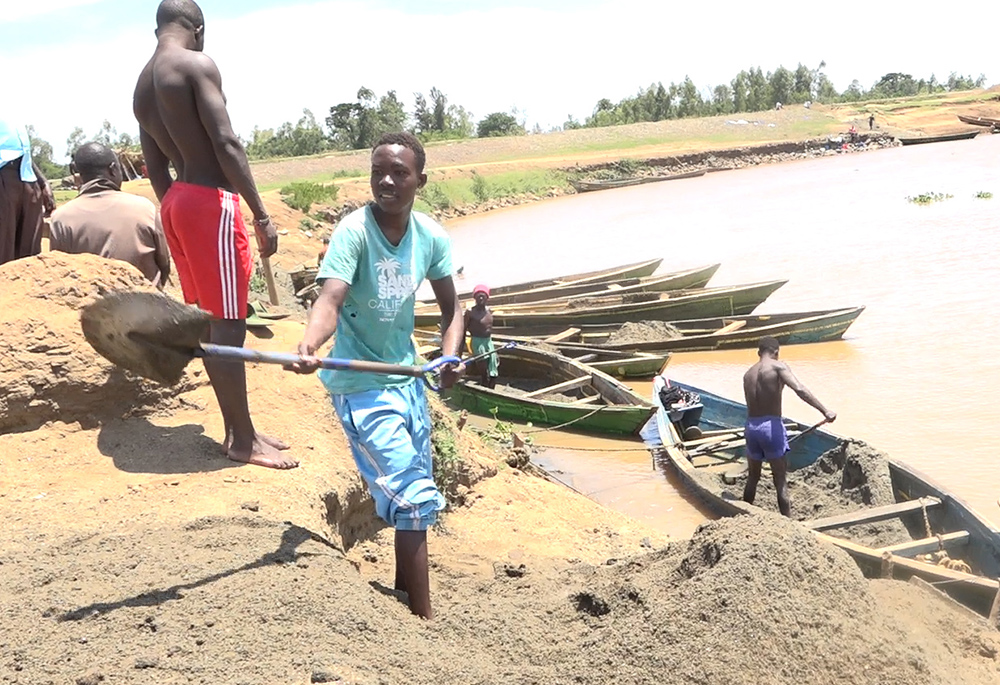
Davis, 16, uses a spade while harvesting sand from the River Nzoia in Bunyala, western Kenya. Davis dropped out of secondary school after flooding, displacement and financial hardship disrupted his education. (GSR/John Mondoh)
The threat is growing: More than 162 million children, over two-thirds of children in Eastern and Southern Africa, live in areas exposed to impacts from the strengthening 2026/27 El Niño, including drought, extreme heat and flooding, UNICEF warned in September.
Those numbers give new urgency to the U.N. climate conference COP31 in Antalya, Turkey, Nov. 9-20. The summit's thematic program dedicates Nov. 14 to Children, Youth, Education and Skills, including climate literacy and education.
For children like Ahmed and Davis, the question is what those commitments will mean beyond Antalya. Will climate action protect only the infrastructure disasters destroy, or also the years of education children can lose?
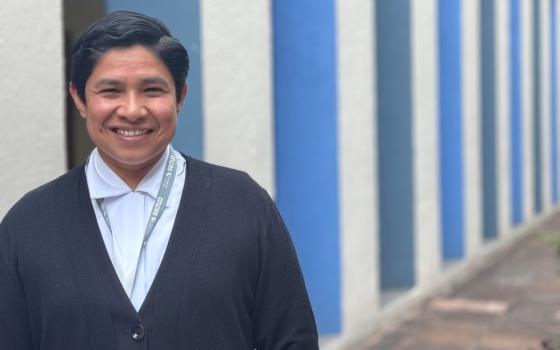
"We have to measure what children lose, not only what buildings lose," said Sr. Maamalifar M. Poreku, executive co-secretary of the Justice, Peace and Integrity of Creation Commission of the international unions of women and men religious.
The commission brings together Catholic religious congregations in advocacy around justice, peace and care for creation. Poreku, who attends U.N. climate conferences as a delegate, argues that climate loss must account for interrupted education, displacement, psychosocial harm and increased exposure to child labor and child marriage alongside destroyed infrastructure and livelihoods.
"These are real losses," she said, "even when they do not appear on a balance sheet."
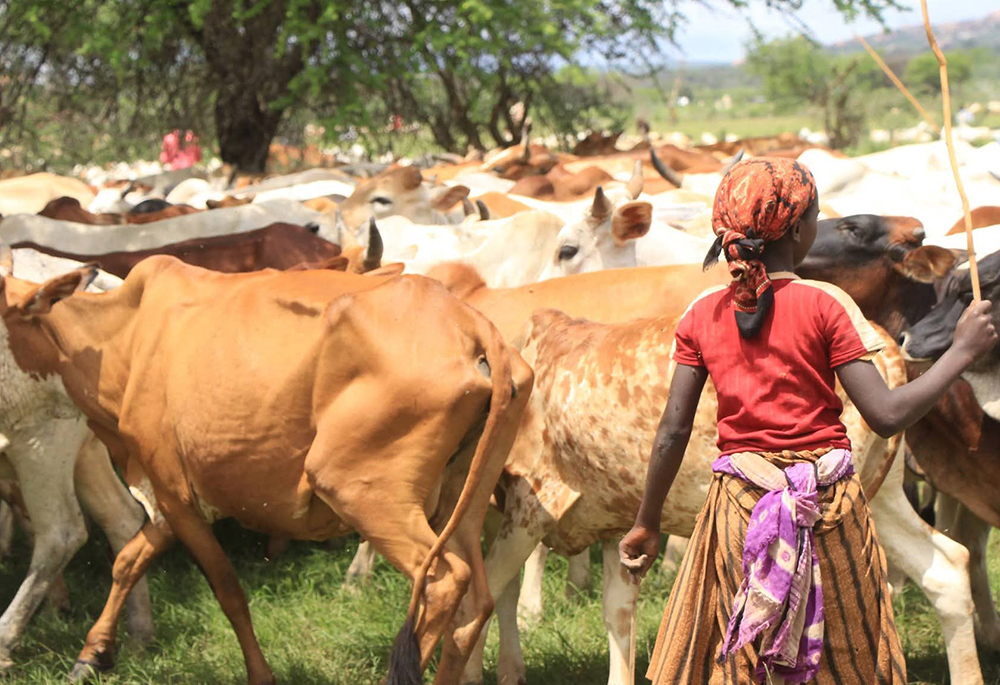
A young herder tends cattle in Marsabit, northern Kenya. (GSR/Abraham Fayo)
When drought empties classrooms
For families like Ahmed's in northern Kenya, livestock are a source of food and income. When drought strikes, losing animals can leave families struggling to survive.
The region experienced a prolonged drought beginning in late 2020, following several failed rainy seasons. As water and pasture disappeared, many pastoralist families had to travel farther with their animals in search of grazing land, sometimes relying on their children to help care for the herds.
GSR witnessed children tending livestock in northern Kenyan pastoralist communities during reporting in September. Ahmed described a classroom that had lost many of his peers.
"We have no permanent home to call a home, so we keep on moving when drought comes," he said. "So it's impossible to settle down and attend school."
Ali Boru, a science teacher in Marsabit, said drought repeatedly disrupts education when children accompany families and livestock searching for water and pasture. Food insecurity also reduces attendance.
"They only attend when you promise to offer them food," Boru said.
He worries that children who lose years of education will have fewer opportunities as adults.
"Something needs to be done to help the future of these children," he said.
Advertisement
Girls in pastoralist communities can face different risks when families lose livelihoods.
Amina, now 17 and a mother in West Pokot in northwestern Kenya, said she was 13 when her parents married her off after drought killed some of the family's livestock in 2023. Her family received 12 cows and seven goats, she said.
"When a parent loses livestock and they have girls, they have to give them out for marriage so that they can get dowry in form of livestock so that they can replenish their dead livestock," she said.
While child marriage has complex cultural, social and economic drivers, drought can intensify the financial pressures that contribute to it.
Sr. Consolata Moracha of the Sisters of the Incarnate Word and Blessed Sacrament sees those pressures in East Pokot, a drought-prone area in northwestern Kenya where she works as a teacher.
"When it's dry, the children and women have to move and look for green pastures, so the children disappear from school," she said.
Moracha and other sisters provide school meals and employ local mothers, giving families both food and income — and an incentive to keep children in class rather than sending them to tend livestock.
"This effort is not enough," Moracha said. "The children are married off and the boys leave schools to care for livestock."
"Climate change is here to stay but many of us are not prepared to handle it, so the children bear the brunt where their futures are sacrificed."
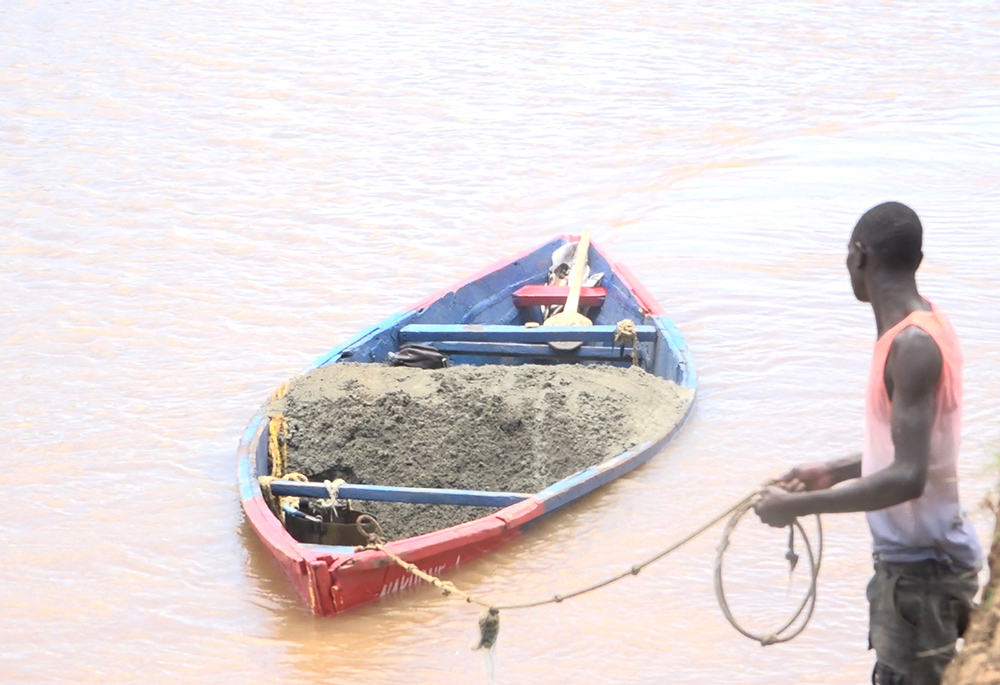
A boat loaded with harvested sand travels along the River Nzoia in Bunyala, western Kenya. Some young people in the flood-prone community turn to sand harvesting for income after disruptions to their education and family livelihoods. (GSR/John Mondoh)
When floodwater changes a childhood
While drought has disrupted children's education in northern Kenya, flooding has caused similar problems for families in Bunyala, western Kenya.
Davis' mother, Consolata Obare, remembers flooding in 2020 forcing the family to seek shelter at a neighbor's home on higher ground. During that period, Davis became ill and doctors recommended a head scan, she said, but the family could not afford it.
He later attended Musoma Secondary School, but living in camps and other temporary conditions made studying difficult.
"Since we were living in camps, we had no time and good environment to study," Davis said.
He wanted to attend a polytechnic school and learn masonry, but his parents were struggling to support other children and could not afford the training. He eventually turned to the River Nzoia.
His job requires diving underwater with a bucket, harvesting sand from the riverbed and loading it into boats. Davis said divers can be buried by shifting sand and that particles entering their ears can cause infections and hearing problems.
His mother said some of what he earns now goes toward treating illnesses associated with the work.
"This sand harvesting has really affected his health," Obare said. "What he gets is consumed in supporting his health due to many infections he gets in the water."
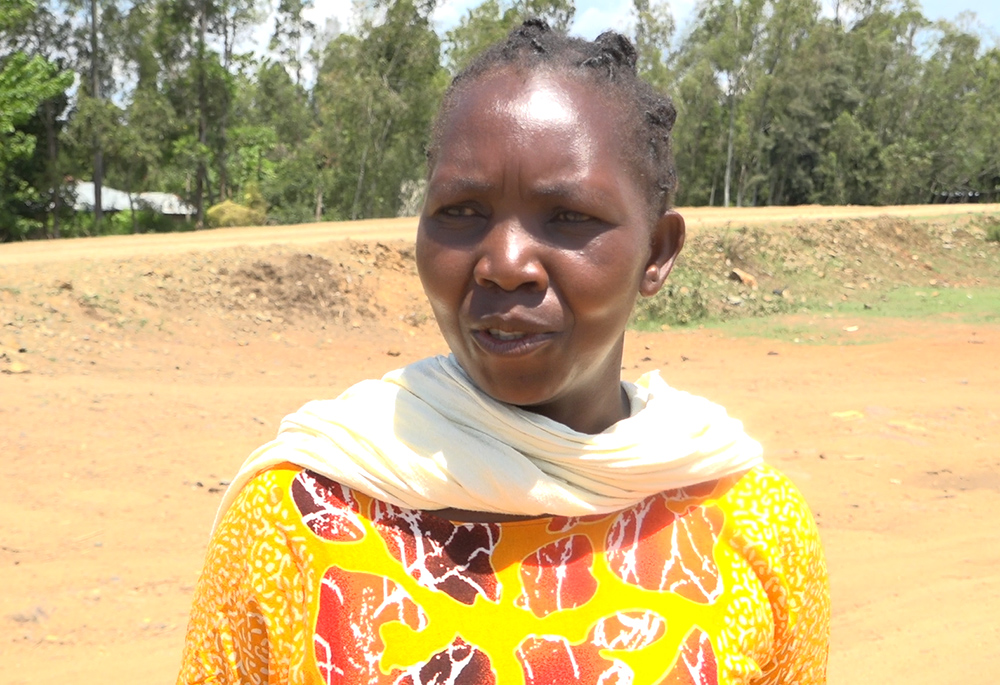
Consolata Obare, Davis’ mother, speaks to reporters near the River Nzoia in Bunyala, western Kenya, where her son harvests sand after dropping out of school. Obare said the work has affected his health, and he has gotten infections. (GSR/John Mondoh)
For Sr. Celestine Nelima of the Sisters of Mary of Kakamega, the most troubling consequences of flooding sometimes emerge after the water has gone.
Nelima, a teacher who has worked in Port Victoria near Lake Victoria in western Kenya, said flooding can submerge homes, schools and other facilities. Once families are displaced, some older children are expected to help support their households and turn to fishing, sand harvesting or other work.
Girls face additional risks when displacement weakens family protection, she said.
Nelima has intervened in cases involving girls who entered early marriages after flooding displaced their families and schools closed. When schools reopened, she involved police and helped return some of them to class.
"When the floods recede, some of these children do not return to school," she said. "They simply continue with the lives they started while displaced."
The problem extends beyond Kenya. In Zambia, climate-related disruptions including floods and droughts have interrupted the education of an estimated 5 million students between 2005 and 2024, according to UNICEF. In Mozambique, repeated cyclones have damaged schools and forced children to study in temporary classrooms.
UNICEF also reported that across Eastern and Southern Africa, weather-related disasters displaced an estimated 8.8 million children between 2017 and 2023, including 5.2 million displaced by floods.
Without stronger action, UNICEF estimates that an additional 440 million to 520 million children could experience climate-related learning disruptions by 2050, resulting in $260 billion to $380 billion in lost future earnings.
COP31: From promises to implementation
As COP31 opens Monday in Turkey, Sr. Maamalifar Poreku hopes the attention given to children will lead to stronger commitments and financing.
"What is missing is scale, dedicated financing and children's meaningful participation," she said.
In northern Kenya, better access to water and school meals could help children remain in school during droughts. In flood-prone communities around Lake Victoria, stronger school buildings and early-warning systems could reduce disruptions to learning.
Poreku said governments should invest in protecting children before disasters strike rather than focusing mainly on recovery.
"We need to invest before the disaster, not only after it," she said.
For Ahmed, the stakes are immediate. When drought comes, his family's livestock need water and pasture, and his family needs him to help find them. Whether COP31's commitments can reach children like him remains an open question.
"When a flood comes, a child's education should not have to stop," Poreku said. "When a family is displaced, a child's future should not be displaced with them."