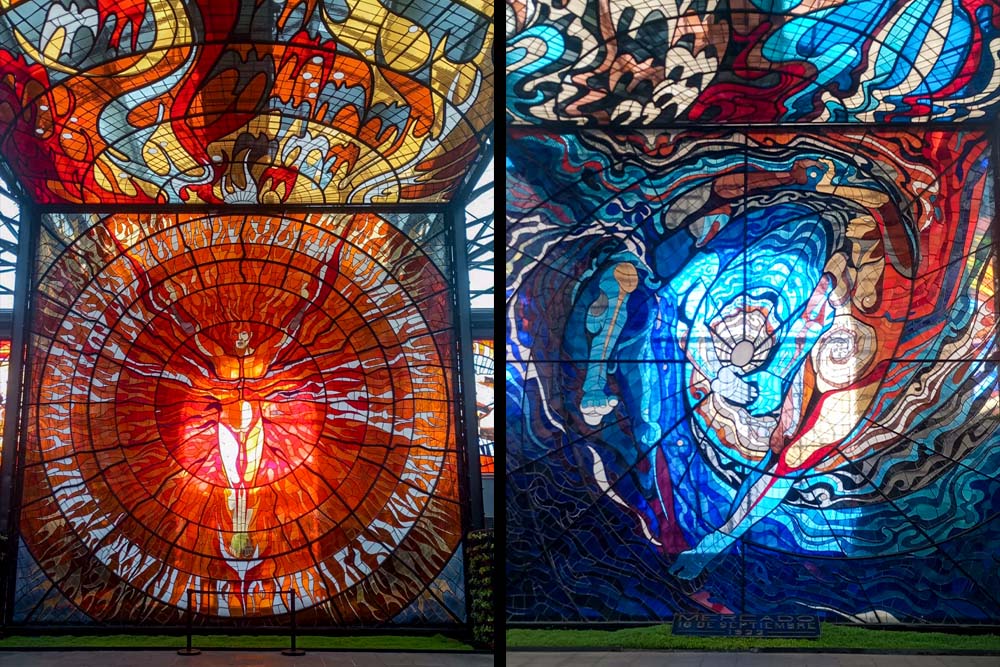
Two views of "Cosmovitral," a stained glass window by Leopoldo Flores in Toluca, Mexico (Photos courtesy of Ma Elena López Munguía)

by Sr. Lourdes López Munguía
A few months ago, a sister asked me how I see the future of religious life. I didn't have an answer. But the question stayed with me because it touched my deepest dreams, my desires and my struggles.
As I prayed with it, an image emerged in my heart: a stained glass window.
I have loved stained glass windows since I was a child. Each piece of glass has its own color and shape. One fragment alone means very little. But together, something happens that none of them could do on their own. Like an icon born of contemplative prayer, its beauty can only be appreciated as a whole, although each piece retains its own identity.
This is how I imagine consecrated life today. We are not interchangeable pieces. Each of us carries a color no one else has. Our beauty doesn't come from being the same. It comes from each one finding her place and letting the light shine through.
Our identity isn't something we receive finished and then preserve; it's alive. It gets recreated, without our noticing, through the daily experience of God in each sister, each brother, each community.
But how do we keep building this window? Who creates it? What light shines through it? I don't have the answers. I have a story.
The river and a question
This image takes me back to a moment in my own vocational journey. When I was a sister in temporary vows, I went through a hard time. Things in my community felt stuck. Life was not what I had dreamed. For the first time, I asked myself: Did I make the right choice?
Our provincial at the time invited me to go for a walk. We have always enjoyed sharing while walking in nature and we ended up beside a river. I still remember it — its vastness, its depth, the strength of its current.
And then my provincial surprised me with a question: "Lulú, do you believe in your sisters?"
My first impulse was to shout, "No!" But something made me stop. I stood there, listening to the river, letting the question sink in.
That precise moment made me understand something I have never forgotten. We're not called to throw stones into the river, resisting its movement. Nor are we meant to be carried away by the current. We're invited to stay rooted in God — in the experience of knowing that each one of us has been shown mercy.
We're called to let ourselves be joined with others, so that together we can create something beautiful.
What if our consecrated life were a beautiful stained glass window, shaped by the profound experience of God lived by every one of us? Our identity would then be a living reality continually evolving through the experience of God in each sister.
Advertisement
God is the artist
So who creates the stained glass window? I believe it is God, the trinity of love. God bends down toward the whole creation. God even looks for "un petit rien" — a little nothing — to bring life in abundance (John 10:10).
Our window is born from this experience of God, the same experience that gave life to our founders and to every generation of consecrated persons before us. Our charism is not a museum piece. It's a living experience of God that we're invited to make our own, to embody, to share.
Every story counts. Even the wounded ones. Especially the wounded ones. Every encounter, every step toward conversion adds a new color to the whole.
What builds the window? We might say the structures: communities, leadership teams, formation, ministries. They matter. But I believe the deepest construction happens elsewhere — in discernment, in the slow rereading of our lives. A daily pause to recognize what has given us life, what needs healing, what we must let go so life can flourish and where God may be opening new possibilities.
Rereading our lives is not nostalgia. It's learning to listen to the present and discerning. It helps us see that fidelity doesn't mean repeating forms from the past. It means finding new ways to incarnate, today, the experience of God from which we were born.
And we have to be honest: Religious life is changing. In some places, vocations are few. Our communities are growing old. Ministries that gave life for decades can no longer continue. There are losses, and they need to be grieved, not explained away.
But can we let our fear of change stop us from imagining new paths? Can we distinguish what belongs to the heart of our charism from the forms it took in another era?
Broken pieces, still beautiful
Every piece of glass has its own color, shaped in our metaphor by its culture, history and experience of God. Each sister offers the world a particular shade that no one else can offer in quite the same way. Interculturality isn't just living beside people who are different from us. It's letting ourselves be transformed by them, discovering that we need one another's experience to glimpse the fuller picture.
And here's something else: The window isn't made of whole pieces. Each of us is, in some way, broken glass. We don't have to hide our wounds to find our place. When we acknowledge them and walk through reconciliation, our fractures can become places from which we accompany others with greater freedom.
"By his wounds you have been healed" (1 Peter 2:24). Vulnerability doesn't have to be the end of the story.
This doesn't mean romanticizing pain. We need care, truth, accompaniment, time. We need communities where we can name our fragilities without being reduced to them. I dream of communities where every consecrated person feels like a sister or brother on the journey — communities that become a Bethany for each one of us; a place of friendship where we can rest, regain strength and share life.
A stained glass window needs one thing to reveal its beauty: light.
Each of our journeys has seasons. Sometimes it's easy to recognize God's presence and let it shine through us. Other times we're in darkness, doubt or exhaustion, and we can barely believe the light is still there.
Maybe the future of religious life depends less on keeping every piece shining than on learning to stay open to the light — even when we can't see it. The light is not ours. We don't produce it. We receive it, and we let it pass through our lives, our relationships and our mission.
And I return to my provincial's question: "Lulú, do you believe in your sisters?"
Believing in one another doesn't mean idealizing one another. It means recognizing that none of us is finished, that we're all on a journey, and that we need each other to see the whole picture. It means daring to dream together without requiring everyone to be or think alike.
I'm still a sister in the making. I don't have the complete picture. Maybe I'm only a tiny shard of broken glass. But I don't have to wait until I'm perfectly repaired to offer something. I only need to stay rooted in God, let God's mercy touch me, and accept the challenge of connecting with other pieces — different from me — so that together we can create something beautiful.
I dream of a consecrated life where every sister and brother finds a place, where diversity becomes communion, and where together we keep letting God's light shine into our world.