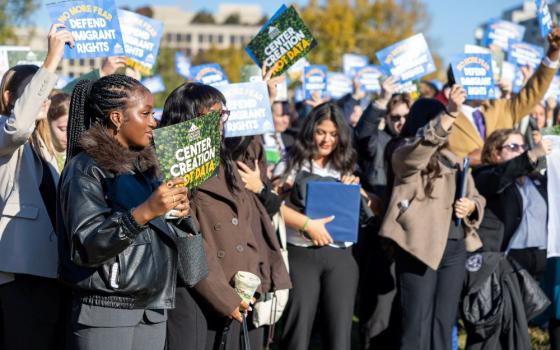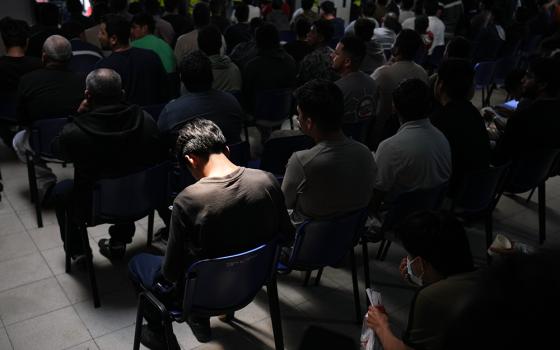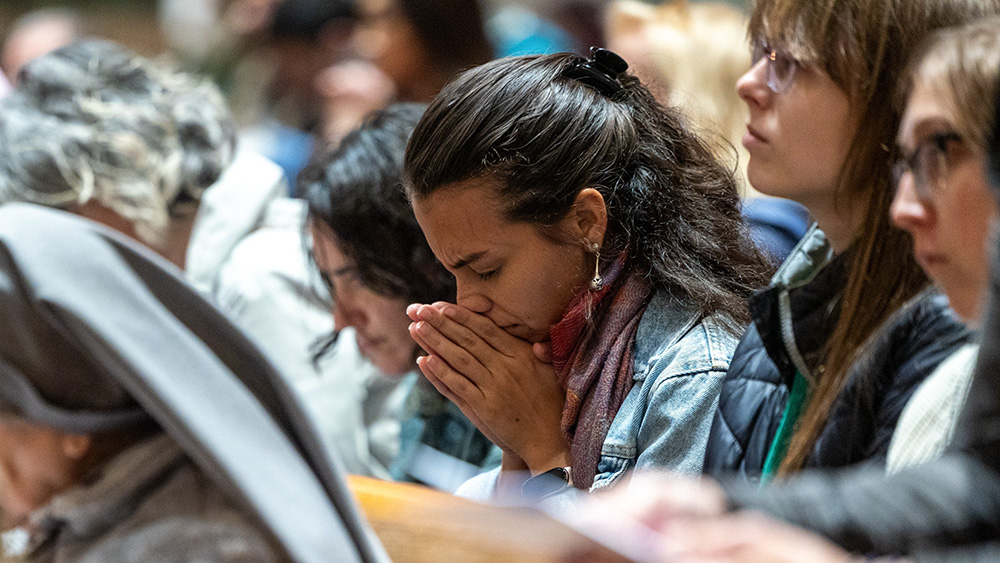
People pray during a Mass for the 112th World Day of Migrants and Refugees celebrated by Washington Cardinal Robert McElroy Sept. 27, 2026, at the Cathedral of St. Matthew the Apostle in Washington. (OSV News/Catholic Standard/Mihoko Owada)

by Sr. Nameeta Renu
Welcome to Theologians' Corner, where each week a different woman theologian from around the world offers a fresh reflection on the Sunday readings.

The Solemnity of Christ the King
November 22, 2026
Today's first reading from the book of Ezekiel requires some historical context. In 597 B.C., King Nebuchadnezzar II of Babylon attacked Jerusalem and deported King Jehoiachin along with elite officials, warriors, craftsmen and priests. Among them was the young priest Ezekiel. Jerusalem and its temple were spared, and a puppet king, Zedekiah, was placed on the throne.
Then, in the fifth year of exile, Ezekiel saw the glory of God in a foreign land and was called to be a prophet to the exiles and to warn them of impending judgment and the destruction of Jerusalem.
Unfortunately, the exiles prefer to believe false prophets who promise a quick return. Back in Jerusalem, Jeremiah warns the corrupt kings, priests and elders, but few listen. Everyone believes the beloved Temple city enjoys immunity because of its special status in God's eyes.
Ezekiel, a young priest who cannot begin serving at the altar, has a vision of the glory of God leaving the desecrated Temple. Yet that same glory resides with the exiles. God is not restricted to the Temple but has power over all nations, and goes into exile with the people.
Six years after Ezekiel's call, Jerusalem is destroyed. The exiles cry out in suffering, nostalgic for their rituals and worship in the temple. Finally, in the text we read for the Solemnity of Christ the King, God calls Ezekiel to console them with the promise of restoration: "I myself will look after and tend my sheep ... I will rescue them from every place where they were scattered ... I myself will give them rest."
Yet the same promise says, "I will judge between one sheep and another, between rams and goats." Elsewhere in the chapter, strong sheep butt and trample the weak. The flock itself is in conflict. But can the divine Shepherd remain aloof from it?
Christians read God's promise through Ezekiel in the light of the Incarnation, when God becomes human — God-with-us as kin. The glory that left the Temple now takes up residence in a body. The Old Testament foreshadows how the faith of the exiles and their descendants matures through suffering. They are being prepared to see and welcome the glory of God residing in the body of Christ, the Temple of the Holy Spirit, which should not be desecrated through the sin of its leaders.
Advertisement
Where is that glory most visible? Not on a throne of power, but on the cross. There Jesus, the Good Shepherd and Kin(g) of the Universe, destroys the power of death and rises again, so that all might share in the Resurrection.
Today's Gospel takes us further into the future, when Christ the Kin(g) comes in glory and sits on his glorious throne to judge the nations, separating the sheep from G.O.A.T.s who think they are the "Greatest Of All Time." What follows is not a literal reading of the passage but my contextual reflection, shaped by Ezekiel's conflicted flock and the world we live in.
I visualize two groups in conflict. Jesus, the Good Shepherd, steps between them, separating the warring factions to his left and right. He stands in front of the injured party, arms spread wide, shielding them as he did on the throne of the cross. These are his brothers and sisters, his kin. An attack on them is an attack on him.
The other party is not condemned outright. If they repent and tend to the injured, feed the hungry, give water to the thirsty, clothe the naked, bind wounds, visit the imprisoned and shelter the homeless, Christ counts it as done to him. The Gospel also names failures of neglect, so the goats may be those who simply looked away.
Why separate them at all? The text is silent on what follows, so here I offer only a reflection. The separation creates space for introspection, repentance and conversion before the two groups come together for restorative justice and healing. Even those whom Jesus shields are called to forgive, and to visit the ones imprisoned for wounding them. This is the "kin_dom" he calls us to proclaim to every nation.
In a world of wars, conflicts, migrations and deportations, this is what the Solemnity of Christ the Kin(g) asks of us. Like Ezekiel's exiles, many migrants and refugees are torn from their families, their places of worship and the freedom they once enjoyed.
When millions cannot even read Scripture freely, where can they encounter God? In the same place the exiles did: in a foreign land, in the glory of God who manifests as their Kin. And where do we encounter that glory? In the very people we are called to serve. When the hungry are fed, the stranger welcomed and the prisoner visited, the "kin_dom" becomes visible, and so does the glory of God. We are called to make it visible.