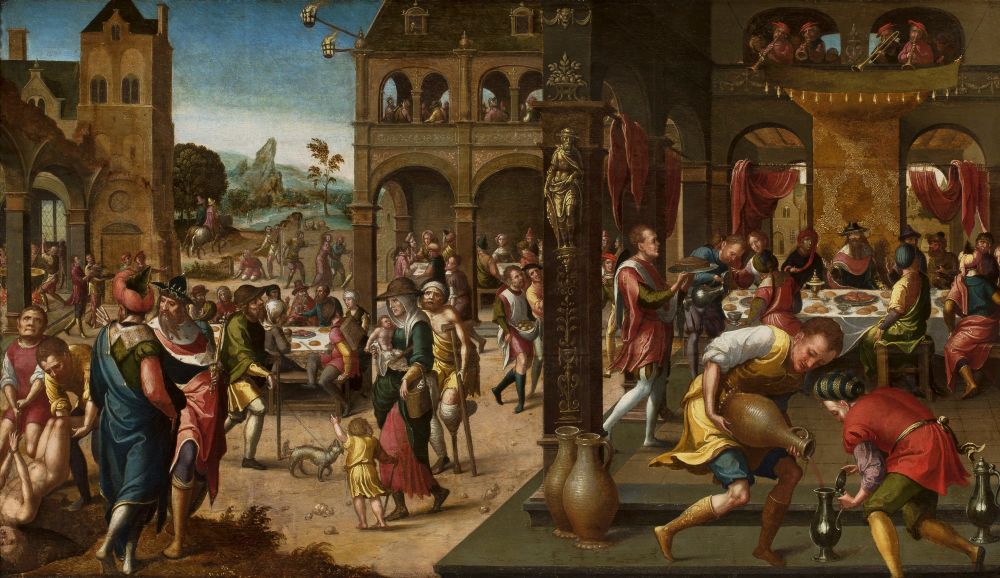
"Parable of the Great Banquet" (circa 1525) by the Brunswick Monogrammist (Wikimedia Commons/Public domain/National Museum in Warsaw)

by Sr. Nancy Mbagara
Editor's note: Welcome to Theologians' Corner, where each week a different woman theologian from around the world offers a fresh reflection on the Sunday readings.

28th Sunday in Ordinary Time
October 11, 2026
In the first reading Isaiah presents to us a God who takes the initiative to prepare the banquet for the people. He prepares the table himself, and therefore he is the protagonist. This banquet is prepared for all people, an expression that opens a universal and deeply missional dimension of the word. The church does not have a private banquet, but is called to proclaim that God's banquet is prepared for everyone.
The prophet envisions the end of an era marked by toil, war and famine. All hope rests solely on the power of God, who finally brings this time to a close, ushering in a gathering of peace and a banquet that seals a covenant of harmony — a harmony that has finally burst forth upon the Lord's mountain in Jerusalem. Our world is stalled in violence and hatred, and peace cannot endure unless it springs from God's own strength. And God, at last, intervenes in this dramatic and desperate world.
The paradisiacal peace held out to humanity since its very beginnings (cf. Genesis 2-3) now appears imminent. The disgrace and humiliation endured by Israel, and indeed by any people will cease forever. This will come to pass not because events automatically turn in their favor, but because God has resolved to fulfill his promises.
Humanity, all peoples, will no longer hunger for truth or justice; they will be filled with divine blessings and freed from want, suffering and evil. Even death itself is destined to vanish.
Advertisement
In the second reading, Paul says that he has learned to be poor and to be rich at the same time. He adds that "I can do all things through him who gives me strength." This calls us to go deeper in our hearts because our security does not depend on what we possess but on Christ. Our possessions should not determine the value of our life.
Matthew presents a central figure of the parable who can only be God. His most significant actions are the preparation of the banquet and the repeated sending of "servants" to invite everyone, without social or religious restrictions or discrimination.
The liturgy today presents the banquet like salvation, always prepared for every person; it awaits our participation. The error into which the first invitees and the man lacking the wedding garment fell is one that can recur throughout history and in our individual lives. God has given us the freedom to choose whether to join in the banquet or to refuse. These are people whom he had in mind and at heart, hence extending his invitation to them, but they deliberately excluded themselves.
In our lives, how often do we turn down God's invitation, listening to the word of God without allowing it to transform us? How often do we receive the Holy Eucharist without becoming the bread to be broken? Our work, our businesses, our friends should never take precedence to the extent of lacking room for God, otherwise we miss the banquet. To whom and to what do we dedicate our time?
God never gives up on us; he constantly invites us to come to the banquet. He calls us, but he will not respond on our behalf, we must respond freely. His grace is sufficient for us, lest we allow ourselves to be transformed by it. We have all been invited and our lack of wedding garments should not be a hindrance. We should be ready for transformation.
The faith we have received should become our life. True transformation does not come in entering the banquet hall, but in resembling the master who invites us.