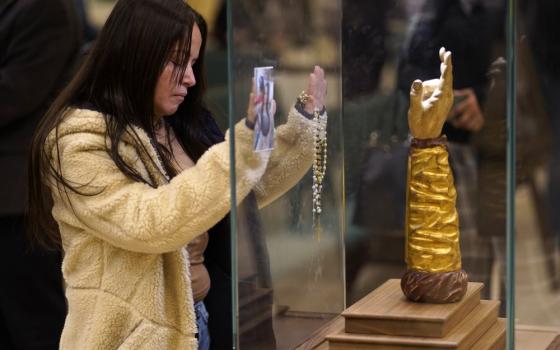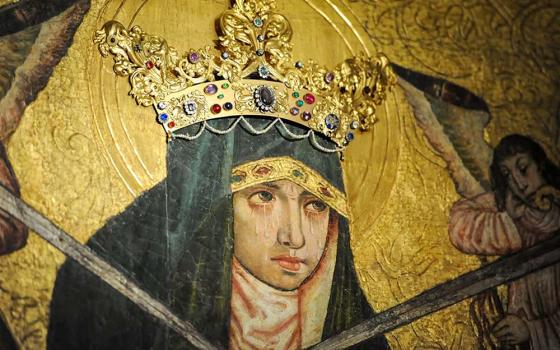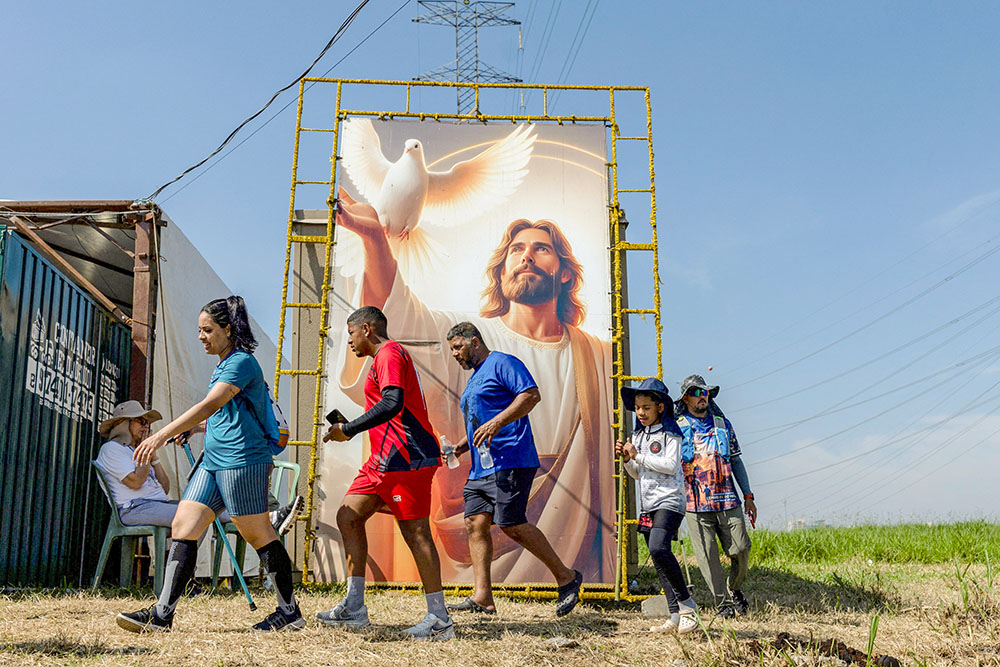
Pilgrims heading to the Basilica of the National Shrine of Our Lady of Aparecida pass a painting of Jesus along the Presidente Dutra Highway in São José dos Campos, Brazil, Oct. 9, 2026. (OSV News/Reuters/Roosevelt Cassio)
by Sr. Nancy Mbagara
Editor's note: Welcome to Theologians' Corner, where each week a different woman theologian from around the world offers a fresh reflection on the Sunday readings.

Solemnity of All Saints
November 1, 2026
A small candle placed in a dark corner may not be as bright as the sun, but it may help someone in the dark to find their way. You don't have to be famous to become a saint, you just have to let God be in your life and allow his love to shine through you.
The church invites us to reflect on the Beatitudes. Jesus provides a portrait of who the saints truly are. The saints are not perfect individuals, detached from real life, some sort of religious heroes. Rather, they are men and women who took Jesus' way of life seriously.
Matthew portrays Jesus ascending a mountain, sitting down, and beginning to teach. He reveals a new path toward true happiness. He begins with a striking word: "Blessed."
Note that Jesus is not suggesting that it is a good thing to be poor, to weep, to suffer injustice, or to be persecuted. He is not saying, "If you are suffering, that's just fine." He is saying something far more profound: Blessed is the one who, even amid difficult circumstances, continues to live according to the Gospel and places their trust in God.
At this point, we arrive at a crucial insight: The Beatitudes are, first and foremost, a portrait of Jesus himself. Jesus is "poor in spirit" because he does not live for himself, he receives everything from the Father. He is meek, for he exerts no dominion over others through force. He weeps in the face of others' suffering. He hungers and thirsts for justice. He is merciful. He is pure of heart. He builds peace. And, ultimately, he is persecuted precisely because he remains faithful, both to the Father and to humanity.
In celebrating the saints today, we are not honoring people who lived trouble-free lives; we are celebrating those who learned to live as Jesus lived. John presents them to us in the first reading, taking us through highly artistic imagery into the midst of the heavenly court, where they are standing before the throne and before the Lamb, in an atmosphere of overflowing exultation and vast horizons.
Here, we encounter "a great multitude, which no one could count, from every nation, race, people, and tongue" (Revelation 7:9). This scene brings relief to our souls, assuring us that there is a great throng of us joining in the celebration.
Advertisement
We must bear in mind that at the beginning, at the foundation, and at the very heart of this communion lies God himself. He not only calls us to holiness but, above all, magnanimously bestows it upon us through the blood of Christ, thereby triumphing over our sins.
This is why the saints in the Book of Revelation "cry out in a loud voice: 'Salvation comes from our God ... and from the Lamb!' ", and then "fall on their faces before the throne and worship God, saying: 'Amen! Praise, glory, wisdom, thanksgiving, honor, power, and strength be to our God for ever and ever!' " (Revelation 7:10-12). We are called to sing a hymn of gratitude and adoration to the Lord, who has enabled us to share in the inheritance of the saints in the light and has "transferred us into the kingdom of his beloved Son" (Colossians 1:12-13).
Like the little candle in the corner, we are called to allow God's love to shine through us. We don't have to be famous to become saints but live our ordinary life in an extraordinary manner. When we share the little we have with those who don't have anything, a light shines through us. When we forgive those who hurt us, when we clothe the naked, when we fight for justice, a light shines through us.
Today's Solemnity of All Saints interrupts the ordinary journey of the liturgy and offers us the opportunity not only to fix our gaze on the goal, where many already enjoy the fullness of God, but it is also an appeal to remind us that we are all called to holiness. As we celebrate the great saints whose names we know, we are celebrating countless others, men and women who lived holy lives without being famous. They could be our grandparents, parents, teachers, neighbours and our friends.
Let us continually allow the grace of God to transform us. The Beatitudes become a concrete way of life in the coming days.
In what area of my life can I become a little more like Jesus? Perhaps within my family, my community, in society? I can choose gentleness instead of an aggressive response. At work, I can stand up for someone who is being treated unfairly. With someone who has angered me, I can take the first step toward reconciliation. Perhaps in the face of injustice, I can refuse to say, "That's none of my business."
The saints remind us that the Gospel is not just a fine theory; it is a life that is truly possible, the life of Jesus taking shape within ordinary people. Let us not only admire them, but also imitate their way of life.