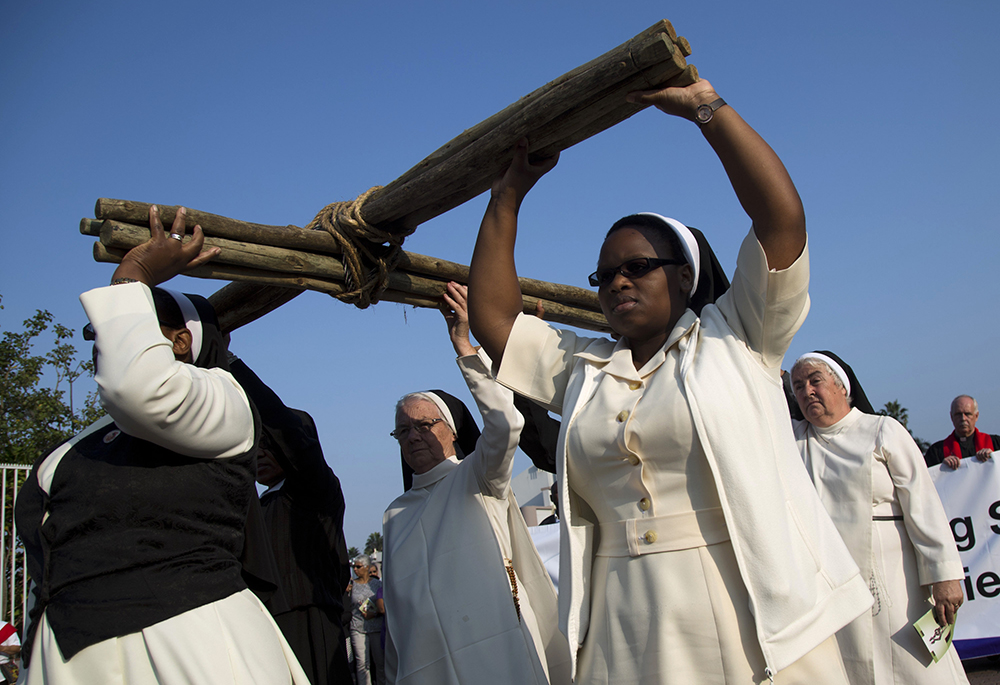
Nuns carry a cross during a silent march during Good Friday celebrations in Durban, South Africa, March 25, 2016. (CNS/Reuters/Rogan Ward)
by Sr. Anne Arabome
When I first discerned with my community, the Sisters of Social Service of Los Angeles, that God was calling me to dedicate myself to the formation of women religious in Africa, I could not foresee the journey ahead. What began as a quiet stirring of the Spirit eventually unfolded into a ministry of accompaniment, healing, theological education, spiritual direction and leadership formation through the Sophia Institute for Theological Studies and Spiritual Formation.
At the beginning, I did not rush to design a program or curricula. My instinct was simply to listen.
Through online theology courses, retreats, workshops and personal accompaniment, I encountered women religious from across Africa. Their stories revealed extraordinary generosity and sacrifice: sisters who educated children, cared for the sick, supported families, advocated for justice and served the poorest of the poor. Their devotion to Christ and the church was unmistakable.
Yet beneath this outward service lay another reality. Many longed for deeper spiritual nourishment. While they faithfully nurtured others, they themselves often lacked opportunities for silence, prayer, discernment or ongoing spiritual direction. Some had never experienced the gift of being accompanied by a spiritual director.
I became convinced that the flourishing of religious life in Africa depends on caring for the inner lives of those who serve. Women religious need spaces to slow down, listen to God, rediscover the joy of their vocation, and allow Christ to renew their hearts.
This conviction gave birth to Sophia Institute's Spiritual Direction Training Program.
Our vision is not merely to teach a ministry but to form women who can accompany others with wisdom, compassion and hope. Rooted in Ignatian spirituality and enriched by African traditions of storytelling, communal values, and spirituality, the program prepares directors attentive to both God's Spirit and the lived realities of African communities.
Earlier this year, we welcomed our first cohort of 10 sisters from Lesotho and South Africa to Namibia for an intensive week of formation. They represented diverse congregations, bringing with them the richness of consecrated life. Together we prayed, reflected, studied and practiced the sacred ministry of listening. That week marked the beginning of a two-year journey.
Advertisement
Back home, their formation continued through monthly online sessions. These gatherings deepened their understanding of spiritual accompaniment through prayer, theological reflection, supervision and practical exercises. Gradually, they were being shaped into spiritual directors who would serve women religious, clergy, and lay faithful in their communities.
The response was deeply encouraging. Witnessing their growth in confidence and spiritual maturity confirmed my belief that Africa is blessed with women religious who, when given the opportunity, can become extraordinary companions in faith.
Encouraged by this, Sophia Institute will be welcoming a second cohort of 14 sisters from Zimbabwe. Like their counterparts in Lesotho, they will begin with an intensive in-person program before continuing their two-year journey online. We hope that they will foster a culture of discernment, compassionate listening and spiritual accompaniment throughout the church.
Listening to women religious also revealed another reality: Many carry hidden wounds. Painful childhood memories, grief, trauma, loss, community conflicts, burnout and disappointments often remain unacknowledged. Authentic spiritual growth, I came to believe, cannot be separated from emotional healing. Grace builds on nature. Healthy communities and joyful religious life require space for reconciliation and integration.
In response, Sophia Institute has developed a program that invites sisters to bring their whole lives into Christ's healing presence. One such initiative, Transforming Our Painful Memories, was created in collaboration with the Conference of Major Religious Superiors in Zimbabwe. We offered the program to over 40 sisters from different congregations in Zimbabwe. It was also offered to Sisters of the Holy Names of Jesus and Mary in temporary and some in final vows. Through prayerful reflection, participants recognize painful memories, understand their emotions and discover how Christ transforms wounds into grace. Healing continues through regular online sessions where community becomes an essential part of the journey.
We also collaborate with trained counselors and therapists in Zimbabwe to develop programs on emotional wellness, resilience and compassionate accompaniment. These partnerships affirm that spiritual renewal flourishes when emotional health is nurtured.
Another invitation emerged from conversations with major superiors and leadership teams. Many spoke of the challenges they face, responsibilities, transitions, decisions and the need to lead with wisdom and compassion. Yet they too longed for ongoing spiritual nourishment.
From this came our Leadership Formation Program for Women Religious Leaders in Southern Africa. Its purpose is simple: to help leaders become more deeply rooted in Christ so that their ministry flows from a living relationship with him. Leadership in religious life is not about administration; it is a ministry of discernment, compassion, courage and faithful service.
The program will begin with an intensive week in Swakopmund, Namibia, where the Atlantic Ocean and Namib Desert invite contemplation and renewal. Afterward, monthly online sessions provide ongoing nourishment, theological reflection, peer accompaniment and communal discernment. My hope is that these leaders return to their congregations refreshed, renewed and deeply rooted in Christ.
Everything Sophia Institute undertakes flows from one conviction: lasting renewal in the church begins with transformed hearts. Women religious who are spiritually grounded, emotionally healthy, intellectually engaged and deeply rooted in Christ become radiant witnesses to the Gospel. They strengthen communities, inspire younger generations, accompany the suffering and proclaim hope in a world longing for healing.
I believe the Holy Spirit is doing something beautiful in Africa today. Women religious across the continent respond generously to God's call, often in challenging circumstances. They deserve opportunities for lifelong formation that nourish both their ministries and their souls.
As Sophia Institute continues this mission, I invite the wider church to accompany us through prayer, collaboration and encouragement. Together we can build communities where women religious grow in wisdom, compassion and holiness.
When women religious are deeply rooted in Christ, they become living signs of hope for the church and the world. That is the future I pray for, and the future Sophia Institute is privileged to help cultivate.