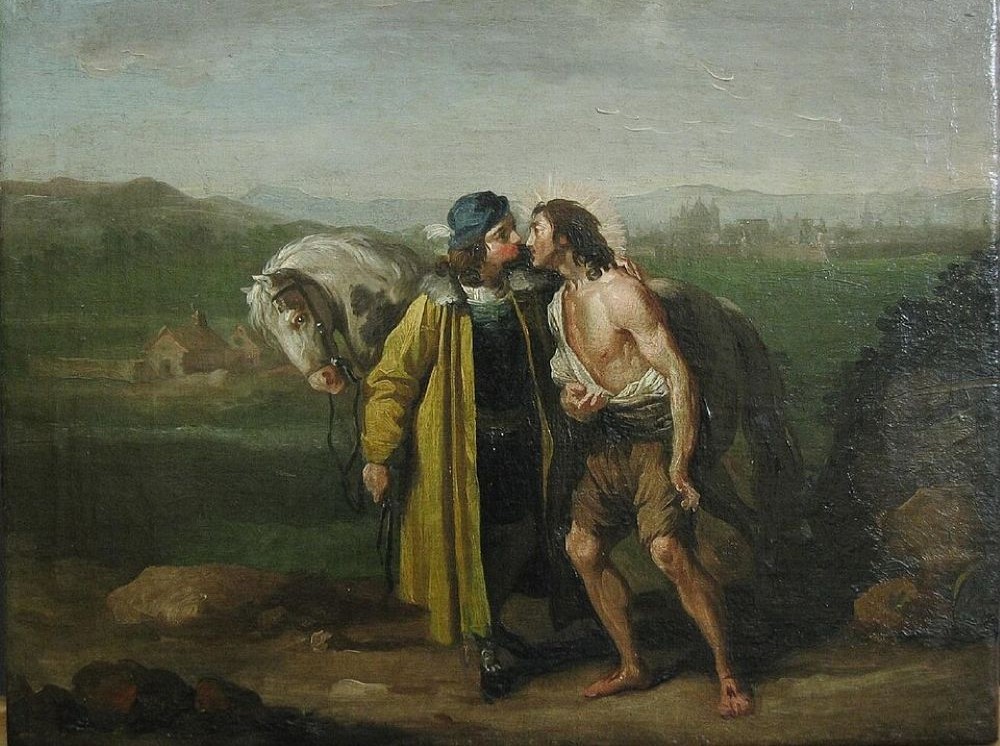
"St. Francis Embracing a Leper"(1787) by Zacarías González Velázquez (Wikimedia Commons/Public domain)

by Sr. Abhita D'Silva
On Oct. 4, we celebrate the feast of St. Francis of Assisi. During my morning meditations, I have found hidden treasures from the life of this adored man of God.
Francis once kissed a leper and, instantly, he recognized that leper as Jesus.
His mind might have been crowded with questions like: If in kissing one leper, Jesus can reveal himself to me, what if I embrace the different types of leprosy in the entire world?
Francis kissing the leper was reciprocal with greater responsibility toward a conversion of heart and renewing the church from within.
Several questions crossed my mind: What types of leprosy do I have? Could it be the hesitance of color discrimination? Could it be the "us" versus "them" division? Could it be a tug of war between immigrants and natives?
Francis was compassionately attentive to the poor, and kissing the leper was his turning point to following the Gospel way of life. As a follower of Franciscan spirituality, I do not see much new in the synod on synodality but to match a radical model of St. Francis of Assisi's ecumenism.
Through 12 years of my youth ministry in the dioceses of Bombay, Goa and Vasai, I learned that I have to walk my talk and consciously journey with them as a model for their own pilgrim journey in hope. While accompanying the youth, I found the best way to their heart is to make them find their own way. I never believed in training the youth, but empowering them with cosmic vision: oneness of all (John 17:21), which Francis embraced.
Australian theologian Ormond Rush describes synodality as "the Second Vatican Council in a nutshell." While guiding youth in Franciscan spirituality, I find the synodal vision is clearly articulated in St. Francis of Assisi's "Canticle of Creation."
Today's younger generation is seeking new ways of the church and spirituality. The emphasis of the synod on synodality is to draw on the voices of every being, including the environment. Here I felt the need of guiding youth to realize "know you are the temple of the holy one" (1 Corinthians 6:19). This is an allegorical perception meaning every being in this cosmic body of the universe is sacred. Since God's spirit dwells within and around us, we ought to treat the cosmic body of Christ with respect.
The synodal way of Gospel proclamation was envisioned by St. Francis of Assisi in the 12th century. Benedictine Sr. Joan Chittister says it clearly: "If ever the 20th century has been given a key to the secret of wisdom in a crazy world, it is in Francis." The synodality of walking together is an ancient image in the church as a community on a pilgrimage, listening to every voice in and around and within us.
What betrays us is our mad rush of upward movement. This is where Francis of Assisi leads us to follow prophetic poverty by walking in the footsteps of the nomadic Jesus.
Advertisement
Today where self-centeredness, individualism and a visionless society have given distorted identity to the youth, St. Francis comes out looking mad. His society and his father thought he had lost his mind. Francis giving up a high position in the army and the family business to live with the poor was in a real sense opening up the synodal journey as a pilgrimage in hope. His heart was a shrine toward which he walked.
Young people are attracted to work hard, make money and become rich, but Francis gives us a radical mantra from the Gospel, "Seek first the kin-dom of God and his righteousness, and all these things will be added to you" (Matthew 6:33). By prioritizing God's kindom and God's will, we will receive everything we need, often in abundance, aiding us to be generous by participating in "good works." Francis of Assisi has proved that God's providential care is easily available for all. Not as a prize for our good works but as a means to selfless service to the poor and needy.
The Jubilee 2025's theme of Pilgrims of Hope, calls us, especially consecrated religious men and women, to go back to our roots of trusting abandonment to the providential care of God for all beings. Francis experienced the power of kiss as metanoia — total change of heart. We desperately need Francis to lead the youth on a synodal pilgrim journey in hope.
For me, upward movement is a sort of leprosy. The worldly fractures of divisions based on dogmas, social and monetary upheavals have divided human beings from one another. A path of personal and communal conversion to bring about radical change is a gift from Francis of Assisi toward new evangelization.
Pope Leo XIV's first apostolic exhortation, Dilexi Te, provides us with a clearcut road map: choosing to live alongside the poor, excluded and marginalized will be beneficial to all, "to discover their richness and all that they have and can give to the world and to the church today."
Francis of Assisi exemplified that love, which has the extraordinary ability to transform even the darkest areas of our lives into something radiant light of Christ. He taught us to"Preach the Gospel at all times; if necessary, use words." Hence conversion of the church depends on my personal conversion and conscience.
By kissing the leper, Francis was awakened to the eternal consciousness — creating a relationship with the entire universe as brothers and sisters.
Francis' conversion experience was the opening point of the synod, with its three pillars: communion with the leper, participation in surrendering everything to God's plan and mission of healing conscience — "walking together."