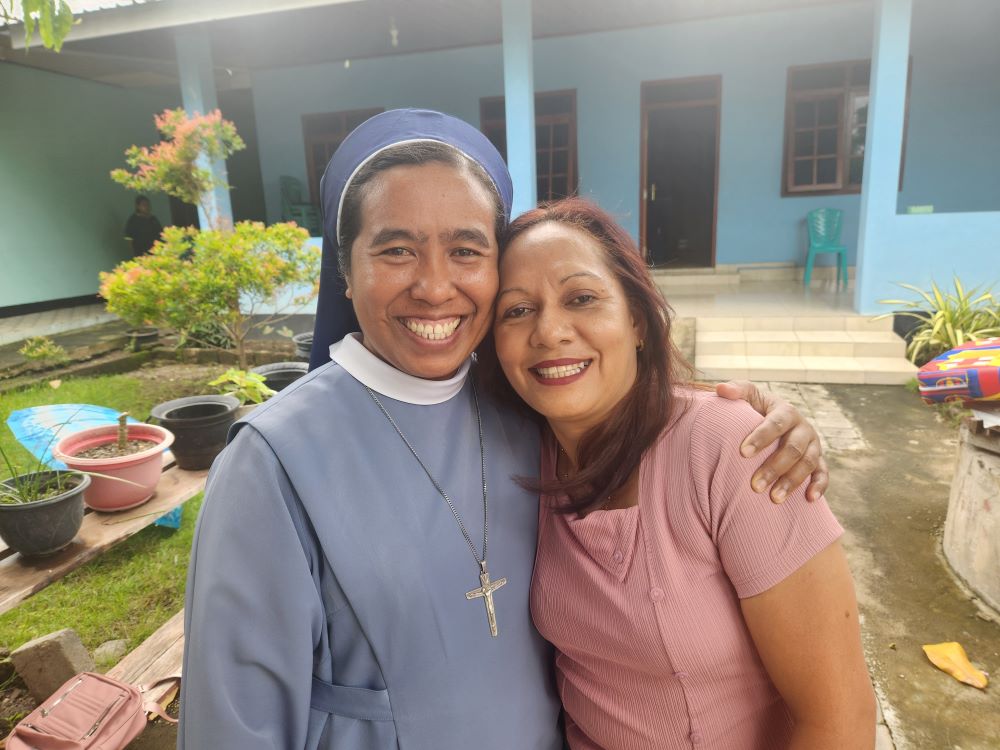
Sr. Fransiska Imakulata, of the Missionary Sisters Servants of the Holy Spirit, poses with abuse survivor Evi Bota Sao, at a shelter for women and children operated by the nongovernmental organization TRUK F, or the Flores Humanitarian Volunteer Team, in the city of Maumere in eastern Indonesia. (GSR photo/Chris Herlinger)

Editor's note: This story is part of Global Sisters Report's yearlong series, "Out of the Shadows: Confronting Violence Against Women," focused on the ways Catholic sisters are responding to this global phenomenon.
(GSR logo/Olivia Bardo)
Last year, Evi Bota Sao realized she had suffered enough.
She was ready for a new kind of life.
After two decades in an abusive relationship, she left her husband and filed a report of physical abuse and assault with local authorities in her home city of Maumere on the eastern Indonesian island of Flores.
She did this after finding support and hope at a shelter cofounded by the Missionary Sisters Servants of the Holy Spirit and the Divine Word Missionaries, a male religious order.
The shelter, run in collaboration with a staff of 17 and three lay volunteers, is a cornerstone of work by a nongovernmental organization known as TRUK F, or the Flores Humanitarian Volunteer Team.
Founded in 1997, it is the only group in Maumere that focuses solely on empowering women and children who face challenges stemming from domestic, physical and sexual abuse and human trafficking, as well as unwanted pregnancies, said Sr. Fransiska Imakulata, TRUK F's coordinator.
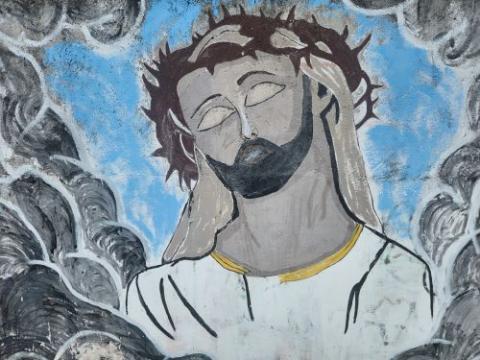
Flores is the only predominately Roman Catholic island in the Indonesian archipelago, and religious street murals, like this one in the city of Maumere depicting the crucifixion of Jesus, are common. (GSR photo/Chris Herlinger)
In addition to the shelter, the group works on abuse and trafficking prevention, public advocacy and overseeing legal cases in a city with a population of about 80,000.
They've helped thousands through the years: Imakulata said they get several new cases a week, averaging about 100 a year.
But this number only hints at the extent of the problem.
Last year Indonesia's National Commission on Violence Against Women reported that since 2015, there were more than 2 million cases of gender-based violence in the country — and those were only recorded cases.
Meanwhile, a 2016 United Nations study said that a third of Indonesian women or girls ages 15 to 64 had experienced some kind of physical or sexual violence in their lifetimes.
To women like Bota Sao, the work of TRUK F is a salve, and its shelter and programs are a haven — a safe space to feel new strength and hope and regain some sense of normalcy after months, years and even decades of pain.
That it is church-based is less important to women than its welcoming, nonjudgmental character. If a woman in an abusive marriage wants to divorce or annul a marriage, "that's their decision, not ours," Imakulata said.
'As women we have to unite to be strong.'
—Evi Bota Sao
But in Flores — the only predominantly Catholic island of the Indonesian archipelago — the group's Catholic foundation and character are a source of comfort and healing.
"Jesus helped a lot of women in his ministry," said Divine Word Missionaries Fr. Laurens Woda, who works at the group's shelter, built in 2009, and ministers to survivors.
'Ordinary people have no power here'
In that spirit, Bota Soa said on a recent rainy afternoon that her renewed prayer life and support from the shelter has "helped me get up again."
Helping women and children "get up again" was the governing vision of the group's founder, the late Sr. Eustochia Monika Nata, who died in 2021.
The genesis of the group came when Nata helped form a collective of women seeking to improve their household skills. But what quickly emerged were stories of abuse and rape, incest and shame.
When Nata realized little was being done in Flores to help those who had experienced such violations, she formed a group for women survivors "with the aim of strengthening each other," Imakulata said, as well as working towards economic empowerment and education.
In addition to helping form the group and eventually the shelter, Nata became an outspoken advocate for women and children.
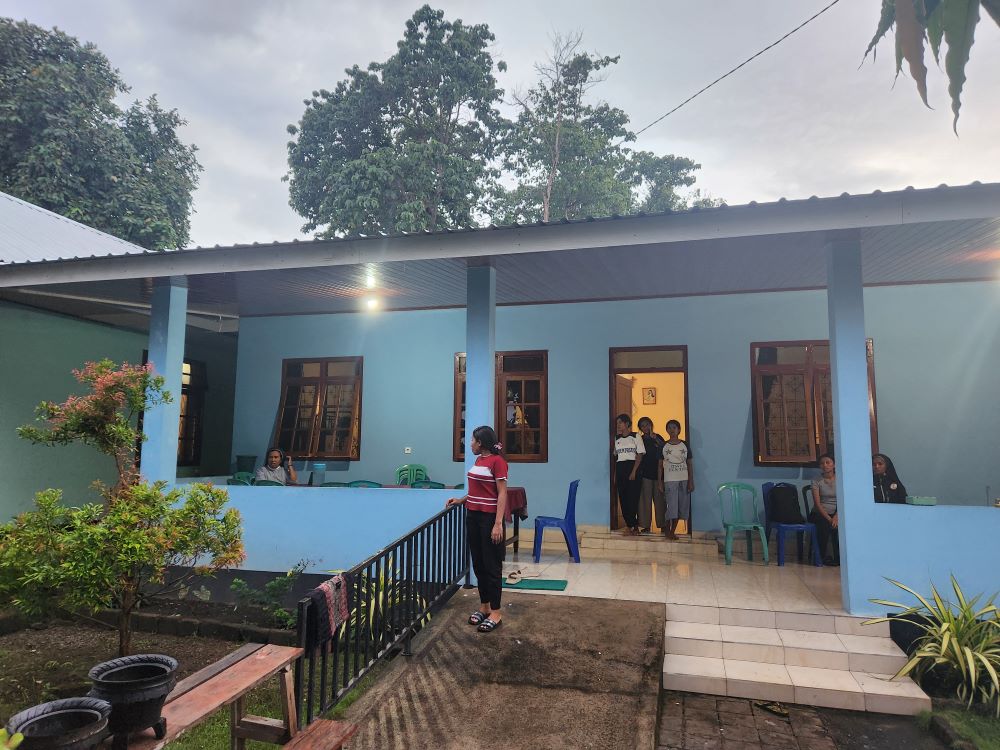
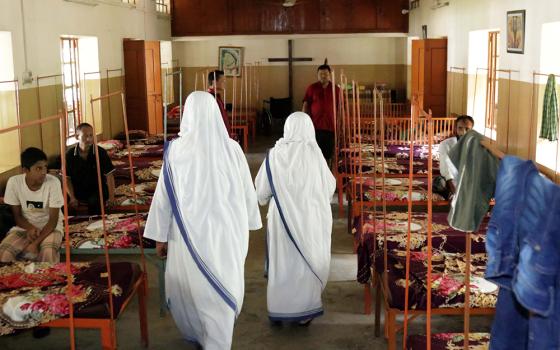
A shelter for women and girls run by TRUK F, or the Flores Humanitarian Volunteer Team, in the city of Maumere in eastern Indonesia, was co-founded by the Missionary Sisters Servants of the Holy Spirit and the Divine Word Missionaries, a male religious order. (GSR photo/Chris Herlinger)
The group's presence proved startling in a socially conservative region.
In 2015, TRUK F was described by the English-language Jakarta Post as the "most feared name on the island of Flores," noting that law enforcement officials had difficulty accepting the visibility of the group — and public awareness of problems that authorities had often ignored.
At the same time, women embraced the group, seeing it as a champion for their lives and validating their experiences as victims and survivors of gender-based violence and trafficking.
As the Jakarta Post put it, just as TRUK F was feared by authorities, it "was the recipient of as much love by residents."
Among them is Maria Herlina Mbadhi, 43, the mother of four children whose husband, Jodocus, a motorcycle driver, died in Borneo in 2024 after accepting a job at a palm oil plantation under false pretenses. To Mbadhi, this was a clear example of human trafficking.
The horrific living conditions — poor shelter, little food — likely contributed to her husband's death. In the aftermath, and as she struggled to repair her life by working as a house cleaner, the shelter took in her and her four children.
That hospitality made a difference, as did TRUK F's assistance in bringing a legal charge of labor violations against the man responsible for the trafficking, resulting in a year and a half prison sentence.
While the case was not processed on trafficking charges that could have resulted in a higher sentence, it did represent something of a victory, said Imakulata and Woda, who noted that local authorities are now more responsive to such cases than they were in the past.
Still, the case highlighted the difficulty residents of Flores face, as human rights groups and others consider this island a trafficking hub because of its economic challenges and lack of job opportunities.
"Ordinary people have no power here," Woda said.
That dynamic, of course, is especially acute among women.
Indonesia is a patriarchal society, Imakulata said, citing, for example, the persistent dowry system, which places financial burdens on women and their families, reinforcing female subjugation. Other problems stem from patriarchal religious traditions, both Catholic and Muslim, and a male-dominated drinking and gambling culture.
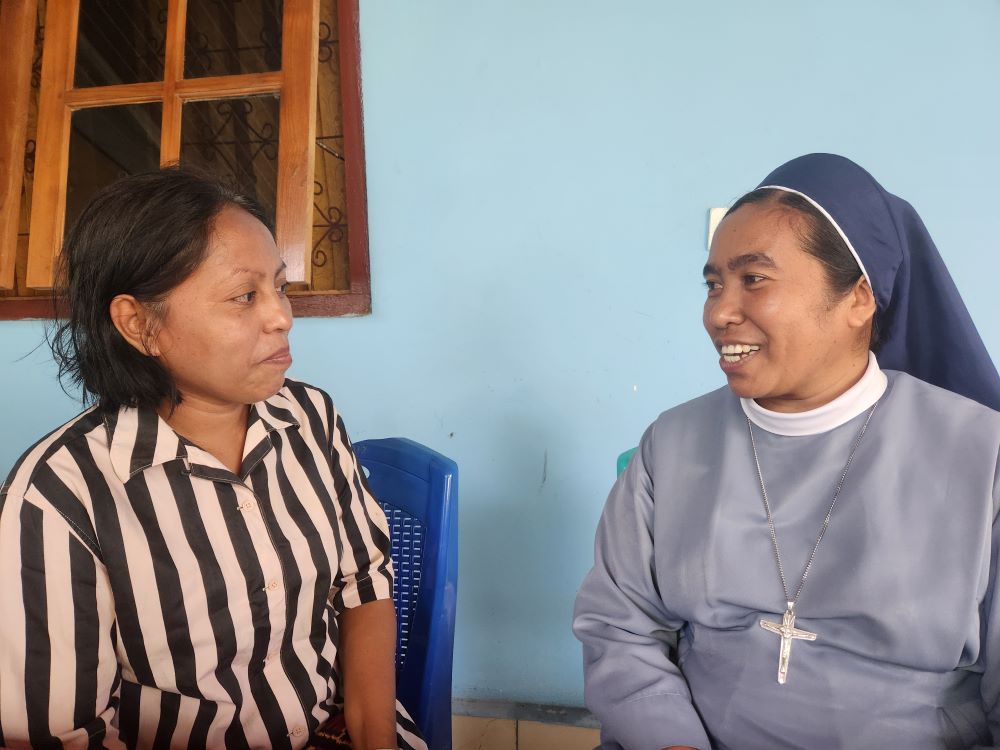
Maria Mater Amabilis, left, a longtime member of a women's self-help group run by TRUK F, speaks with Sr. Fransiska Imakulata, of the Missionary Sisters Servants of the Holy Spirit, who coordinates TRUK F. (GSR photo/Chris Herlinger)
But advocates like Imakulata and Woda often circle back to economics: poverty that engenders constant tensions and pressures within families and also causes people to migrate to other countries (such as Malaysia and Thailand), which can often result in trafficking.
A sister and survivor
Imakulata, 35, a teacher by training, said her own life experience has informed her ministry. She calls herself a "survivor, too" because of domestic abuse she witnessed between her parents while growing up.
She said that gives her some insight into what survivors might be experiencing. "This is like my mission."
Such dedication means much to a group of seven teenage survivors of trafficking or sexual abuse who spoke on their lives and challenges in a group setting alongside Woda and Imaulata. (The young women agreed to be interviewed if they were not publicly identified.)
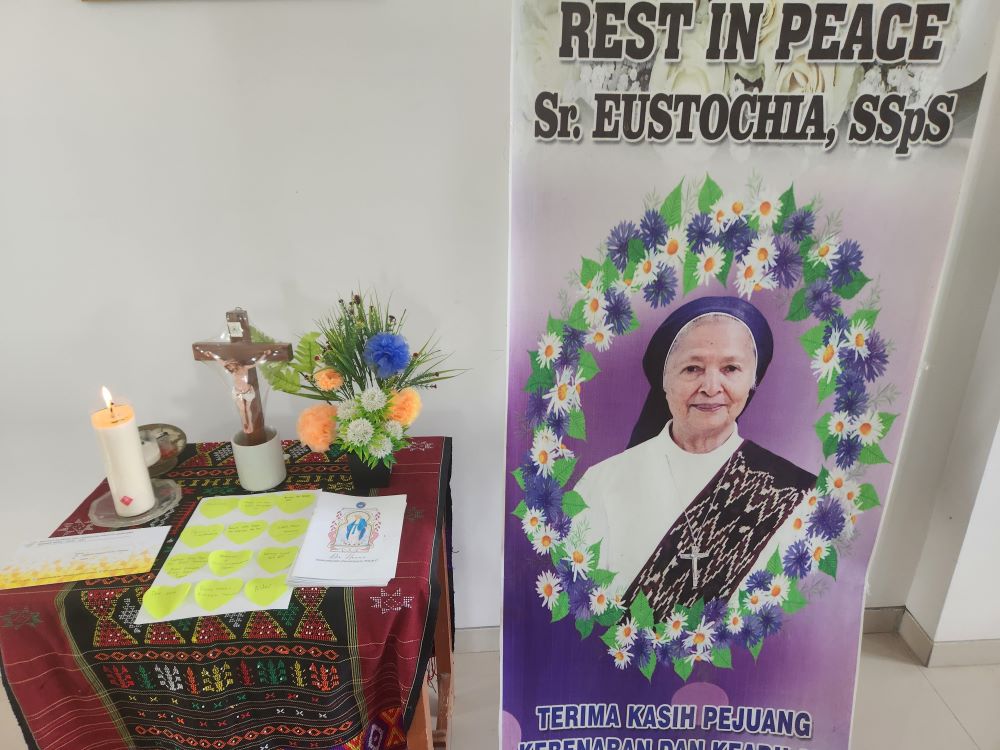
An informal shrine in the offices of TRUK F, or the Flores Humanitarian Volunteer Team, in the city of Maumere in eastern Indonesia, honors the group's founder, the late Sr. Eustochia Monika Nata, a Missionary Sisters Servants of the Holy Spirit sister who died in 2021. (GSR photo/Chris Herlinger)
Most were quiet and hesitant about speaking in much detail about their experiences, though the girls who were trafficked said their families faced economic challenges and that they were lured into work elsewhere in the country by the promise of good money.
All said they felt a sense of safety and comfort at the shelter and were grateful that they have been able to continue their secondary studies as residents there.
"I'm just very happy I can stay here," said a 17-year-old victim of incest, adding that counseling has helped her immeasurably, though she still has frequent flashbacks and cannot sleep without a night light. "It's very heavy for me."
Recounting her experiences in a quiet voice, tearing up, she also shared that in her rural village, a community shaman formally outcast her in a public ceremony.
"It's very unfair, very unjust, very bad," Imakulata said of the cultural stigma, particularly the fear that somehow asking for help will become public and bring shame upon the family.
"They can feel that violence is normal."
Maria Mater Amabilis, 42, a longtime member of the center's self-help group, said just being a woman in Indonesia "can be difficult."
"It's a big effort to come out of a bad situation," she said.
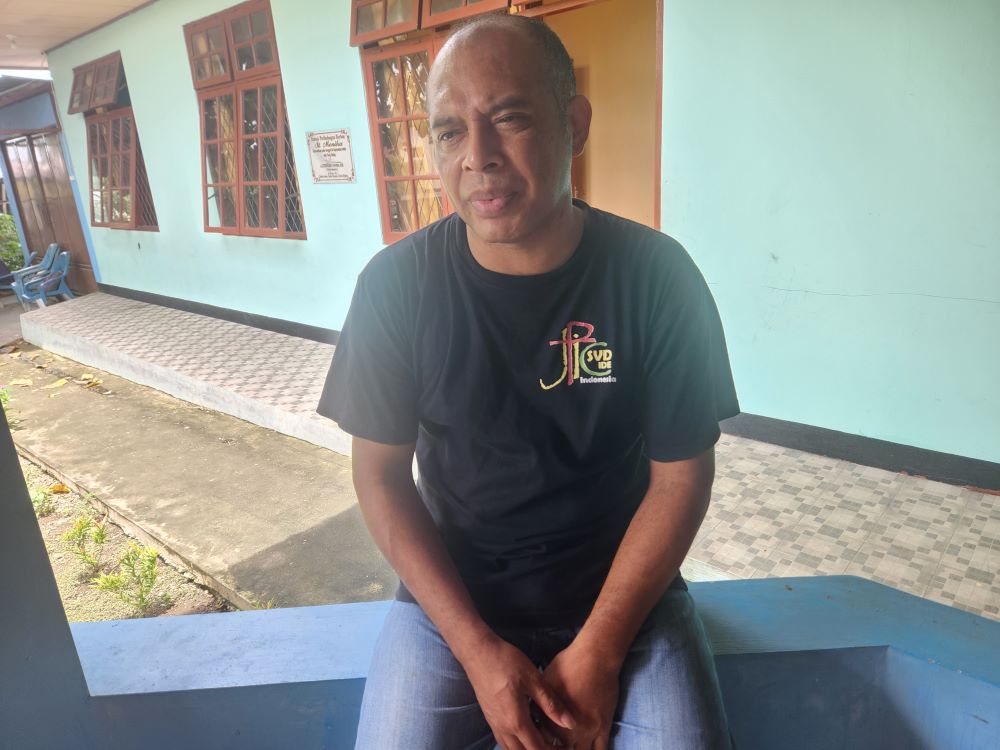
"Jesus helped a lot of women in his ministry," said Divine Word Missionaries Fr. Laurens Woda, who works at a shelter for women and girls run by TRUK F. (GSR photo/Chris Herlinger)
Still, with help, survivors like Amabilis find ways to embrace new lives.
Amabilis, suffering in what she described as an abusive marriage, and who is still contemplating an annulment, said her life was transformed in her encounter with Nata, the group's founder, and feels empowered as an ongoing member of the self-help group.
She tells women who might be reluctant to seek help that her life has changed — and that her religious faith has deepened, too. "I feel accepted and loved. I don't feel solitary and alone."
Fr. Ignasius Ledot, another Divine Word Missionary priest working at the shelter, said that growing survivor testimonies like these are prompting more compassion and awareness from the wider society about gender-based violence.
He points to social media, the proximity to global news, and even the grassroots synodal process within the local diocese as all having effects.
"There has been a change," he said.
Solidarity and strength as "new women"
Such change gives survivors like Bota Sao encouragement and hope.
While Bota Sao is still contemplating an annulment, she has had no more contact with her husband. And she has reported the physical abuse she suffered at her husband's hands — weekly punches to the face — to local authorities.
"It was a constant," she recalled of a life marked by abuse, but also by her husband's drinking, gambling and infidelity.
While her four children — two boys, two girls — still have limited contact with their father, she said they support their parents' separation. " 'It's better to separate, Mom, than to suffer,' " she said they told her.
Advertisement
And what does Bota Sao tell them, particularly her sons? "Don't do what your father did to me if you have a family. Don't hit a woman. You were born of a woman."
When she was suffering abuse, she would pray the rosary in the middle of the night. Now she prays in the full light of day, but with the knowledge that the sisters and priests who have ministered to her "have shown me a new way."
"I feel strength and courage," Bota Sao said, which she shares with women who come to her for advice. "We give each other the strength to speak to others. We are new women."
Her changed outlook is helped by a new hard-won financial independence working as a domestic helper and selling baked goods.
In finding a community of shared experiences and hope, Bota Sao tells other women that it is unfortunate that women in Indonesia "are often not strong, that men often feel they can do anything they want."
"As women we have to unite to be strong."