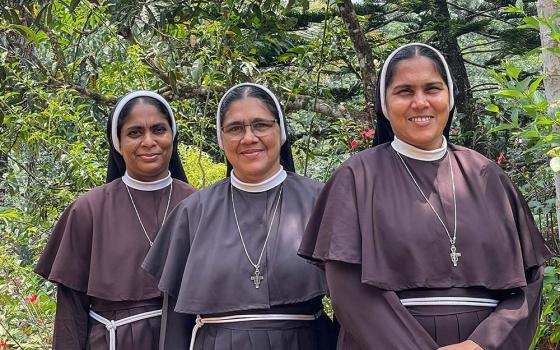
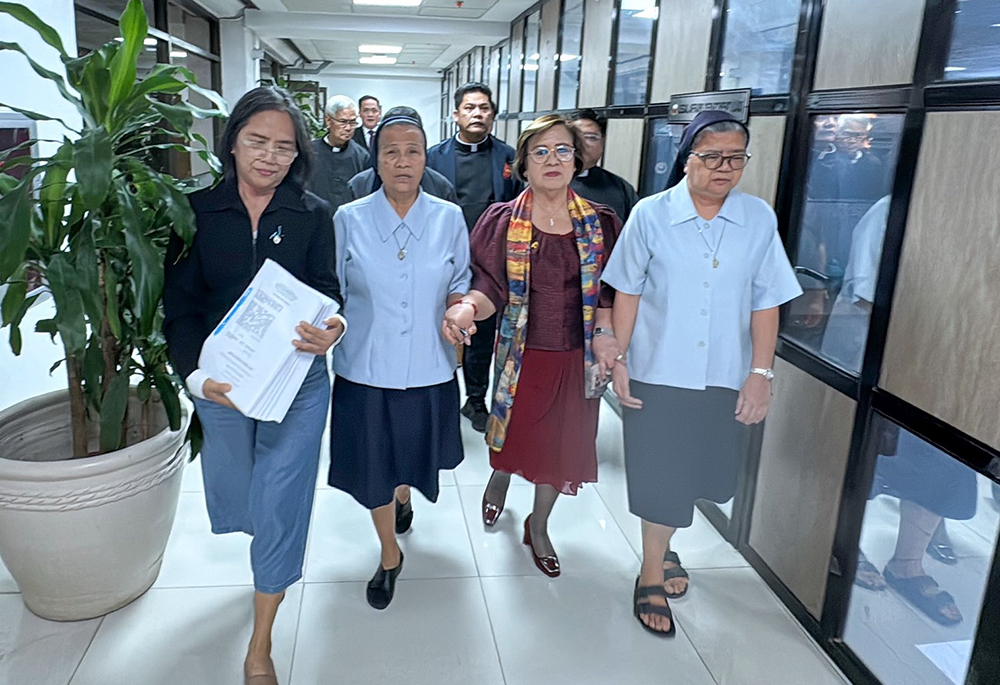
Sr. Geraldine Denoga, right, is one of three Daughters of Charity who filed an impeachment complaint against Vice President Sara Duterte on Feb. 9, 2026. She is accompanied by Sr. Nieves Servito, second from left, who came to support her fellow Daughters of Charity. (Courtesy of Office of Representative Leila de Lima)
by Paterno R. Esmaquel II
At 65, Sr. Geraldine Denoga still remembers her father's words at the dinner table. "Finish the food on your plate. … Do not leave even a single grain of rice."
It was her first lesson in stewardship — that God's gifts should never be wasted.
Decades later, the Filipino nun, a certified public accountant, sees public money the same way. Every peso squandered through corruption is a resource stolen from the poor.
Today, the Daughter of Charity, along with two fellow nuns, were among the 13 people — including four Catholic priests and a Christian pastor — who filed a high-profile impeachment complaint Feb. 9 against Vice President Sara Duterte, accusing her of corruption.
Duterte, 48, faces allegations of misusing roughly US$9.9 million in confidential funds, amassing unexplained wealth, bribing public officials and allegedly plotting to assassinate President Ferdinand Marcos Jr. and two of his relatives.
The vice president is currently on trial before the Senate, sitting as an impeachment court, after she was impeached by the 318-member House of Representatives on May 11.
If convicted by the Senate impeachment court, the daughter of former President Rodrigo Duterte will be removed from office and barred from seeking the presidency in 2028.
Following the money
Her training as an accountant led Denoga to notice red flags in Duterte's public disclosures, prompting her to check if public funds had been spent for the good of the people.
She cited Duterte's statement of assets, liabilities and net worth (SALN) — a mandatory disclosure for Philippine officials — which showed zero cash on hand or in bank accounts from 2019 to 2024.
The vice president's camp claimed that her cash was lumped into the "others" category of her SALN.
"I am an accountant, so I really can't accept that there's no cash, and then they'll just put it under ‘others,' " the nun told Global Sisters' Report.
She said in doing that, Duterte's camp was either "so careless" or that "impunity" was involved.
"Do they think that they're untouchable?" Denoga said.
A charism of service
For Denoga, joining to file the impeachment complaint was a way of fulfilling her congregation's charism.
For Denoga and other nuns, signing the complaint was not a political act but a moral responsibility rooted in their vocation.
Denoga has been a member of the Daughters of Charity in the Philippines for 35 years and is currently the vice president for administrative services and finance at Santa Isabel College of Manila.
She said her congregation focuses on "serving the poor," and that fighting corruption is part of that charism because corruption devours public funds that could "serve the people, especially those on the margins of society."
Advertisement
For 79-year-old Sr. Violeta Cecilio, the conviction stemmed from personal experience of spending more than five decades as a nun, some 30 years in Thailand and Cambodia.
The missionary journey made her witness how poor governance and entrenched corruption push the poor into increasingly desperate situations.
"Because whatever happens, the first victims are the poor. As of now, we can see the poor becoming poorer because of the system of government we have," Cecilio said.
When faith demands action
Cecilio also addressed critics who hold that nuns should not get involved in politically sensitive issues.
Cecilio said Christians should distinguish between taking a stand for truth and the poor, and engaging in politics for power.
"When I signed the impeachment complaint, I was not thinking of Sara Duterte. I was thinking of the truth that I should fight for," she said, adding: "God is the truth."
Aside from Denoga and Cecilio, Sr. Maria Liza Ruedas of the Daughters of Charity also signed the impeachment complaint against Duterte.
In an interview with Global Sisters Report, Ruedas said part of her mission during her 38 years as a nun was forming voters' consciences and "empowering the poor to claim their rights" in the face of widespread accusations of corruption.
"Religious groups and Christian communities must demonstrate they cannot be silenced in their efforts to advocate for the persecuted poor. We stand with the poor and victims, and we empower communities to do the same," Ruedas said.
Across this Catholic-majority nation, hundreds of clergy and religious have openly rejected the prospect of another Duterte presidency.
They often cite the culture of violence under the elder Duterte, who is currently on trial at the International Criminal Court for his bloody war on drugs.
For the nuns, the impeachment is ultimately about what kind of nation the Philippines would become. It depends on people "who stand up and take a stand for the truth, transparency and justice," Denoga said.