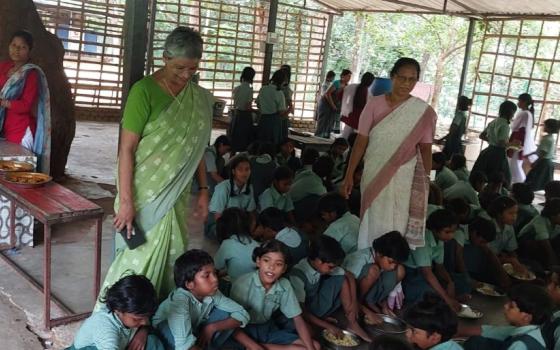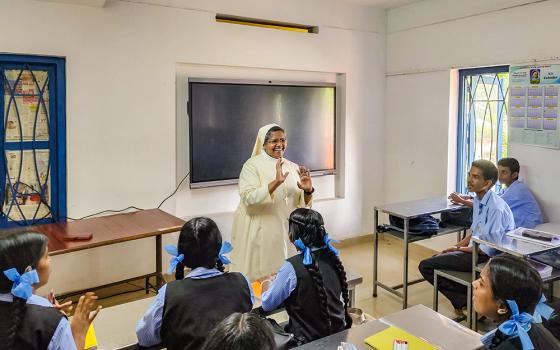
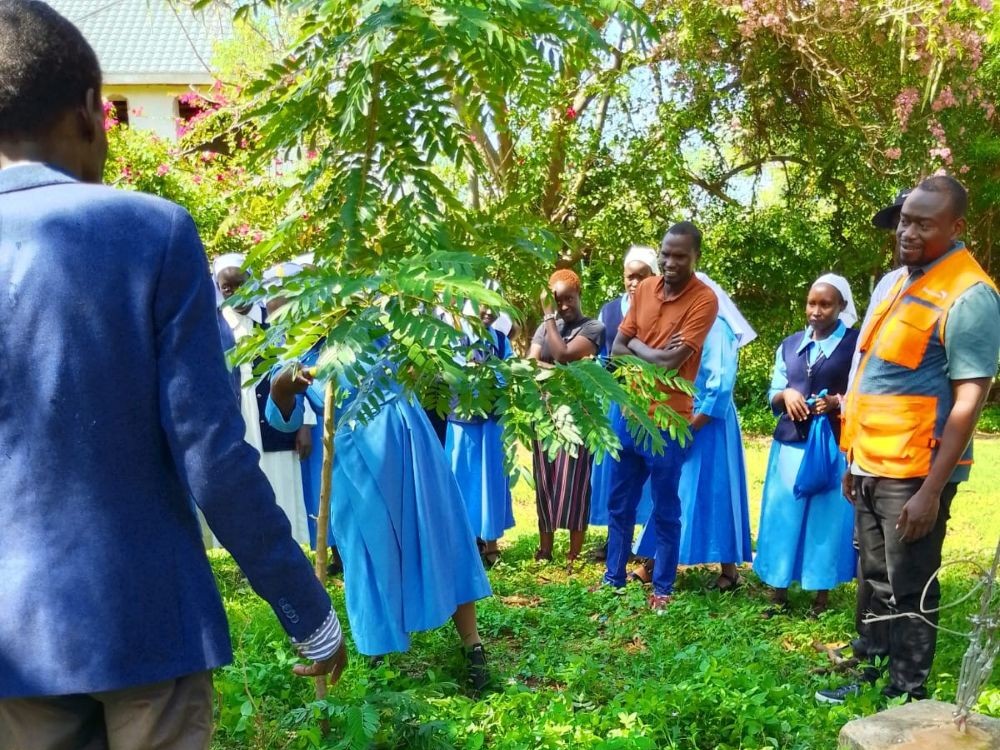
Participants watch a demonstration on proper tree pruning techniques as part of the farmer-managed natural regeneration training organized by Institute of the Holy Trinity Sisters in Isiolo County, Kenya. (Courtesy of Sr. Catherine Ciingi)

by Sr. Catherine Ciingi
In early April 2025, an unusual yet deeply hopeful gathering took place in the arid heart of Isiolo County, Kenya. The Institute of the Holy Trinity Sisters organized a farmer-managed natural regeneration training to equip themselves and the wider community with practical skills for restoring degraded land. Recognizing that lasting environmental change must be rooted in community ownership, the sisters intentionally invited pastoralist leaders and community mobilizers to take part alongside them in the training.
To support this initiative, the sisters partnered with OikoDiplomatique and experts from World Vision. Participants came from the Turkana, Samburu and Borana communities, bringing diverse experiences, local knowledge and a shared concern for the future of their environment. What emerged became a space where faith, ecological awareness and hope converged in response to growing climate challenges.
The sisters' leadership was shaped by years of lived experience with environmental hardship and close accompaniment of communities affected by climate change. During the discussions, participants spoke openly about the realities facing Isiolo today. Rain no longer arrives when expected, seasons have become unpredictable, and prolonged droughts are often followed by destructive floods.
Like many arid and semi-arid regions of Kenya, Isiolo now lies at the intersection of environmental degradation and climate-related conflict. Extended droughts have reduced pasture and depleted water sources, intensifying competition among pastoralist communities and fueling tension. As resources grow scarcer, livelihoods are threatened and access to food, healthcare and education becomes increasingly fragile — especially for women and children.
Isiolo's scattered acacia trees, hardy shrubs and drought-resistant grasses reflect generations of adaptation and traditional grazing practices. Yet prolonged dry spells reduce vegetation cover and dry up water points, while sudden heavy rains wash away topsoil and young seedlings before they can establish. Indigenous species once vital for fodder, livelihoods and traditional medicine are disappearing, leaving behind exposed and degraded landscapes.
Faith was central to the farmer-managed natural regeneration training. One sister recalled Pope Francis' Laudato Si', which calls all people to care for our common home. Another participant said: "We are mandated by our creator to steward the environment, not exploit it."
For the Holy Trinity Sisters, this commitment has been shaped through years of perseverance. Their journey began with the fencing of a 6-acre piece of land and the planting of trees. Repeated setbacks, including wildlife destruction, insecurity and damaged infrastructure, often made the vision of nurturing both land and people seem distant.
Farmer-managed natural regeneration offered a simple, low-cost approach centered on regenerating Indigenous trees from existing stumps, roots and seeds already present in the soil. Learning that Isiolo's acacia trees could be restored rather than replanted was transformative. Farmer-managed natural regeneration opened a pathway toward improving soil fertility, restoring water tables, enhancing biodiversity and strengthening food security, while empowering communities to reclaim stewardship of their land.
The April training marked a significant turning point. Sisters and pastoralist leaders worked together to develop restoration plans for both church and communal lands. The sisters' 6-acre farm is now envisioned as a demonstration site, a living classroom where the wider community can observe, learn and practice regeneration techniques.
The sisters also participated in a learning exchange in Nakuru organized by OikoDiplomatique, where they shared progress from the Isiolo pilot and learned from other faith-based practitioners engaged in environmental restoration.
Rooted in a charism of care for creation and care for the vulnerable, the Holy Trinity Sisters are demonstrating that environmental restoration is not only about trees and soil. It is about resilience, relationships and hope.
Advertisement