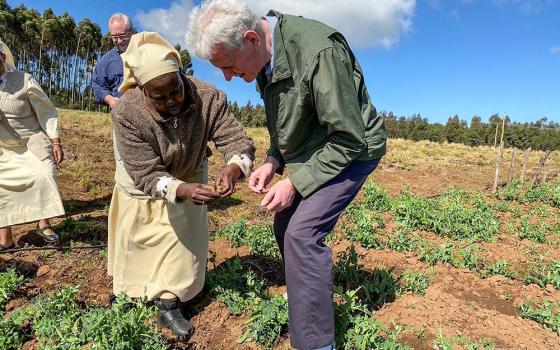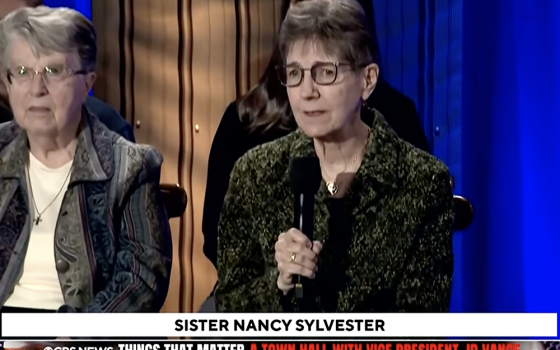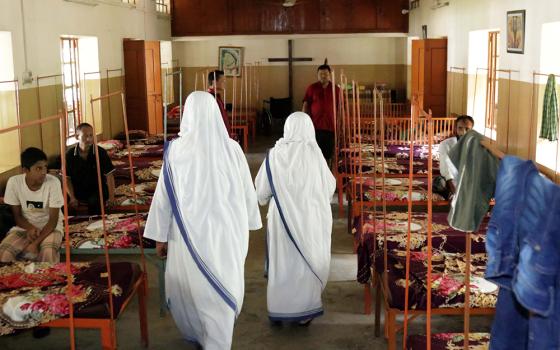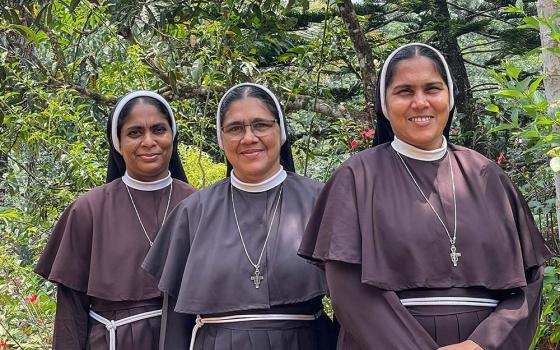
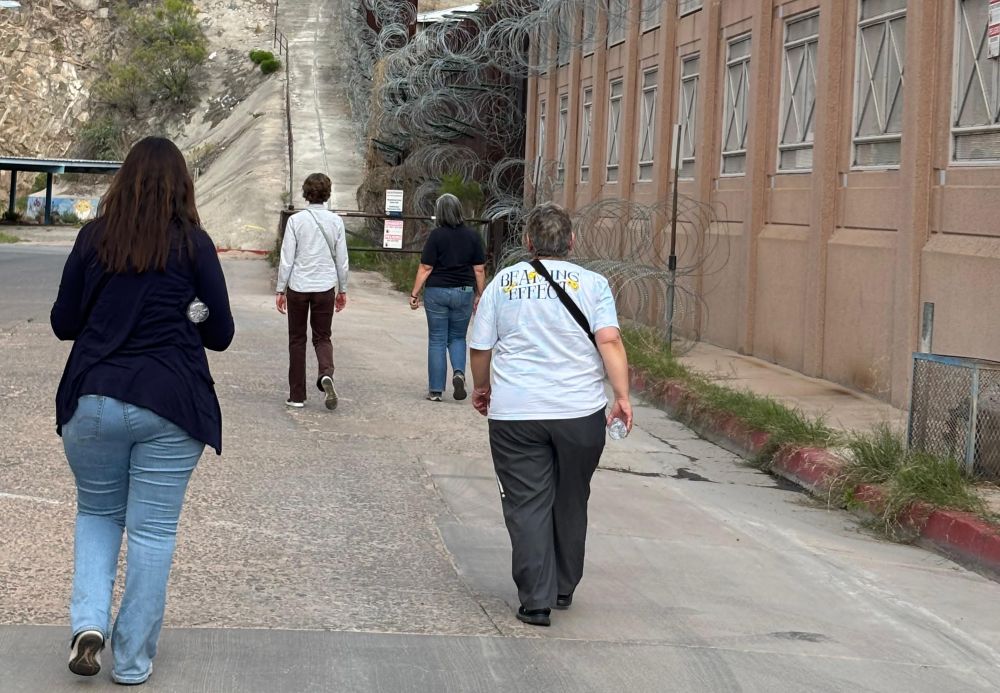
Catholic Sisters Walking with Migrants participants walk alongside the U.S. wall at the Morley Port of Entry in Nogales, Arizona. (Eileen McKenzie)

by Sr. Eileen McKenzie
On May 2, eight Catholic sisters met at the Tucson International Airport in Arizona to embark on a weeklong immersion of Catholic Sisters Walking with Migrants, a program I coordinate through the Kino Border Initiative. This international group represented five congregations, and their religious life experience ranged from sisters in initial formation to elected leadership. They ministered in education, ecology, pastoral care, immigration accompaniment and vocational ministries. They all had two things in common: curiosity about an immersion at the border and openness to transformation.
The purpose of the immersive educational experience at Kino is threefold: to humanize the border experience for those who don't live there; to accompany them as they encounter the people and land of this region; and to both expand and deepen understanding of immigration. Many of us fall into the temptation to simplify a very complicated issue; therefore, we invite people to lean into the complexity and all the discomfort that it brings.
For example, participants are exposed to different realities, as they first visit and attend Mass with cattle ranchers in the area, who share why they support a more secure border and support people "coming to America the right way" (with legal status). Then, they serve and share breakfast with people who have been deported after living in the U.S. for decades because their parents brought them when they were children; many do not understand until they are teens that they do not have legal status in the U.S.
I've accompanied many groups at Kino, and none are like the sisters. No matter the charism, the congregation, the ministry — a sister's singular presence usually stands out in a group, and a group of sisters stands out that much more. For example, as I walked with these sisters along the 30-foot concertina wire-laden wall that marks the international border between Nogales, U.S.A., and Nogales, Mexico, I was drawn into how they silently gazed upon it, considered those who have encountered it, and then offered a prayerful lament for the violence and suffering that such divisive configurations cause.
The solidarity of these sisters didn't stop in the suffering, though. As we continued to walk, we turned a corner and met a Cinco de Mayo street party. It took a moment to wrap our heads around walking into a community that was eating, drinking and dancing within 100 yards of the highly militarized geopolitical landmark, but, as sisters are wont to do, we walked right into the celebration! It didn't take long for us to join the party — eating street food, enjoying mariachis and dancing with a community that refuses to be defined by oppressive structures and stereotypes.
This capacity for sisters to walk with others, meeting them where they are and then going deeper with them, is something that I love about our vocation. I watched it over and over again as these sisters walked with migrants for a week. They wept with one man who shared his struggles about being unable to provide for his daughters, who are all U.S. citizens living in California, on what he earns in Mexico. "They can't take care of themselves, and here I am unable to take care of them, either," he said.
They also questioned the judge who presided over the Federal District Court in sentencing proceedings, as they observed more than 40 migrants dressed in orange jumpsuits, chained to each other, shuffling through a courtroom. They listened to Sheriff David Hathaway describe his resistance to the criminalization of '"people who just want to work and be with their families." They enjoyed posole made by a single mother who was preparing for asylum with her family before it was eliminated in January 2025.
In the evenings, they returned to the house they were staying in and reflected on their day. One sister said, "My favorite part of this experience was meeting the guests at Kino in the company of sisters and caring staff members during the day, then in the evening, reflecting on the graces received over community dinner."
Advertisement
It was beautiful to observe the conversation the sisters had with Sr. Engracia Robles, a Missionary of the Eucharist, co-editor of the book Voices of the Border, and recognized by many as the "mother foundress" of Kino. Their inspiring conversation focused on Catholic sisters doing what needs to be done with little preparation and few resources, but plenty of prayer, hope and collaboration. "I see the great works of God start with small gestures," Sister Engracia said. "This center started with a few women serving meals to hungry men who were being deported to a city that had no infrastructure to support them. We saw that their needs were way beyond what we could do, but we did what we could: We fed them. In time, with prayers, effort and generosity, we now have a humanitarian aid center."
Wherever we walked, I sensed these sisters' impact in their care, questions, laughter, tears and righteous anger. They walked with migrants, sharing compassion. They walked with each other, sharing experiences. They walked with their God, searching for understanding. At times, they shared feelings of powerlessness in the face of such complexity. And at the same time, they shared their faith wholeheartedly. They encountered each day without knowing what to expect and showed up fully present to receive what the day held for them. Their way of walking caused me to reflect on how important it is for us to show up fully present, wherever we are, whatever we do.
We now live in an age when so many of our Catholic ministries ask for "the sisters." If not as staff, volunteers or board members, we are invited to events, to share reflections, to engage — to just be present.
Before returning to the Tucson International Airport, as the sisters cleaned up their house for the week, we reflected on how sacred this experience was. We recognized how strongly the spirit works in and through us. As our religious congregations become smaller and we divest of corporate ministries, I feel grateful to be part of a movement of sisters who, in accompanying and advocating for migrants, respond to the signs of these trying times with presence, in our own way, to act justly, love tenderly and walk humbly with God (Micah 6:8b).
To learn more about the Catholic Sisters Walking with Migrants program, contact Sr. Eileen McKenzie at 520-867-5438 or [email protected].