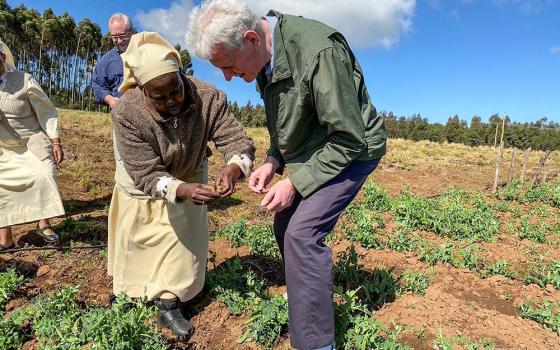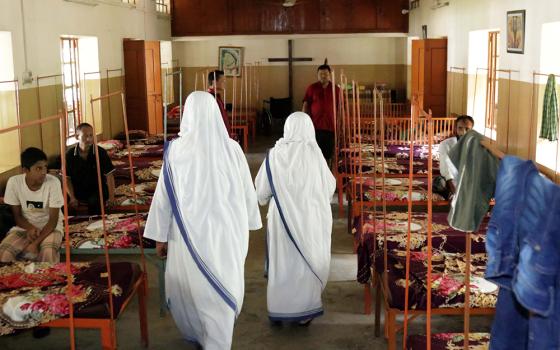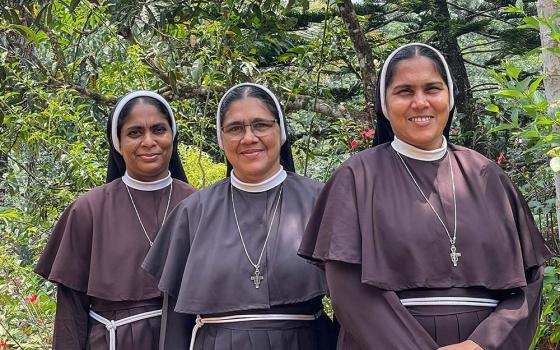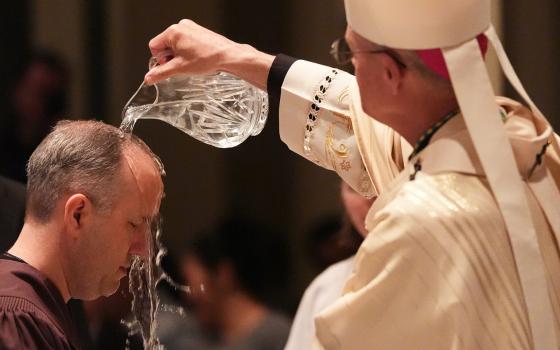
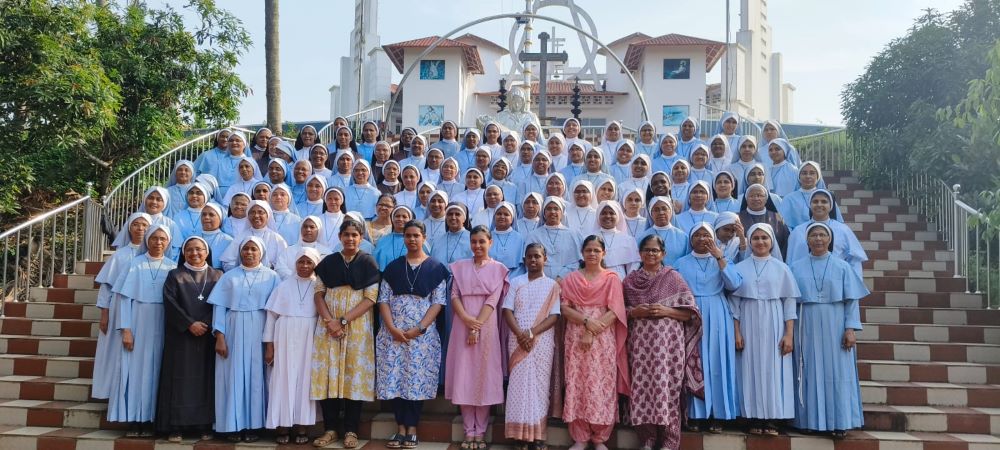
Indian sisters from various congregations gather for "home mission," where they visit every family in local parishes prior to retreat days. (Courtesy of Sujata Jena)

by Sr. Tessy Jacob
Contributor
Amidst growing intolerance against Christian missionaries, social media attacks on religious and their morality, and a diminishing number of vocations to religious life, I was fantasizing about a world without religious, especially nuns.
In my fantasy, I felt it was an impending disaster that might occur in a few decades time. Anti-missionary groups project our existence as useless in exchange for huge pseudo-charity entrepreneurs whose sole aim is to extract money. These assumptions are strengthened with the efforts of groups from every religion forming organizations for philanthropic activities. Their activities are made known to the world through advertisements for crowd fundraising and social media posts.
In all that, at least a huge section of society began to believe that Christian men and women who forgo married life to save society are a tragedy. It is more evident that whenever there is an attack on religious institutions, social media posts breach all decency in condemning the religious as "agents of conversion." Unfortunately, it's not only the non-Christians who shower abuse on us; a good number of Christians also join the fold to tarnish our name.
Missionaries have pioneered health care, education, pastoral assistance and social developmental activities. Until recent years, our institutions were sought after, considering the committed services we provide. With globalization, the trend has changed, and money can now provide what one needs, even love and care. That made the less competitive religious institutions redundant and worthless, and apparently, the decreasing vocations substituted lay staff for the personal care that sisters would directly offer.
The changes were drastic, at least for a developing country like India. All of a sudden, people started to feel many possibilities, which was the monopoly of Christian missionaries once upon a time. Also, political propaganda worked as a hypodermic needle, injecting fanatical venom drop by drop.
The world still needs people who will show them what it means to care, walk the extra mile, or smile at someone even if they don't reciprocate.
Even though I was living in a different reality, where vulnerable humanity still needed religious women, the excess negative media messages had camouflaged my objective outlook.
It came home to me recently when one of my friends, another nun, posted a photograph of nearly 100 sisters from different congregations and age groups on her social media. All of them looked so enthusiastic as if they were on a picnic. She told me that they were on a "home mission."
"Home mission" is a concept where sisters assist priests when retreats are conducted in a parish. Nearly 100 sisters are involved in home mission, and they visit every family in the parish ahead of retreat days to prepare them personally.
This was a new concept to me. My friend is based in Kerala, the southern state of India. Even though Christians are a major group in the state, and it's a home for three saints and a number of venerables in the Catholic Church, the church is not spared of fanatical whips.
She says this new initiative is noble and apt to the signs of the time. It has brought consolation to the sick, reconciliation to the broken families, saved the lives of children from drugs, and provided companionship to the aged and the abandoned parents.
While connections increased, relations decreased, and physical proximity and care were overlooked. The communities that once lived as one huge family are reduced into nano units, creating huge vacuums. In these circumstances, sisters reach out, without invitation, to talk and listen to people. Here, social media does not drive opinions; lived experiences and human vulnerabilities narrate the tales. For instance, one person who had not made confession for 30 years did so and was reunited with the church. In another case, the understanding between the teenage children and parents was improved. This happened thanks to the sisters who walked, talked and prayed, even if the family didn't feel the need initially.
My friend's experience also brought me into an introspection. I have been part of a university for the past four years. To be precise, besides priests in administration, I was the only religious nun on the campus. Except for being a mentor to and guide for those in need and assisting students in pastoral care, I have not felt my role as something of greater significance.
While working on my doctoral thesis, I spent a lot of time in the library. Gradually, I realized that students would occupy seats beside me. One day, one of the students revealed to me, "Sister, students like to sit with you for study; they feel focused and cared for in your company!" That was an eye-opener.
This particular girl would take every opportunity to catch up with me for random conversation. I used to tell her about my childhood, the values learned in a joint family, the culture of caring for the other promoted by parents, the importance given to prayer and religious activities, learning to live with the minimum, and growing up in an era where social media was nil and other electronic communications were a luxury.
It was a purely two-generation, Gen Z-millennial time. It was a learning time for her, which she says her parents had not taught them.
On another occasion, I remember one student imitating me while doing her laundry. To my curious smile, she responded, "Sister, I learned to do it by observing you." A missionary is always a missionary — be it in formal or informal settings. We are walking textbooks from which someone else is drawing a lesson.
Advertisement
My role in the university was as a Ph.D. scholar rather than a religious nun, but the innate nature of a religious nun was more apparent to others than I consciously exhibited it. Religious outfits or long hours of prayer didn't define me, or rather, it didn't mean anything to the students, who were mostly from Hindu or Muslim communities. My aura as the chosen one of God, and set aside for a special purpose, indirectly worked the magic, even when I was not aware of it.
At the end of the academic year, I will move out from the university that was my home for nearly four years, and the visible shock and apprehension expressed by my friends and students of all walks make me realize that the world isn't yet ready to part with religious missionaries.
The world still needs people who will show them what it means to care, walk the extra mile, or smile at someone even if they don't reciprocate. While families are reduced into nano units, the religious who live in bigger communities can teach them the value of human relationships and the attitude of forgiveness. While the world is in a rat race against materialistic gains, we who have embraced the vow of poverty can teach them what it means to be minimalists; when prayers and religious ritualists are buried under logic and counter values, we can inspire them to try the spiritual paths.
Religious are inevitable, and quality vocation to religious life is important. The world does not need "doers" but role models. We can't do much, but we can do small things with a difference.
Amidst all the controversies, we need to remember John 15:18: "If the world hates you, just remember that it has hated me first."