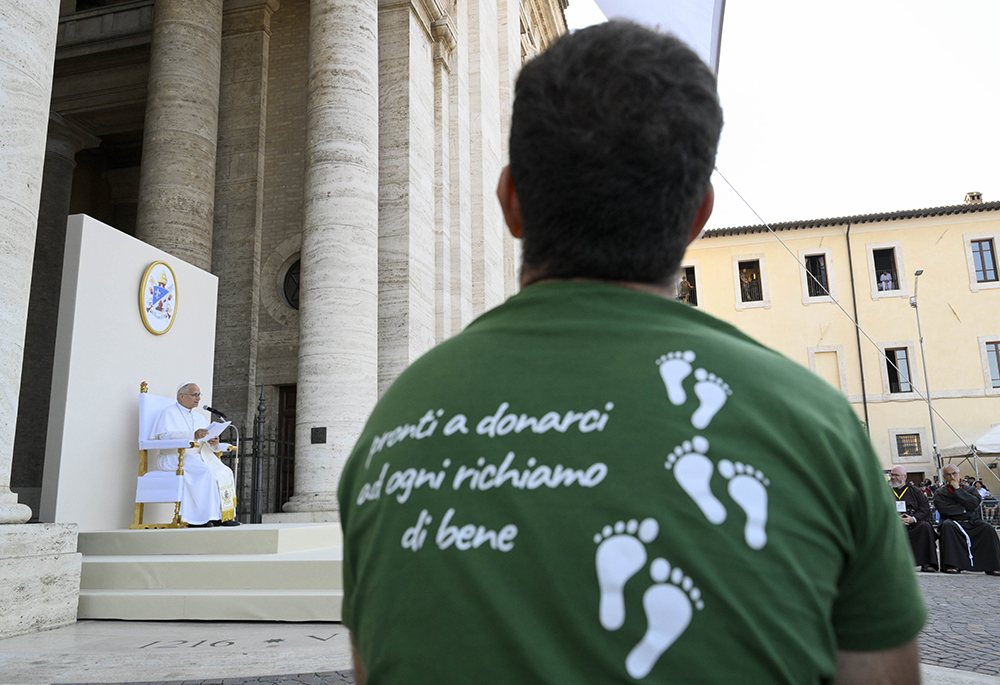
A young man listens to Pope Leo XIV during a meeting between the pope and young people taking part of the "Go! Franciscan Youth Meeting 2026" in Piazza Santa Maria degli Angeli in Assisi, Italy, Aug. 6, 2026. (OSV News/Vatican Media/Simone Risoluti)

by Sr. Margaret Gonsalves
Contributor
Gen Z youth worldwide are protesting government negligence, unrealistic policies, corruption and high youth unemployment as well as poor education and healthcare systems for all. In some countries, they are succeeding in overthrowing unjust governments.
Drawing inspiration from the triumphant victory of Gen Z movements in Sri Lanka, Nepal and Bangladesh, the Indian Gen Z movement got triggered by a comment from the Chief Justice of India: "There are youngsters like cockroaches, who don't get any employment and don't have any place in the profession. Some of them become media, some of them become social media, some of them become RTI activists, some of them become other activists, and they start attacking everyone."
Born into the social media era, the well-informed Gen Zs have unique virtues and are the most researched generation with a lot of questions. They are angry and hate hypocrisy and look for honesty and integrity in their leaders who are not walking their talk.
I tend to think that St. Francis of Assisi was a Gen Z youth, a son of Assisi's rising elite merchant. His family opulence placed him among the fortunate urban class.
After witnessing the hazards created by wealth, leading to rivalry, segregation and antipathy, widening the divide between haves and have-nots, Francis renounced his family patrimony and rejected family's elite lifestyle. He opted to favor morality over the mathematics of realism and objectivity, breaking away from the economic culture that shaped his upbringing.
While praying before the crucifix in the rickety chapel of San Damiano, Francis heard a voice saying: "Francis, repair my church, which has fallen into disrepair." Though initially he took it literally, later he understood that church is a human body and not an institutional structure.
Advertisement
Pope Leo XIV declared the 800th anniversary of the saint's death a special jubilee year, inviting the faithful to follow Francis' simplicity, care for creation and authentic source of peace and reconciliation with every being.
During his pastoral visit to Assisi, Leo responded to questions asked by young people, saying that religion shouldn't be used for political aims and that leadership should be liberating for all.
Leo's prophetic encyclical Magnifica Humanitas promotes a civilization of love, peace and justice. It draws our attention to a culture of supremacy which favors a few and dominates most. Is he aware that today's Gen Z is skeptical about those not walking the talk? Leo, will you prove them wrong by walking your talk?
Can the Vatican follow St. Francis of Assisi's example of rejecting inheritance and material prosperity and voluntarily embracing poverty to capsize the values of unjust bureaucracy in the hierarchy of the church?
Can you pave the way to reject the violence of exiling women from active decision-making leadership roles?
The way to deal with these issues is to engage with women and youth in conversations and give them their rightful place as disciples of Jesus.
Gen Zs speak with one voice and are endowed with reason and conscience. So are women.
"Doubly poor are those women who endure situations of exclusion, mistreatment and violence, since they are frequently less able to defend their rights," Pope Francis wrote in Evangelii Gaudium.
Can the Vatican recognize that women all over the world are eager to welcome change and reform? Enlarging the space for ordaining women will neither fracture unity nor lose traditions.
Perhaps if Leo pushed the limits of his world by involving women in decision-making, then women too will push their limits, leading to a Gen Women movement, making the church radiant again.