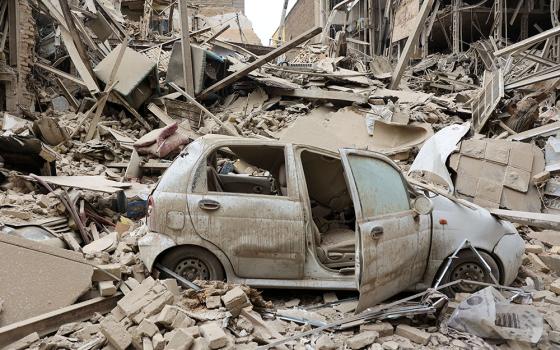
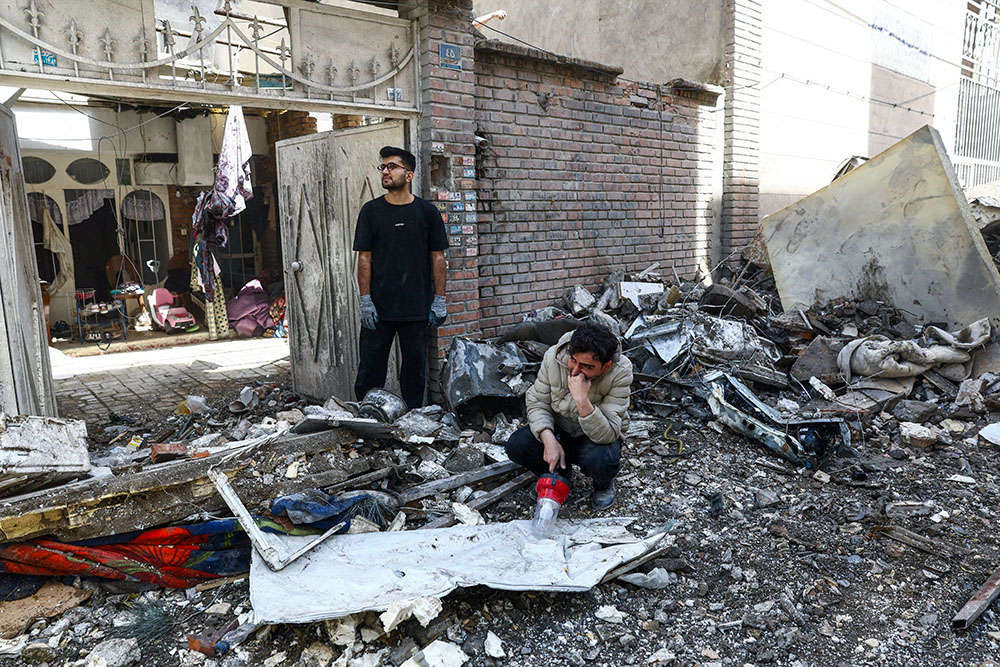
People react at the site of a residential building in Tehran, Iran, March 27, 2026, that was damaged by a strike amid the U.S.-Israeli war with Iran. (OSV News/West Asia News Agency via Reuters/Majid Asgaripour)

I recently picked up a novel by Scott Turow, Ordinary Heroes. I've liked his legal thrillers, but this book is different. It tells the story of a young man trying to piece together his father's life when he was in the military during the Second World War. The plot is intriguing, but what drew my attention and grabbed my heart were the scenes when Turow brought to life the suffering of the soldiers at the hands of their enemy brothers as they waged a horrible and cruel war.
Turow does not mince words as he portrays the brutality, gore and witless destruction the soldiers and civilians in the towns that peppered the countryside experienced as the Allies and the Axis powers fought each other throughout those years.
While I was reading this book, U.S. President Donald Trump, together with Israeli Prime Minister Benjamin Netanyahu, waged a war of choice. With no clear purpose or end plan to their folly, they unleashed drones and missiles, which rained down on Iran while Israel extended the war to Lebanon.
Unlike Turow, Trump uses different language for his narrative. He talks about it as a "little excursion" that will end quickly. His casual language includes making jokes about military tactics. Of course, when the president talks, it is all in superlatives. Take Iran back to the stone ages; blow them to hell; our response is the biggest, best and strongest than anyone has ever seen. He threatened to bomb power plants, bridges and other infrastructure, oblivious to violations of international law. He thinks nothing of destroying a civilization that is about 2,600 years old, existing for only 47 years as the Islamic Republic of Iran.
The AI app Perplexity summarized 10 sources to get current estimates as to the financial cost of the war to the U.S.: about $42 billion as of April 14, 2026. The number and cost of the drones and missiles are not easily obtained. However, as an example, the U.S. lost 24 MQ-9 Reaper drones at a cost of $720 million, at $30 million each, and we have fired more than 850 Tomahawk cruise missiles at $1.7 billion to $2 billion, at $2 million each. It is difficult to find out how much of our taxpayer money is being drained from use for other more needed areas both at home and abroad.
Advertisement
The narrative offered by the White House only boasts of the war's victories, shielded by rhetoric that justifies it all because we are targeting, as the president likes to say, only the terrorists and "bad people." This keeps us from seeing the suffering that is happening in the modern trenches of apartment buildings, schools, hospitals, as well as underground bunkers and tunnels.
We hear and see little to shock us into feeling the destruction and human toll of this war of choice. Reports indicate that at least 13 U.S. service members have been killed and more than 380 injured. Iran estimates vary between 2,076 and 3,363 killed and roughly 4,475 to 26,500 injured. What is clear is that the human cost for Iran is in the thousands.
Modern warfare hides the human suffering and masks what is really happening in choosing war as the way to resolve conflict. The complexity of nation-states and international relationships today calls us to imagine new possibilities to address complex adversarial issues.
I am proud of our Pope Leo XIV, who publicly called for an end to this "atrocious" conflict urging all parties to lay down their weapons, and for his courage to name and denounce the "delusion of omnipotence" and "idolatry of power" that is fueling this war. He stands firm that this position is not partisan but is that of the Gospel.
Perhaps an evocative question raised in the aftermath of any war is one we need to ask ourselves today: What is the moral cost of stopping violence when the means required to end it also produce immense destruction? At what point does the scale of suffering force us to examine not only the cause of war but also the way it is carried out?
Let us renew our commitment to sit in contemplation, opening the space within ourselves to better understand the immorality of war today and to recommit ourselves to working for peaceful, diplomatic solutions.