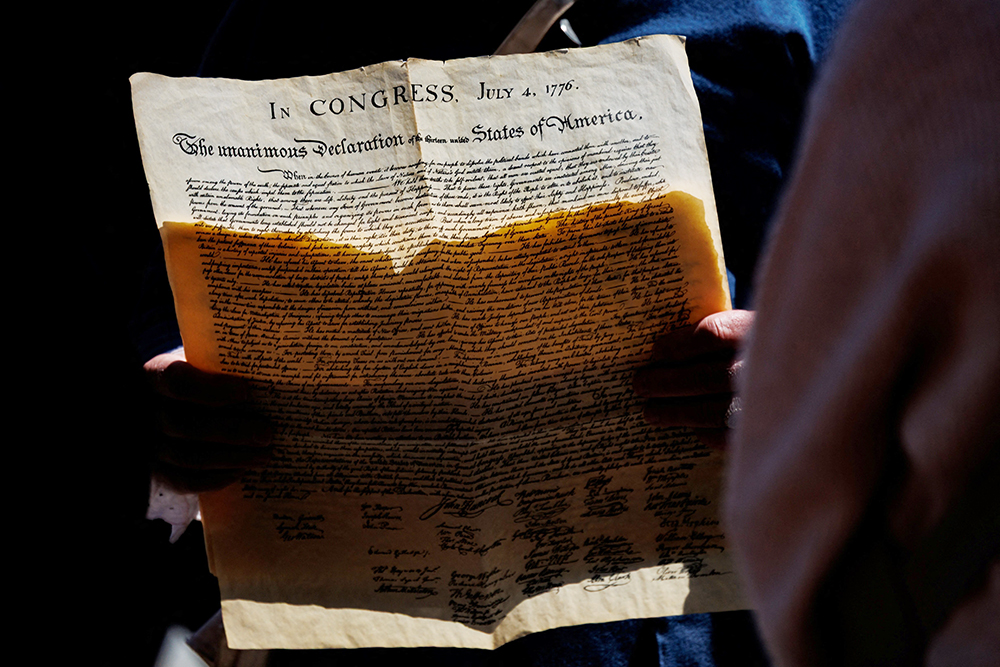
Kyle Jenks, a professional interpreter of late U.S. President James Madison, holds a copy of the Declaration of Independence while leading a tour in Philadelphia, Pennsylvania, May 1, 2026. (OSV News/Reuters/Hannah Beier)

July 4 will soon be here. This year it marks the country's 250th anniversary of proclaiming who we wanted to be as a country and expressing it in the Declaration of Independence. The values and the hopes we held dear could not be envisioned within an authoritarian monarchy led by an inept king. Rather, as painful as it was, the fledgling nation declared independence and enshrined its vision in a document that continues to stand the test of time.
At this moment there is concern that it is failing that test, given the shifts that have been occurring in our country. We are witnessing a return to authoritarian leadership rather than representative democracy; transactional leadership rather than transformational; aggression and the notion that "might makes right" rather than diplomacy and negotiation; and the unbounded accumulation of wealth for the few rather than equitable access to fulfill the basic human needs of the many.
I have to admit I've thought to myself, who are we becoming as a nation? Are we threatening the very values that make us who we are?
The other day I finished reading Pope Leo XIV's encyclical, Magnifica Humanitas, ("Magnificent Humanity"), in which the future of our technological revolution through artificial intelligence is addressed in light of Catholic social justice teaching. When I finished, I felt a great sense of hope, a renewed sense of possibility about who we are as human beings and who we can become.
Although people of faith, especially Christians and Catholics, will find additional meaning and weight in his words, I found myself thinking that the values addressed and the questions asked are critical for us as a country as we shape our future.
Advertisement
I found myself reflecting on the key beliefs enshrined in the Declaration of Independence: that all "men" (sic) are created equal and endowed with certain inalienable rights of life, liberty and the pursuit of happiness. I also reflected on how the structure of three equal branches of government, later established in our Constitution, is being interpreted and abused by people elected to serve the whole country and protect the values expressed in our founding documents.
I feel we are in need of a reset, not to go backward but forward, incorporating the best of our history while acknowledging where we are today and how best to move into a future that is currently chaotic. I believe the values of Catholic social justice teaching can help us see where we are in ways that can strengthen us to honor our past while yet steadily creating our future.
I know I'm walking a tightrope here, as the debate over whether we are a Christian nation or not is raging. But I believe that Catholic social justice teaching is not about that question. Rather, it is a compendium of values that serves somewhat like a plumb line, a foundational tool to help us regain our footing when we fall out of alignment or list to one side or the other.
Today, as Leo wrote in Magnifica Humanitas, within what is being called the "fourth industrial revolution," the emergence of AI technology poses a grave challenge with a new type of concentration of power in the digital world. To move forward responsibly, we need, as Leo wrote, "criteria for judgment and discernment in this new situation." Catholic social justice teaching provides another, though still limited, lens through which to interpret what is happening today.
Leo skillfully engages in such a discernment, establishing standards — the dignity of the human person, the universal destination of goods, the preferential option for the poor, care for our common home and peace. These are values that have consistently been addressed throughout the development of Catholic social justice teaching "marked by different emphases, progressive insights, and, at times, changes in perspective that do not break with what came before, but allow its implications to mature."
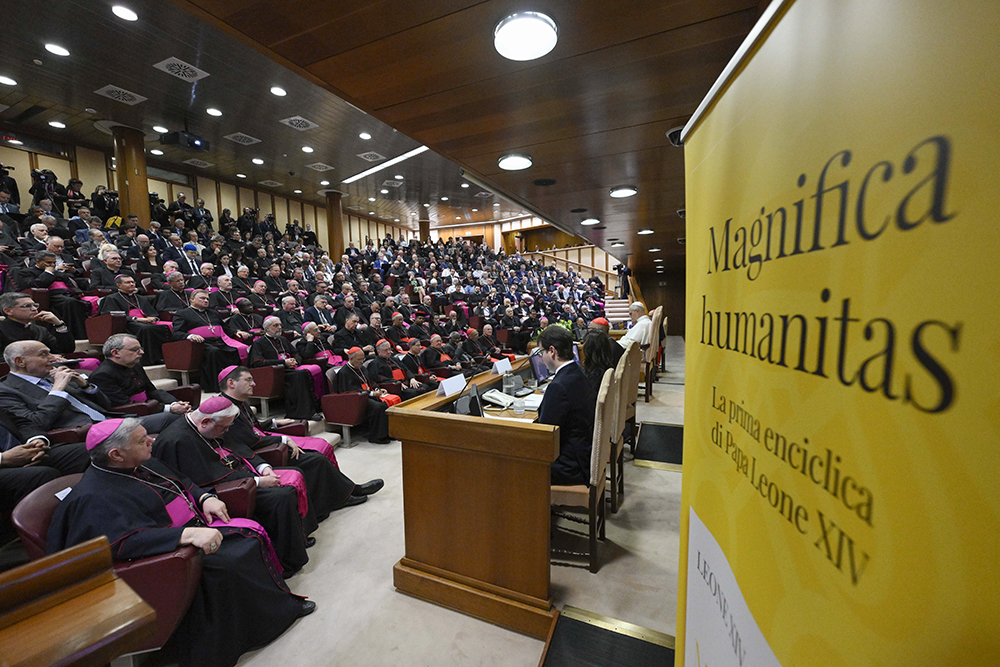
Cardinals attend the presentation of "Magnifica Humanitas" at the Vatican's Synod Hall May 25, 2026, the first encyclical of Pope Leo XIV's papacy. (OSV News/Vatican Media/Simone Risoluti)
Here are a few "plumb lines" that I gathered from the text. Let us bring them to contemplation and discernment in hopes of realigning ourselves with the best of who we have been and can be.
We proclaim that we all have the right to happiness. Yet there is a growing belief that "the fullness of life is equated with having more, reducing weakness, eliminating uncertainty and exerting total control," Leo wrote. "Human dignity does not depend on a person's abilities, wealth or position in life, nor on the right or wrong choices made."
Work "expresses and enhances the dignity of our lives," creating a path "toward maturity, development and personal fulfillment." "The pursuit of greater profits cannot justify choices that systematically sacrifice jobs, because the human person is an end, not a means, and the economy must remain subordinate to human dignity and the common good."
We proclaim liberty and freedom, yet the digital revolution is weakening our freedom through subtle forms of addiction linked to the "digital attention economy." As Leo wrote, "when business models thrive on human weakness, the person is treated as a means rather than as an end; those who design or finance such systems bear a moral responsibility that cannot be ignored."
"The search for truth is an essential element of democracy, which is itself a means of contributing to the common good." Yet "tools that could foster dialogue and participation are often used to construct distorted narratives and blur the boundaries between truth and falsehood. … Only the shared pursuit of the veracity of facts, perceived as a common good, can provide a solid foundation for just communication."
Everyone's right to life, including the life of our Earth home, is threatened by a culture that prioritizes conflict and confrontation. Today, then, "it is important to reaffirm that the 'just war' theory, which has all too often been used to justify any kind of war, is now outdated," Leo wrote We must shift from a "culture of power" to a " 'culture of negotiation,' in which dialogue and diplomacy become the standard means of resolving conflicts."
On July 4 we celebrate 250 years of living the vision and spirit of our forebears. We are also facing a future unlike anything we have ever imagined, one that will reshape the way we live, think, work and relate to each other. This July 4, let us use the plumb lines of Catholic social justice teaching to straighten up, stand tall and pledge ourselves to creating a future that is aligned with the best in our country's tradition.