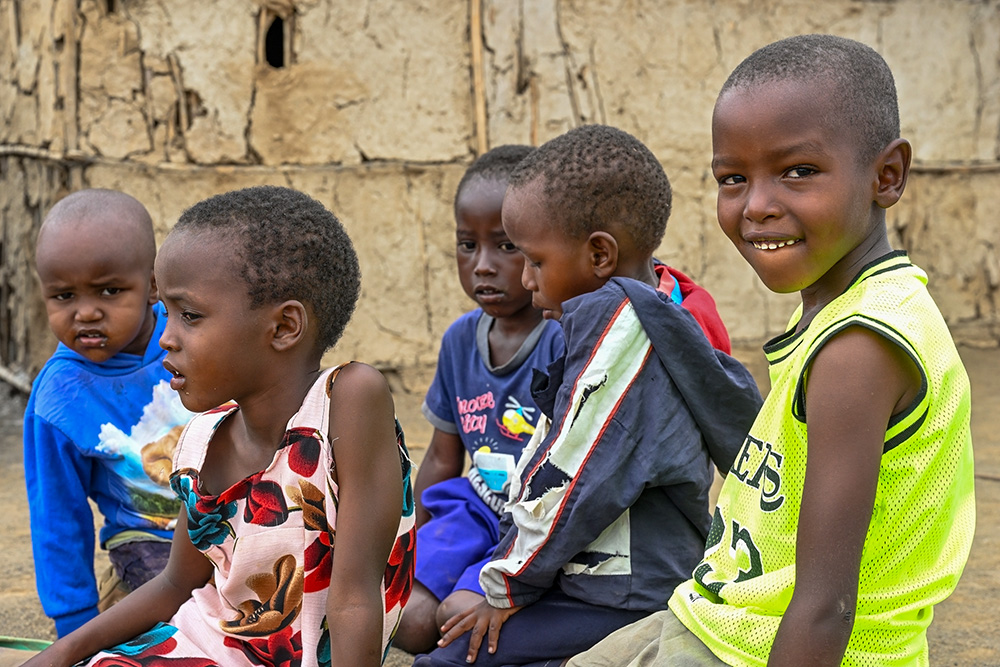
Children are seen in a village near Nairobi, Kenya, in a 2022 photo. (Dreamstime/Alexey Kuznetsov)
by Sr. Hedwig Muse
I am the program manager of the Catholic Care for Children department of the Association of Sisterhoods of Kenya, and also serve as its legal officer. I am currently undertaking my doctoral studies in human rights law at the University of Nairobi in Kenya. I am also a teacher and lawyer with a focus on children's rights, which inspires my work at the Association of Sisterhoods of Kenya.
My passion is for children, and I find that just being with them lifts my spirits because of their energy, curiosity and love for life. This passion began and grew in me at a very young age. I am the firstborn of six in my family, so babysitting was a major task for me. That meant that while our mum was busy working to earn money for us, I filled the role of caring for my siblings.
I remember one day my mummy took a long time getting groceries for us, and one of the babies cried and cried as she yearned for breast milk. Today, many children still experience this in my country. Therefore, once I chose to study law, I knew I wanted to protect and uplift children's rights.
Children are often thought of as just infants, toddlers and preschoolers, but they are people and have rights at every stage of life. In our society, many children grow into adulthood without adequate care or protection because they are dismissed as unimportant.
For instance, some grow up in abusive families where parents or guardians do not care about their welfare. They are denied food and proper shelter, which makes many resort to street life. Many are then abandoned and abused, frequently finding themselves in the justice system. Their needs are often neglected in a system where we might expect compassion and care.
As a lawyer, I work with a network of stakeholders — schools, churches, prisons, families and sisters who are concerned about children. Much of my work is focused on training teachers, sisters and other community leaders across the Catholic dioceses of Kenya to become gatekeepers of children's rights and to watch for signs of abuse and neglect so that children can be protected.
Advertisement
The Association of Sisterhoods of Kenya works with children in charitable homes as human rights teachers and peacemakers in every Catholic diocese in Kenya. Together, we work to champion justice and human rights by training and certifying sisters to help their local communities. We find that where children's champions are present at the grassroots level, children are rescued from early marriage and educated. They are also saved from physical or sexual abuse in families, schools and churches, and supported to access justice.
Unfortunately, disrespect against children is common, including in the judiciary of our country. For example, sexual abuse cases against children are delayed, and at times perpetrators are set free, leaving children without support or justice.
The judiciary has allocated resources to establish children's courts, but the number of personnel remains insufficient or lacks training. Many court stations suffer from poor physical infrastructure and technology to effectively track cases and information across agencies.
I have found again and again a disconnect between the theory and practice of the law to the detriment of children, and I believe it is important to spotlight the broken link between victimized children and justice.
For example, the law states that children's matters should be resolved as quickly as possible. However, in the cases I have handled, especially those of sexual abuse and custody, the practice on the ground is that most children's cases are frequently adjourned and left hanging for long periods. A major reason for delays is the lack of witnesses, and, worse, perpetrators often interfere with witnesses by offering them gifts as reparation for their criminal acts. Parents also refuse to cooperate in finding witnesses because they do not want their family issues brought to the limelight.
Finally, court officers often delay cases by claiming to be busy with other matters they consider more important. Whether family or state, adults are not recognizing the pain of their children or the fact that they are entitled to justice.
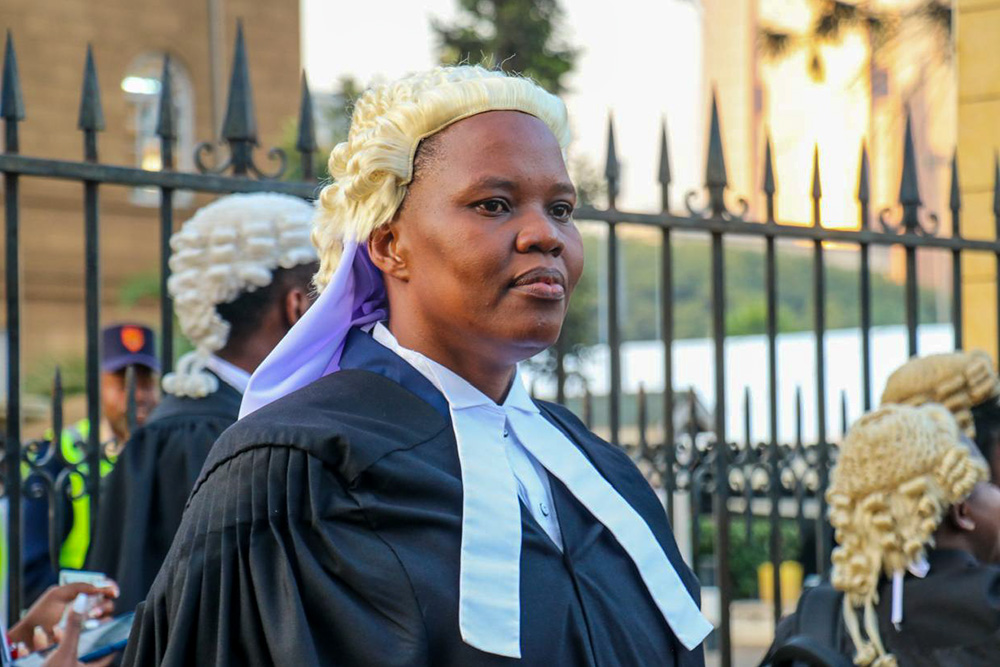
Sr. Hedwig Muse belongs to the Congregation of the Little Sisters of Mary Immaculate of Gulu. She is a lawyer who works with the Association of Sisterhoods of Kenya as its legal officer with a focus on children's rights. (Courtesy of Hedwig Muse)
Another issue I have discovered in my work is finding many children living with their mothers in prison. Some have been born to incarcerated mothers or have accompanied them upon admission or joined them during the trial. Parental care is central in the development of a child, and prisons do not provide a suitable environment for healthy development. Although the child is still with the mother and has her love, mothers are experiencing the trauma of prison and cannot provide the comfort, attention and safety their children need.
More often than not, children at the time of a mother's arrest are abandoned, traumatized by losing the most significant person in their lives. Worse, in these cases, mothers have no idea of their whereabouts, a trauma they too must endure.
Children who are left behind are sometimes rescued and taken to children's homes or orphanages, while some are forgotten and frequently end up on the streets and trafficked. Each time I hear a story of a child taken away from their mother, I am motivated to do all I can, even pro bono, to be of service.
Our children are our most important resource, and I passionately plead for people to hear their voices. We need to listen to how they experience interventions and the care provided after their parents are incarcerated. We need to identify their needs, and not just what we think is best. Children are arguably the most vulnerable group in society. They rely on adults and members of society to listen to them and ensure their basic rights and needs are served and protected.
Many children yearn for a loving, nurturing and caring family environment where they can be free to interact and grow up. Listening to their voices can be a call to action for the state and other key child justice actors to take up their mantles, build on their comparative strengths, and work individually and collaboratively to make the justice system for children more accountable in the best interest of the child.