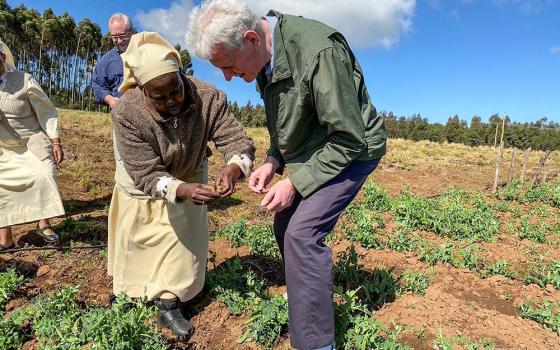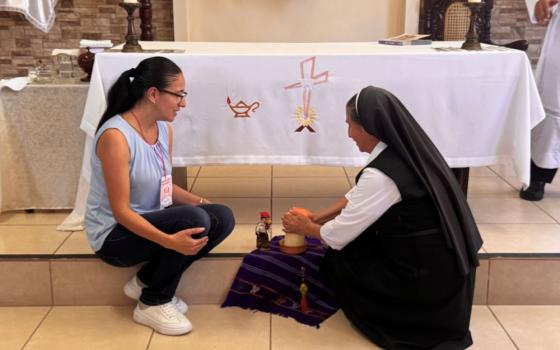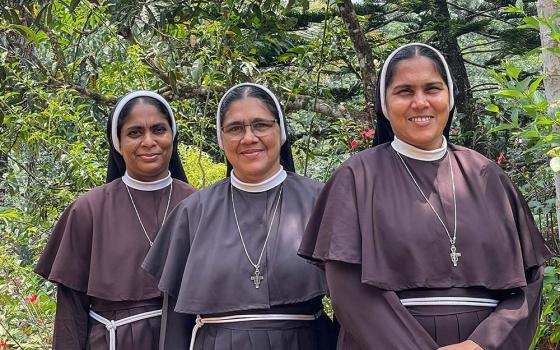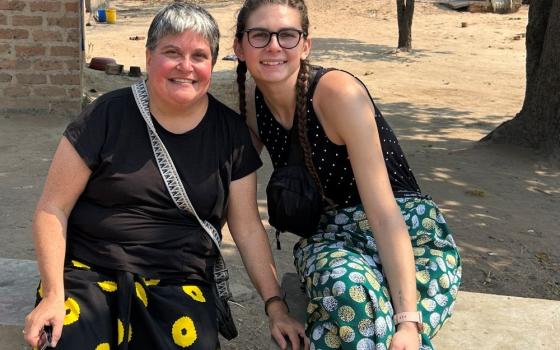
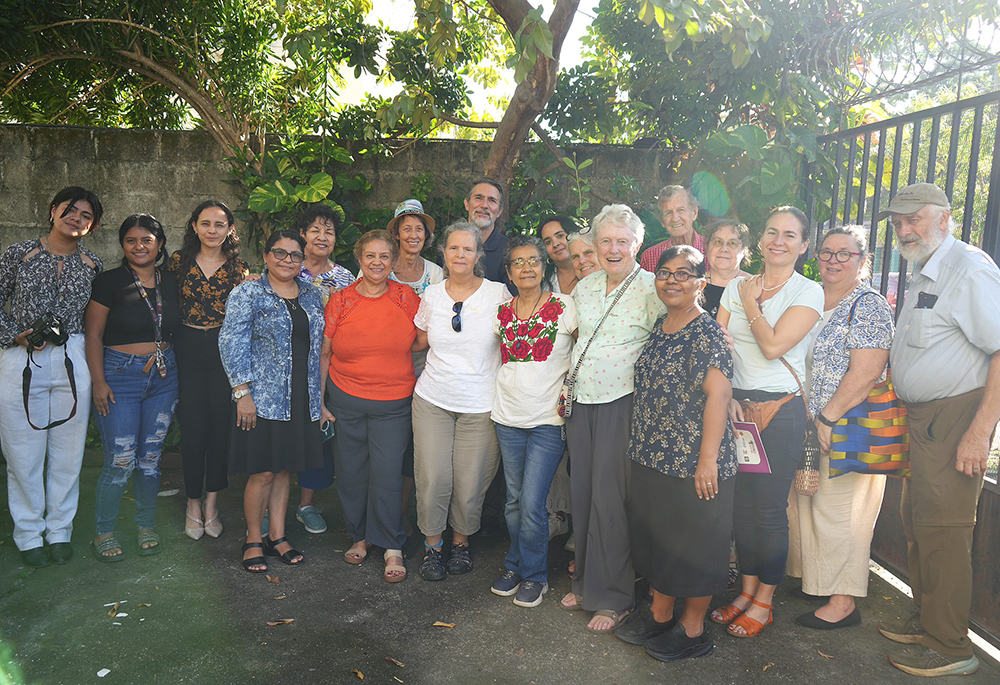
Sr. Anita Cleary, fourth from right, poses with delegation members in Honduras. Cleary took a recent pilgrimage to El Salvador and Honduras, sponsored by the SHARE Foundation and the Leadership Conference for Women Religious. (Courtesy of Anita Cleary)

by Sr. Anita Cleary
Recently the Priests for Justice for Immigrants, a coalition of priests in the Chicago Archdiocese, declared a call to action. On the dawn of the 250th birthday of the United States, they proclaimed "A Creed and Covenant for the Common Good," supported by several interfaith groups. This creed is more than just an invitation to speak and live what one believes; it is a compelling plea for action, for hope for a peace-filled life on this Earth, now, in this moment.
In this text there are nine tenets. The eighth one states:
8. Memory, Truth, and Responsibility
We believe honest memory is the soil of justice.
We denounce denial and distortion of harm past and present.
We commit to remembering truthfully and acting boldly for repair.
My recent pilgrimage to El Salvador and Honduras, sponsored by the SHARE Foundation and the Leadership Conference for Women Religious, was a tangible experience of this eighth tenet. We walked in memory of the four women missionaries murdered on Dec. 2, 1980: Maryknoll Srs. Maura* Clarke and Ita Ford; Ursuline Sr. Dorothy Kazel; and Maryknoll lay missionary Jean Donovan.
We stood in the shade of the trees whose roots hold the blood of their martyrdom. We stood at the edge of the garden where the Jesuit priests Ignacio Ellacuría, Ignacio Martín Baró, Segundo Montes, Amando López, Joaquin López y López, and Juan Ramón Moreno were killed, and nearby where Elba Ramos and her daughter Celina Ramos were killed. We knelt in the hospital chapel where St. Óscar Romero poured out his blood for the people he loved.
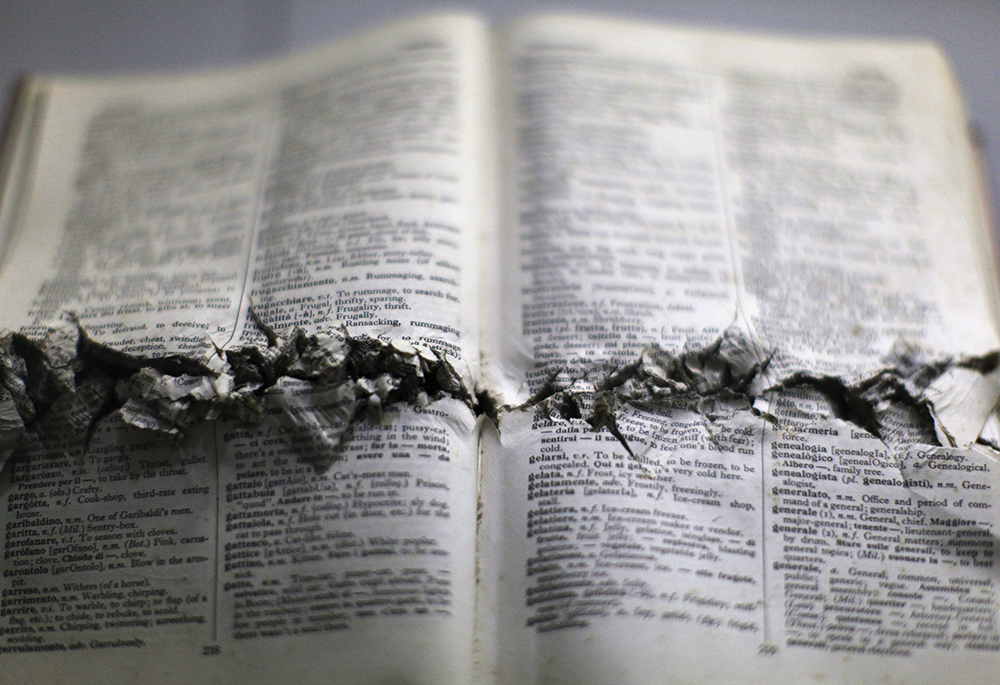
A book of one of the six Jesuit priests killed in El Salvador in 1989 is exhibited at the Museum of the Central American University in San Salvador Jan. 6, 2016. (CNS/Reuters/Jose Cabezas)
We heard truth from so many individuals. The reality of their family members disappearing in the night, their relentless search for them, and occasionally a joyful story of reunification. We listened to the stories of grassroots groups operating with scant funding to assist those deported by the United States back to these countries.
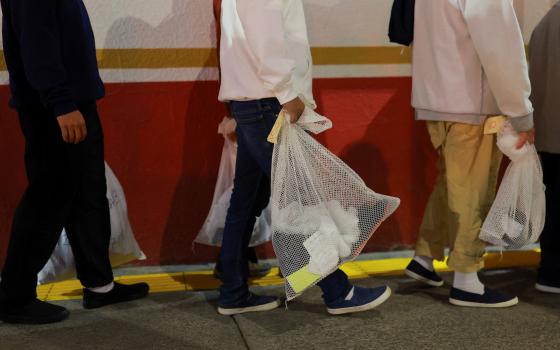
How extremely difficult it is for them to reintegrate into a country now unfamiliar to them after many years' absence or to integrate into a country they have never known or countries that do not welcome them because these countries are struggling to house, feed, and provide jobs and health care for those already there. We heard from those deported of the horrific hardships of their treatment in the U.S., especially at the border.
We gathered in El Mozote, in an area where about 1,000 individuals were killed over three days of horror, including an infant. Some individuals survived to speak to the truth of the massacre of their families. One, a woman now deceased, had spoken of losing her spouse and hearing the screams of one of her four children calling for her.
Another survivor was a young boy, now an adult, who was not able to be present to share his story with us. We heard from an individual who lost 45 members of his family. Another tearfully shared losing 13 family members. Those stories touched me so deeply I knew I had to make some kind of response acknowledging the pain and the complicity of my nation's government.
Advertisement
These deaths happened more than 40 years ago. The people and the land still hold their memory: in El Salvador, in Honduras, and in so many countries around the world.
What do we do with such knowledge? How do we hold these stories while continuing our daily routines? How do we honor this responsibility of memory and truth?
I witnessed many ways in El Salvador and Honduras in which the people did just that. Some published stories of family members and friends who are no longer present. Others, through poems, murals and music, expressed the hope that this would never happen again.
Each of us pilgrims, now back in our own countries, seeks to find our own way of remembrance, truth and responsibility.
I share the stories. I have initiated a weaving project, inviting others to assist me in creating a cloth woven in the colors of El Mozote (black, red, yellow and pink). This cloth will represent all those who were murdered. It will be given to the villagers of El Mozote when they remember the 45th anniversary of their families' losses in December of 2026. With this gift, we say we remember, we hear your truth, and we choose to accompany you. This is our responsibility.
As the "Creed and Covenant for the Common Good" states, there are ways to "commit to remembering truthfully and acting boldly for repair." For we are "people of faith and good will," and we "lift our voices in a shared affirmation of truth, justice, and hope."
*This story has been updated to correct Sr. Maura Clarke's name.